
Stellar Bancorp’s Strategic Merger and Financial Outlook Through 2025
Stellar Bancorp’s robust liquidity and evolving capital strategy provide a foundation for its forthcoming merger with Prosperity Bancshares.
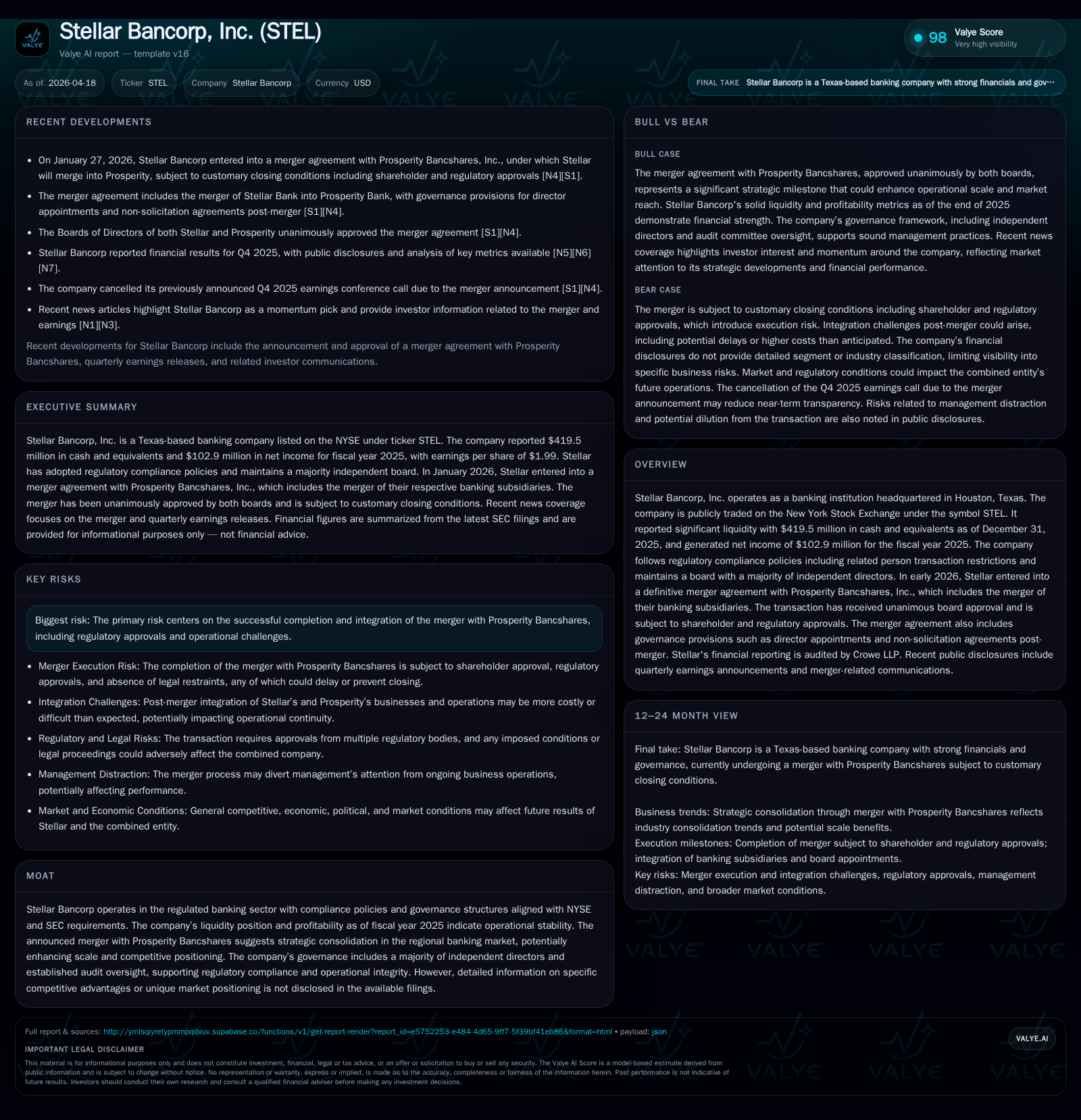
Stellar Bancorp, a Houston-based banking institution, has exhibited strong liquidity and sound governance leading up to its planned merger with Prosperity Bancshares. Despite net income declining from $130.5 million in 2023 to $102.9 million in 2025, the company maintained disciplined capital allocation through dividends and substantial share repurchases. The redemption of its fixed-to-floating rate subordinated notes in early 2026 underscores prudent balance sheet management ahead of consolidation. While the merger promises potential scale benefits consistent with regional banking trends, regulatory approvals and integration execution remain key risks.
Historical Earnings Trajectory and Growth Drivers
Stellar Bancorp’s financial trajectory over the last four fiscal years illustrates notable volatility intrinsic to regional banking dynamics. Net income surged from $51.4 million in FY2022 to a pinnacle of $130.5 million in FY2023, more than doubling as Stellar capitalized on favorable market conditions or portfolio expansions [F1]. However, post-2023, profitability contracted by approximately 11.8% to $115.0 million in FY2024 and further declined by 10.5% to $102.9 million in FY2025 [F1].
Operating cash flows echoed this pattern: after peaking at $168.2 million in FY2023, CFO decreased by 21.2% in FY2024 followed by another sharp fall of nearly 26.9% to $97.0 million in FY2025 [F1]. This contraction suggests less cash generation likely tied to slower core earnings growth.
Capital expenditures remained modest relative to cash flows but trended downwards from $6.9 million in FY2023 to $4.4 million in FY2025, indicating restrained reinvestment possibly due to cautious capacity expansion or technology deployment pacing typical of banks optimizing expense profiles during margin stress [F1].
Historical performance (annual)
| FY | Net ($mm) | CFO ($mm) | Capex ($mm) | Net YoY |
|---|---|---|---|---|
| 2025 | 103 | 97 | 4 | -10.5% |
| 2024 | 115 | 133 | 5 | -11.9% |
| 2023 | 130 | 168 | 7 | +153.7% |
| 2022 | 51 | 109 | 4 |
Source: SEC companyfacts cache [F1].
Capital returns and efficiency (annual)
| FY | Div ($mm) | Buybacks ($mm) | FCF ($mm) |
|---|---|---|---|
| 2025 | 29 | 73 | 93 |
| 2024 | 28 | 3 | 128 |
| 2023 | 28 | 0 | 161 |
| 2022 | 15 | 24 | 105 |
Source: SEC companyfacts cache [F1].
Net income peaked before experiencing double-digit percentage declines both years following; operating cash flow mirrored this trend.
Liquidity Strength and Capital Structure Evolution
As of December 31, 2025, Stellar maintained an impressive liquidity position with $419.5 million in cash and cash equivalents [F1], providing substantial headroom to navigate operating cycles or regulatory demands during the merger process.
Crucially, Stellar redeemed its entire outstanding principal of $30 million fixed-to-floating rate subordinated notes maturing in 2029 on April 1, 2026 [S3][S4][S23]. This action reflects prudent balance sheet management by eliminating higher-cost subordinated debt ahead of consolidation with Prosperity Bancshares.
The overall equity base expanded steadily from $1.38 billion at end-2022 to $1.67 billion at end-2025 despite profitability softness [F1], suggesting retained earnings accumulation supported by measured dividend payouts.
Dividend Policy and Share Repurchase Activity
Dividend distributions have grown consistently alongside earnings shifts but at a far more moderate pace: from $15.4 million paid in dividends during FY2022 to nearly double that amount ($29.3 million) by FY2025 [F1]. This restrained dividend growth aligns well with maintaining capital ratios while still returning meaningful cash to shareholders.
In contrast, share repurchase behavior exhibits more variability; after no buybacks recorded in FY2023, Stellar markedly accelerated buybacks to nearly $73.4 million for FY2025—a significant jump presumably signaling management’s confidence or intent to support shareholder value heading into the strategic merger announcement [F1][S5][S11][S12].
Merger Agreement Details and Strategic Rationale
On January 28, 2026, Stellar Bancorp entered into a definitive merger agreement with Prosperity Bancshares Inc., involving a combination of their banking subsidiaries [S5][S16][S26]. The transaction received unanimous approval from both companies’ boards prior to public disclosure.
Terms include a share exchange ratio whereby each Stellar common stockholder will receive approximately 0.3803 shares of Prosperity common stock plus $11.36 per share in cash consideration, replacing fractional shares with cash equivalents [S5]. Equity awards such as stock options below the per-share merger consideration value will be cashed out proportionally; those above this threshold will be cancelled without payment.
Governance provisions anticipate increasing the size of Prosperity’s Board and its banking subsidiary Board by two directors each appointed from Stellar’s current directors—indicative of negotiated control sharing customary in deals seeking smoother integration compliance [S5].
This transaction exemplifies broader US regional bank consolidation trends aimed at enhancing scale efficiencies—cost reduction via operational overlaps—and expanding geographic footprint into new markets while navigating increasingly complex regulatory environments.
Forward-Looking Considerations in Light of the Deal
Post-announcement milestones hinge primarily on obtaining customary shareholder approvals for both parties alongside regulatory clearances potentially involving FDIC and Federal Reserve reviews given the banking charter implications [S16][S20]. The timeline usually spans several months.
Integration challenges loom large: melding IT systems across dual bank charters requires harmonizing compliance frameworks including anti-money laundering controls and loan underwriting platforms without operational disruption—a known pain point that can inflate merger costs beyond initial estimates.
Synergy realization will depend upon effectively consolidating branch networks and rationalizing product offerings while retaining customer relationships amidst organizational change fatigue.
Investors should monitor subsequently filed proxy statements detailing transaction terms alongside any updates on cost-saving targets or delays attributed to regulatory stipulations or competitive responses.
Governance Framework and Regulatory Compliance
Stellar’s governance structure is anchored by a majority of independent directors complying with NYSE independence criteria per formally documented evaluations considering familial connections, significant equity holdings, and related party transactions oversight [S1].
The company maintains an audit committee empowering Crowe LLP as its external auditor for continuous fiduciary assurance [S1]. The presence of a written Related Person Transactions Policy further enforces rigorous conflict-of-interest safeguards critical for maintaining investor confidence during transformative events such as mergers.
These measures collectively reinforce Stellar’s regulatory standing amidst an environment where governance lapses could otherwise hinder deal approvals or damage reputation.
Key Risks Surrounding the Acquisition and Integration
According to risk disclosures updated through late-2025 filings [S6], material risk factors remain largely consistent with prior periods; however, merger-specific uncertainties emphasize:
- Potential delays or adverse conditions imposed by regulators that could alter deal economics or timing,
- Difficulties realizing planned operational integrations raising costs or limiting expected efficiencies,
- Distraction effects on management focus risking organic business performance degradation,
- Cultural mismatches adversely affecting employee retention,
- Credit quality risks emerging from aligning differing loan book standards,
- Shareholder dissent impeding vote approvals given sizable ownership stakes held by directors under voting agreements [S27].
These are conventional yet critical risk vectors that warrant ongoing monitoring throughout completion phases.
This analysis compiles information solely derived from official SEC filings and company disclosures without leveraging speculative projections beyond stated facts or company-provided forward-looking statements subject to inherent uncertainties.
Disclaimer: This document does not constitute investment advice or recommendations regarding securities mentioned herein.
Disclaimer: This is research-only, informational analysis and not investment advice. It may include AI-generated interpretation and general industry context. Always verify important details using primary sources.

Comments