
Marchex Inc’s Strategic Transformation and Financial Challenges in Call Analytics
Marchex faces ongoing losses and customer concentration risks while leveraging its proprietary conversational analytics technology to pivot strategically.
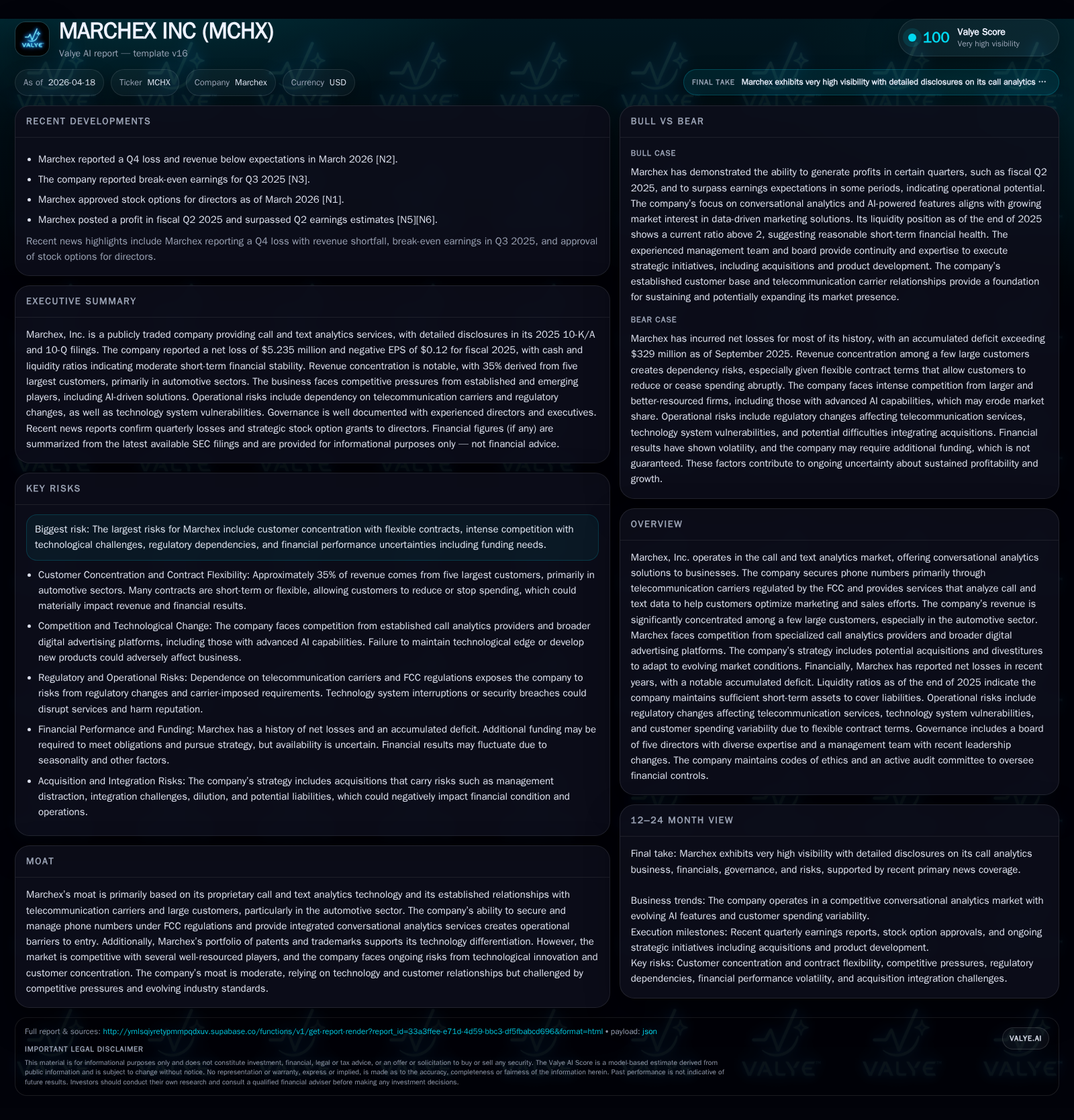
Marchex Inc. operates in the niche call and text analytics sector, marked by proprietary technology and significant FCC regulatory dependencies. Despite advancing conversational analytics capabilities, the company has experienced a notable revenue decline and sustaining net losses through 2025, with an accumulated deficit exceeding $329 million as of late 2025. Customer concentration—particularly in the automotive industry—and contractual flexibility among key clients create revenue predictability challenges. Marchex’s strategy includes potential acquisitions and divestitures as it navigates regulatory complexities, competitive pressures, and technological innovation demands. Capital allocation reflects constrained resources with negligible recent dividends or buybacks amid modest liquidity. Future growth hinges on broadening the conversational analytics adoption against ongoing operational and regulatory headwinds.
Marchex’s Revenue Trajectory and Operating Performance: Historical Overview
Marchex's financial history reveals a steady erosion in core business metrics over the past decade. Revenue peaked at approximately $183 million in fiscal 2014 but declined sharply to around $90 million by fiscal 2017 [F1]. The downward trend continued into recent years, culminating in a nearly 30% year-over-year revenue decline as of fiscal 2025 [F1]. Concurrently, operating income remained negative since at least fiscal 2022, with the latest annual operating loss recorded at approximately $5.7 million for FY2025 [F1]. Net income followed a similar trajectory, showing consistent losses with a $5.2 million deficit in 2025 [F1].
Operating cash flow (CFO) has deteriorated notably—from a negative $2.3 million in FY2022 to a deficit nearing $1.4 million by FY2025—reflecting ongoing operational challenges compounded by shrinking capital expenditures that dropped over 90% in the most recent year ($36,000 in FY2025 vs. $429,000 in FY2024) [F1]. This financial picture underscores continued pressure on profitability despite streamlining efforts.
Historical performance (annual)
| FY | Net ($mm) | CFO ($mm) | OpInc ($mm) | Capex ($mm) | Net YoY |
|---|---|---|---|---|---|
| 2025 | -5 | -1 | -6 | 0 | -5.8% |
| 2024 | -5 | -1 | -4 | 0 | +50.1% |
| 2023 | -10 | -4 | -10 | 1 | -20.2% |
| 2022 | -8 | -2 | -8 | 3 |
Source: SEC companyfacts cache [F1].
Capital returns and efficiency (annual)
| FY | FCF ($mm) | ROE% |
|---|---|---|
| 2025 | -1 | -17.4 |
| 2024 | -2 | -15.2 |
| 2023 | -6 | -27.6 |
| 2022 | -5 | -18.7 |
Source: SEC companyfacts cache [F1].
Note: Operating cash flow includes cash generated from operations before investing activities.
Concentration Risk: Dependence on Automotive Sector and Major Customers
About 35% of Marchex’s revenue is sourced from its five largest customers as of September 30, 2025 [S2][S4], underscoring material customer concentration risk that is predominantly rooted in the automotive vertical [S4]. This dependency creates substantial exposure to client-specific budget changes and spend variability given the company’s flexible contract arrangements which typically lack long-term lock-ins or guaranteed minimums [S2][S4]. Customers can reduce or cease expenditures on short notice without severe contractual repercussions.
Additionally, these large clients wield considerable negotiating power potentially requiring customized feature development with associated penalty structures or pricing concessions, which could compress margins [S4][S10]. Any acquisition or consolidation activity involving these major customers could disrupt spending patterns unpredictably [S4]. This fragility is compounded by their leverage over contract terms concerning termination rights and indemnification obligations.
Absent replacement by new high-spend accounts or growth from smaller clientele segments, this dependence threatens revenue stability and results continuity.
Technological Moat and Intellectual Property Landscape
Marchex’s business moat rests chiefly on its proprietary conversational analytics platform which integrates call and text data insights tailored for marketing optimization . The company's ability to secure phone numbers mainly via regulated telecommunications carriers under FCC oversight further entrenches operational barriers to entry given the licensing complexity [S12]. Additionally, a portfolio of patents and trademarks underpins technological differentiation yet simultaneously exposes the firm to patent infringement claims common within this sector [S5][S7].
Industry-wide patent portfolio consolidations are intensifying legal assertions against companies leveraging foundational communication technologies—an environment where rights holders seek settlements through aggressive assertion efforts [S5]. Marchex may be drawn into costly disputes that could distract management focus or restrict use of essential technology if licenses are not secured under reasonable terms [S7]. This dynamic places a premium on robust intellectual property strategy including defensive patent filings and careful partnership selections.
Regulatory Environment: Telecom and Data Privacy Implications
Operating within telecommunications services involves compliance with layered federal and state regulations promulgated chiefly by the FCC under mandates such as the Communications Act of 1934 (amended by Telecomm Act of 1996), alongside telemarketing-related laws like TCPA affecting robocalls and automated messaging [S7][S18][S25]. These regulatory frameworks require registration obligations (e.g., Robocall Mitigation Database), content restrictions enforced via carrier screening technologies, and consent management critical for call recording/legal compliance across varied jurisdictions [S7][S24][S25].
Noncompliance risks include fines, service discontinuations from carriers due to automated filtering penalties, or expanded liability stemming from customers’ unauthorized usage patterns [S8][S25]. Data privacy legislation (including CPRA/California Consumer Privacy Act expansions) adds overlay complexity dictating contractual data use limits with service providers plus exposure to private right-of-action litigation for breaches [S21]. Emerging AI regulatory proposals foreshadow increased compliance costs which may constrain rollout of new tech-powered offerings integrated within conversational analytics platforms.
Strategic Initiatives: Acquisition, Divestiture, and Market Positioning
In response to evolving market dynamics described above, Marchex aims to recalibrate its portfolio through targeted acquisitions aimed at expanding product breadth as well as strategic divestitures that prune non-core businesses . Such moves intend to foster competitive resilience yet carry execution risks including integration costs, possible employee attrition, earnings dilution from equity-based payments for acquisitions, plus unknown liabilities [S19].
Board-approved stock option grants reported recently serve as managerial incentives aligned towards fostering growth initiatives amid challenging conditions [N2]. These measures suggest recognition that innovation capacity must be linked tightly with prudent governance to stabilize performance progressively.
Competitive pressures from entrenched players like Twilio or Google Ads complicate Marchex's market positioning notably; continuous investment in AI-enhanced conversational analytics features remains essential yet resource-intensive [S14].
Capital Allocation Review: Cash Flow, Dividends, and Shareholder Returns
Financial stewardship during ongoing loss-making phases reveals tight capital allocation constraints at Marchex aligning with preservation over yield generation strategies. The company recorded an approximate return on equity near negative 17.4% for FY2025 given net loss versus shareholders’ equity balances hovering around $30 million at year-end [F1]. Operating cash flow stayed negative at roughly $-1.4 million while capital expenditures contracted drastically signaling deliberate cost discipline amidst resource scarcity [F1].
Dividend distributions have ceased since around calendar year-end 2018 after prior historical payouts totaling over $21 million cumulatively across years which coincided with better profitability intervals; no share repurchases occurred recently either contrasting with modest buyback actions completed several years ago through FY2020 [F1]. Liquidity appears sufficient with a current ratio above two times providing some near-term operational flexibility despite profitability pressures [F1]. However sizable accumulated deficits (~$329 million) underscore long-term capital recovery challenges hindering shareholder return prospects presently.
Future Growth Constraints and Opportunities
Forecast visibility remains limited as Marchex abstains from explicit forward guidance presently; however multiple factors clearly shape its path forward:
- Customer concentration volatility combined with flexible contracts continues to cap predictable revenue scaling absent diversification success strategies.
- Competitive intensity escalates both technologically—where faster adopters of AI integration may outpace—and market positioning as larger well-resourced incumbents defend share aggressively.
- Regulatory uncertainty especially with respect to telecommunications compliance costs plus evolving data privacy statutes may increase operational overheads diminishing margins.
- On opportunity fronts: growing awareness among businesses of conversational analytics’ value proposition presents addressable market expansion prospects if delivery can be reliably differentiated sufficiently [N1][S2].
Profitability turnaround will depend heavily on balancing investment in innovation against disciplined cost management combined with broadening customer base beyond legacy automotive sector dependencies.
Key Metrics to Monitor and Market Expectations
Market watchlists should focus on these critical near-term indicators:
- Revenue trends post Q4 loss report issued in March 2026 revealing continued downside below estimates demand close scrutiny for signs of stabilization or accelerated decline [N1].
- Outcomes related to pending litigation settlements impacting expenses or contingent liabilities influencing reported results further detailed in recent filings [S3].
- Board actions including further equity incentive issuance signaling shifts toward growth prioritization or cost control emphasis integrating insights from recent stock option approvals for directors [N2].
- Changes in customer contract tenure or concentration shifts especially within automotive sector critical for reopening predictable revenue base assessment.
- Regulatory event developments regarding FCC rules implementation impacts such as STIR/SHAKEN enforcement or new telemarketing restrictions that could materially affect cost structure or service offerings.
Absent explicit company-provided forecasts demands heightened vigilance on quarterly financial disclosures supplemented by competitive landscape shifts within call analytics space.
This analysis synthesizes publicly filed SEC documents alongside corroborated news reports without extrapolating undisclosed financial guidance or future performance estimates beyond substantiated facts provided herein about Marchex Inc's recent fiscal developments, strategic posture, risks exposure, technological environment, regulatory framework and capital discipline practices.
Disclaimer: This is research-only, informational analysis and not investment advice. It may include AI-generated interpretation and general industry context. Always verify important details using primary sources.

Comments