
Petros Pharmaceuticals’ Shift to Licensing Platform Exposes Capital and Regulatory Challenges
Petros Pharmaceuticals pivots from product commercialization to a proprietary SaaS and SaMD platform targeting Rx-to-OTC switches amid ongoing liquidity constraints.
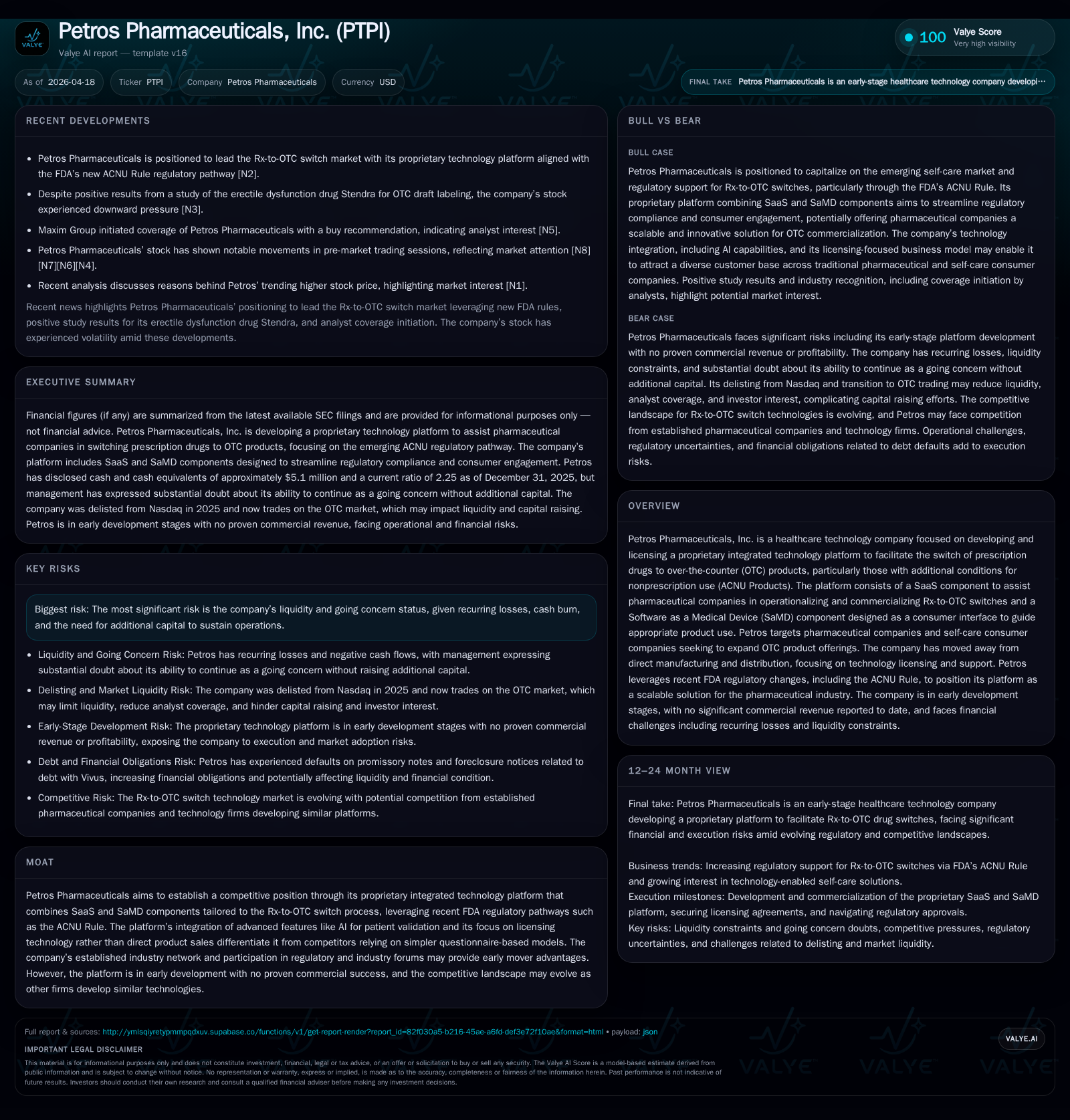
Petros Pharmaceuticals is transitioning from prescription drug commercialization to a technology licensing model centered on an integrated platform facilitating Rx-to-OTC drug switches under newly adopted FDA regulations. The platform, incorporating AI-driven patient validation, remains in early development with no commercial revenues. Despite improving profitability metrics, the company faces significant cash burn and liquidity risks, including Nasdaq delisting and the need for additional capital to sustain operations. Future success hinges on FDA approvals of its technology and licensees' products alongside effective capital raises.
Company Overview and Strategic Shift
Petros Pharmaceuticals, Inc. has transitioned into a healthcare technology developer focused on facilitating the switch of prescription drugs to over-the-counter (OTC) products requiring Additional Conditions for Nonprescription Use (ACNU Products) [S1][S5][S13]. Its proprietary integrated technology platform comprises two core components: a Software as a Service (SaaS) tool designed to assist pharmaceutical clients operationally navigating the Rx-to-OTC switch process, and a Software as a Medical Device (SaMD) component intended as a consumer interface guiding proper product selection by end-users [S13].
This pivot moves Petros away from direct manufacturing or distribution toward licensing its software infrastructure to companies responsible for production and supply chain management [S4][S5]. It leverages the FDA’s December 2024 adoption of the ACNU Rule that expands regulatory pathways for nonprescription drug approvals involving products requiring assisted consumer decision-making [S6][S13].
Historical Performance and Financial Trajectory
Financially, Petros has faced significant challenges consistent with this transformation. Operating losses narrowed from -$19.9 million in 2022 to -$4.6 million in 2025 [F1]. Net income reversed from net losses exceeding $20 million in 2022 to positive $1.9 million in 2025 [F1], reflecting cost rationalizations aligned with its new business focus.
Operating cash flow remained negative at approximately -$6.7 million in 2025, underscoring ongoing funding needs [F1]. Capital expenditures were minimal but increased notably year-over-year between 2024 and 2025, likely reflecting investments in software development rather than physical assets [F1][S4][S14]. Cash stood at $5.1 million at year-end 2025 with working capital near $2.9 million, yielding a current ratio of about 2.25x; however, these resources remain insufficient to fully fund ongoing activities without additional financing [F1][S10][S11].
Historical performance (annual)
| FY | Net ($mm) | CFO ($mm) | OpInc ($mm) | Net YoY |
|---|---|---|---|---|
| 2025 | 2 | -7 | -5 | +113.4% |
| 2024 | -14 | -3 | -18 | -75.4% |
| 2023 | -8 | -8 | -14 | +59.3% |
| 2022 | -20 | -13 | -20 |
Source: SEC companyfacts cache [F1].
Capital returns and efficiency (annual)
| FY | ROE% |
|---|---|
| 2025 | 66.7 |
| 2024 | 191.7 |
| 2023 | -67.6 |
| 2022 | -120.0 |
Source: SEC companyfacts cache [F1].
Note: Revenue figures are not separately reported; table highlights operating income trends.
Business Model Details
Petros targets pharmaceutical companies seeking regulatory assistance for Rx-to-OTC switches as well as self-care consumer product firms aiming to expand OTC offerings through digital guidance tools embedded within commercialization strategies [S5][S13].
The platform integrates Artificial Intelligence for patient validation using real-world electronic health records and longitudinal population data—surpassing conventional questionnaire-based methods used by competitors [S13][S24]. By focusing on licensing rather than direct product sales or distribution responsibilities, Petros aims for scalable growth across multiple partners without inventory or supply chain burdens [S4][S5].
Despite these ambitions, the platform remains early-stage with no commercialized or FDA-approved products leveraging it yet; each licensee must secure individual FDA approval under complex regulatory pathways involving Label Comprehension Studies and Actual Use Trials compliant with the ACNU framework [S6][S13][S16].
Regulatory Environment & Risks
Regulatory approval poses significant operational risks for Petros [S6][S16][S19]. Successful Rx-to-OTC switches require demonstrating consumers can self-select or deselect products based on Drug Facts Labels supported by compliant technology tools [S6]. The SaMD component must meet medical device regulations while SaaS functionalities face scrutiny under HIPAA and evolving state/federal privacy laws governing personal health information security [S8][S19].
Challenges include intellectual property protection amid competition from established pharmaceutical firms developing independent technologies without licensing models like Petros’ [S24]. Emerging health-tech companies also exert competitive pressure within digital Rx-to-OTC assistance arenas.
Additional uncertainties arise from forthcoming AI governance frameworks potentially affecting SaMD applications broadly—delays or increased costs could result if regulatory clarity is lacking [S7][S16][S24]. Failure to obtain timely FDA clearances or encountering enforcement actions could impair scaling prospects.
Liquidity Position & Capital Structure Constraints
SEC disclosures detail acute liquidity constraints impacting operational viability [S10][S11][S15]:
- Cash reserves were approximately $5.1 million at fiscal year-end 2025 with working capital around $2.9 million yielding a current ratio near 2.25x.
- Quarterly cash outflows exceeding $2 million contribute to management’s substantial doubt regarding going concern status; independent auditors expressed related concerns [S2][S11][N1].
- Nasdaq delisting occurred in mid-2025 due to failure meeting minimum equity requirements and sustained low share price; shares now trade OTC under ticker PTPI limiting capital raising avenues and liquidity [N1][S21].
- Default events triggered increased preferred stock dividend obligations up to 15%, elevating financial burdens further [S3][S18][S25].
Absent successful equity or debt financing on favorable terms—which remain uncertain given past defaults—Petros may need operational downsizing or asset sales jeopardizing strategic goals [S11][S25]. Future securities issuances pose dilution risks.
Capital Allocation & Operational Focus
Capital spending centers on software R&D supporting cloud-based platform infrastructure emphasizing cybersecurity for scalable deployment [S4][S14]. General administrative expenses including legal and compliance functions are material ongoing costs linked to public company obligations.
No dividends or share repurchase programs exist reflecting early-stage commercialization status and prioritization of resource allocation towards platform maturation rather than shareholder distributions [F1][S12].
Competitive Landscape Insights
The OTC switch market is fragmented without established technology platforms until recently when the FDA’s ACNU Rule enabled new regulatory paths accommodating digital assistive technologies integrated into nonprescription therapeutics. Large incumbents engage mainly in individual product-level Rx-to-OTC switches without broad tech licensing strategies akin to Petros’ integrated SaaS/SaMD model.
Emergent competitors offering proprietary software support services targeting ACNU switches have appeared but may lack comprehensive AI-driven patient qualification functionalities emphasized by Petros so far.
Success depends heavily on establishing credible precedents through successful licensee product approvals demonstrating safe consumer usage guided by sophisticated digital tools.
Future Outlook & Milestones To Watch
Key near-term milestones include:
- Completion of clinical validations underpinning SaMD functionality achieving FDA clearance;
- Execution of licensing agreements converting prospects into paying customers;
- Licensees’ successful navigation of individual Rx-to-OTC switch FDA submissions utilizing Petros’ technology;
- Additional capital raises sufficient to fund operations during commercialization ramp-up while managing dilution;
- Expansion of integration into electronic health record networks conforming to TEFCA frameworks enhancing data-driven patient assessments.
Market watchers should monitor announcements of new contracts alongside FDA filing updates tied directly or indirectly to Petros’ software components as indicators of commercial traction.
Summary
Petros Pharmaceuticals aims to pioneer technology-driven facilitation within the complex Rx-to-OTC drug transition sector enabled by novel regulatory frameworks such as the ACNU Rule. Its strategy foregoes traditional drug commercialization models favoring scalable SaaS/SaMD licensing innovations incorporating AI-enabled consumer safety validation mechanisms absent in prevailing offerings.
Financially fragile yet showing improving profitability signals despite heavy cash burn pressures highlight the delicate balance required while advancing product maturity ahead of tangible commercial revenues. Delisting impacts and liquidity concerns underscore fundamental capital risks demanding swift resolution.
Success rests on securing broad-based product approvals among licensees coupled with adept capital acquisition strategies amid an evolving competitive field where technological differentiation matters but institutional acceptance poses formidable barriers.
Disclaimer: This analysis relies exclusively on publicly available information extracted from SEC filings and verified news reports; it does not constitute investment advice regarding Petros Pharmaceuticals securities.
Disclaimer: This is research-only, informational analysis and not investment advice. It may include AI-generated interpretation and general industry context. Always verify important details using primary sources.

Comments