
Affinity Bancshares Accelerates Profit Growth Amid Regional Banking Challenges
Affinity Bancshares harnesses regional expertise and a diversified loan portfolio to boost profitability and capital returns despite sector headwinds.
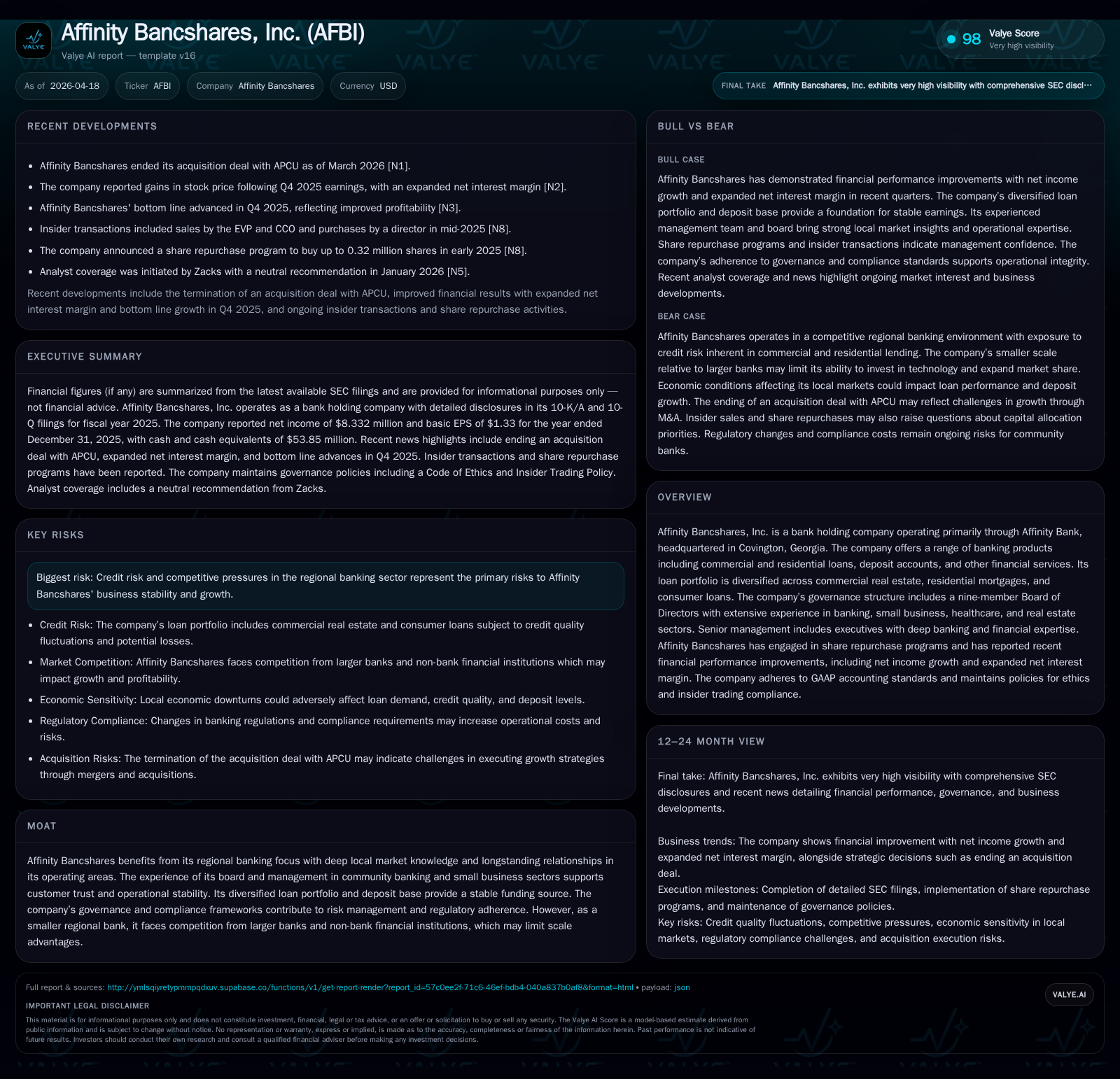
Affinity Bancshares, Inc. posted a notable 53.1% increase in net income during fiscal year 2025, driven by improved net interest margins and operational efficiencies. The company’s diversified loan book spanning commercial real estate, residential mortgages, and consumer loans underpins this growth, alongside disciplined capital deployment highlighted by increased share repurchases. However, the recent termination of its acquisition deal with APCU reflects ongoing competitive pressures and credit risks typical of smaller regional banks. Going forward, Affinity’s deep local market relationships and governance expertise offer avenues for organic growth, though external constraints may temper scaling advantages.
Robust Historical Growth Backed by Diversified Loan Portfolio
Affinity Bancshares demonstrated measured financial performance improvements from FY2022 through FY2025, culminating in a significant profit acceleration in the most recent year. Net income reached $8.33 million at year-end 2025, up from $7.13 million in 2022, exhibiting moderate volatility but a clear upward trajectory [F1]. This progression coincides with the company's diversified loan book which includes commercial real estate (owner-occupied/non-owner occupied), construction-related financing, residential mortgages on primarily one-to-four family properties, and consumer installment loans [S12][S25]. Such segmentation aligns with community banking best practices aimed at balancing risk exposures across asset classes.
Operating cash flows also rose markedly to $11.64 million in FY2025 from $7.57 million in FY2022, signaling enhanced core earnings quality and operational efficiency [F1]. At the same time, capital expenditures stabilized around $422,000 annually since FY2024 after an elevated amount in FY2022 [F1], indicating controlled reinvestment into physical infrastructure.
Historical performance (annual)
| FY | Net ($mm) | CFO ($mm) | Capex ($) | Net YoY |
|---|---|---|---|---|
| 2025 | 8 | 12 | 422000 | +53.1% |
| 2024 | 5 | 7 | 422000 | -15.6% |
| 2023 | 6 | 8 | 527000 | -9.6% |
| 2022 | 7 | 8 | 1394000 |
Source: SEC companyfacts cache [F1].
Capital returns and efficiency (annual)
| FY | Buybacks ($mm) | FCF ($mm) | ROE% |
|---|---|---|---|
| 2025 | 6 | 11 | 6.6 |
| 2024 | 3 | 6 | 4.2 |
| 2023 | 3 | 7 | 5.3 |
| 2022 | 6 | 6 | 6.1 |
Source: SEC companyfacts cache [F1].
Table: Affinity Bancshares Financial Snapshot: FY2022–FY2025 [F1]
Drivers Behind the Substantial Net Income Jump in FY2025
The rebound to $8.33 million net income in FY2025 represents a sharp recovery following the dip below $5.45 million seen in FY2024 [F1]. Key drivers include expanded net interest margin boosted by favorable funding cost dynamics and pricing power within its diverse loan portfolio segments as noted in the overview [S1]. The parallel jump of operating cash flow by over 70% reinforces stronger core earnings rather than accounting or nonoperating adjustments.
Operational costs held relatively stable while credit loss allowances did not spike materially - supporting a stable credit climate in the company's lending base [S12][S25]. Additionally, management commentary acknowledges prudent risk controls amidst industry headwinds [S1]. While no direct financial impact from acquisition activities was recorded during FY2025 due to the subsequent termination of the APCU deal [N1][S3], internal focus on efficiency likely contributed.
Strategic Withdrawal from Acquisition: Implications from the APCU Deal Termination
In March 2026, Affinity Bancshares formally ended its acquisition agreement with Fidelity BancShares’ APCU unit [N1][S3]. This strategic rollback implies reconsideration of growth via external consolidation - potentially due to valuation misalignments or regulatory complexities.
This move refocuses emphasis on organic growth leveraging Affinity's established regional presence rather than scale-driven synergies that acquisitions often target—a prudent stance given competitive pressures within regional banking frameworks [S1]. Capital earmarked for acquisitions might now redirect towards share repurchases or reinforcing balance sheet resiliency.
Future Opportunities Rooted in Regional Focus and Management Expertise
The company’s deep ties across Georgia's local markets serve as a moat reinforced by an experienced board versed in small business and healthcare sectors - niches that require customized banking solutions [S1]. These entrenched relationships foster cross-selling opportunities across deposit products and lending verticals.
Affinity's product mix supports community banks’ traditional strengths such as deposit gathering stability through money markets and certificates of deposit along with specialized C&I lending notably to professional practices like dental industry clients within the region [S12]. Continual innovation in lending structures or digital client engagement could underpin future loan book expansions without compromising credit standards.
Key Constraints Arising from Competitive and Credit Risk Challenges
Nonetheless, Affinity faces intrinsic scale limitations when competing against megabanks offering broad service footprints or non-bank fintech actors providing niche lending platforms [S1]. Competitive penetration can pressure margins or customer fee income absent significant technological investment.
Credit risk remains prominent especially given significant exposure to construction land development portfolios which can exhibit heightened default volatility during economic swings [S12]. Vigilance over non-performing loans and provisioning metrics will be critical to preserving asset quality amid potential interest rate cycle shifts.
Capital Allocation Dynamics: Share Repurchases, Dividend Policy, and ROE Insights
Capital stewardship is notable with around $5.94 million spent on common stock repurchases during FY2025—a near doubling compared to prior years ($3.28 million estimate for prior periods as disclosed) reflecting management’s confidence in value creation via buybacks [F1][S6][S16]. Dividends distributed approximated $8.8 million concurrently supporting shareholder returns without compromising liquidity.
Equity levels moderated slightly from $129 million to roughly $127 million representing minor share count changes aligned with repurchase activity [F1]. Return on equity stands at a healthy approximate level of 6.6%, respectable for a regional bank balancing growth with prudence and regulatory capital cushions [F1]. Free cash flow generation exceeding $11 million furnishes ample flexibility for continued programmed capital deployment.
Liquidity Position and Capital Structure: Strength with Vigilance
Liquidity remains robust anchored by cash and equivalents totaling approximately $53.85 million at fiscal year-end close—supplemented by investment securities available-for-sale including high-grade U.S. Treasury and agency bonds ensuring low credit risk buffers [F1][S4][S5][S7]. Deposit base sustained growth beyond $739 million providing stable funding complemented by manageable borrowings primarily through Federal Home Loan Bank advances around mid-$50 million range [S8][S19].[S22]
Such liquidity profiles comply with regulatory expectations emphasizing high-quality liquid assets enabling readiness against market disruptions while supporting ongoing lending operations.
Monitoring Milestones: What Upcoming Filings and Initiatives Could Reveal
With explicit guidance limited within disclosures reviewed, key forward-looking metrics warrant close observation including quarterly net interest margin trends post-acquisition withdrawal impact; allowance for loan losses trajectory as repayment patterns evolve; balance sheet growth rates especially within targeted niche sectors; management commentary regarding competitive positioning or digital platform investments.
Further insight into dividends sustainability alongside capital return programs will inform how strategy balances shareholder returns versus reinvestment needs amid evolving regional banking pressures.
This analysis confines itself strictly to disclosed facts without conjecture beyond sourced information provided herein. The figures cited are directly extracted from mandated filings ([F1], [S#]) or reputable news disclosures ([N#]). Readers should note that evolving macroeconomic factors affecting regional banks broadly may influence these fundamentals going forward but fall outside factual scope here.
Disclaimer: This is research-only, informational analysis and not investment advice. It may include AI-generated interpretation and general industry context. Always verify important details using primary sources.

Comments