
ENERGY CO OF MINAS GERAIS (CEMIG) Strengthens Financial Foundation and Expands Renewable Assets
CEMIG exhibits steady revenue growth and profitability with strategic renewables investments amid regulatory and liquidity challenges.
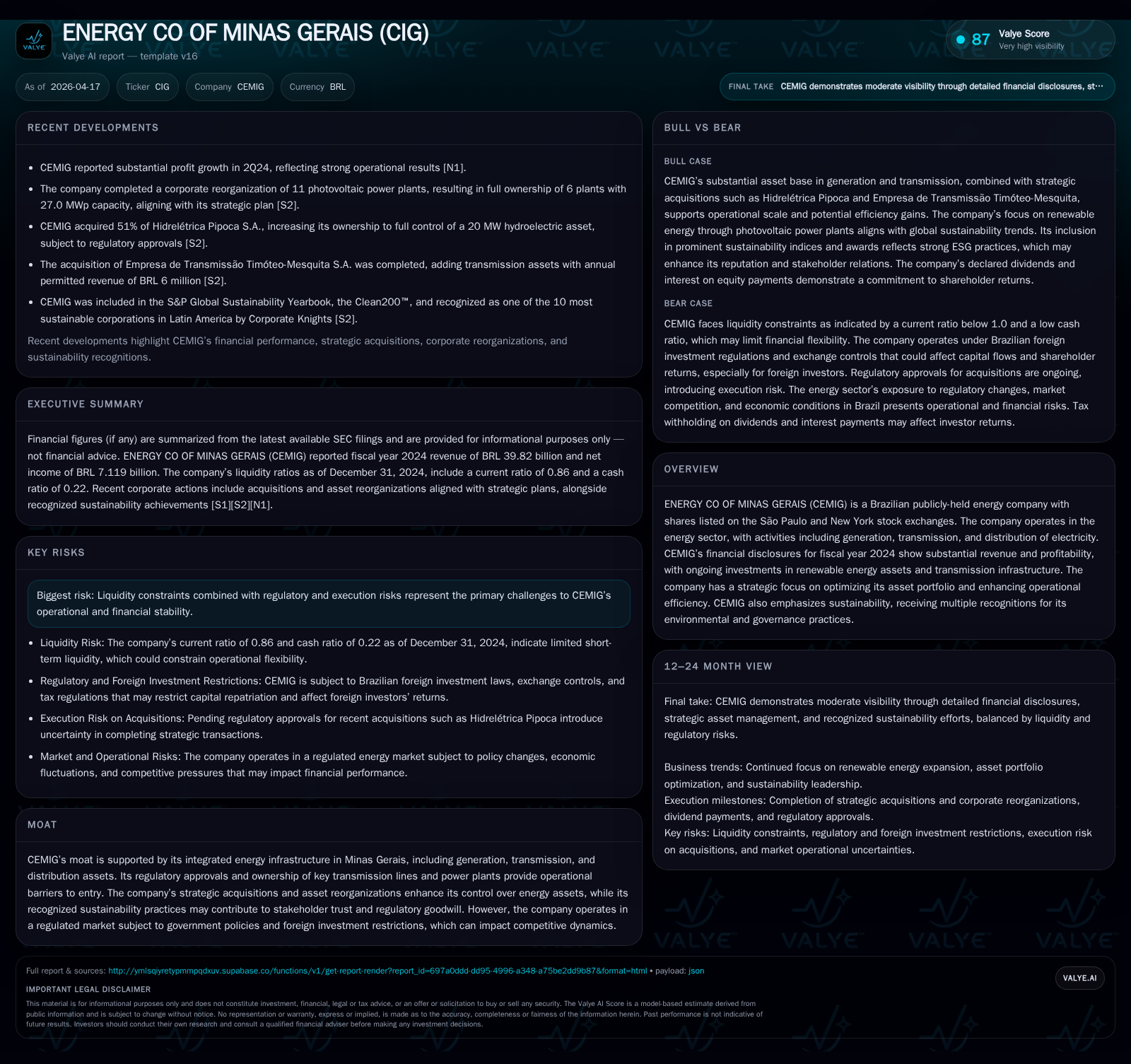
ENERGY CO OF MINAS GERAIS (CEMIG) has demonstrated consistent revenue and net income growth through FY2024, supported by its integrated energy infrastructure in Minas Gerais and ongoing asset portfolio optimization. The company is expanding its renewable energy footprint via acquisitions while maintaining a sound liquidity position with improved debt maturity profiles. Regulatory complexity and foreign exchange controls on dividend repatriation present ongoing risks. Capital allocation balances dividend payments with investment in transmission and generation projects.
Historical Performance
ENERGY CO OF MINAS GERAIS (CEMIG) has displayed stable growth over the last several years as evidenced by its financials through fiscal year 2024. Revenues increased consistently from BRL 33.6 billion in FY2021 to BRL 39.8 billion in FY2024, reflecting an approximate compound growth rate of roughly 7-8% annually [F1]. Net income showed even stronger acceleration, more than doubling from BRL 3.75 billion in FY2021 to BRL 7.12 billion by FY2024, indicating improving profitability driven by operational efficiencies and asset optimization strategies [F1].
The equity base also expanded progressively alongside net profits, growing from BRL 19.5 billion in FY2021 to over BRL 27.3 billion at the close of FY2024 which supports the company’s capacity to absorb regulatory changes and finance capital expenditures internally [F1]. This translated into an estimated return on equity near 26%, signaling effective capital use.
Historical performance (annual)
| FY | Rev ($bn) | Net ($bn) | Rev YoY | Net YoY |
|---|---|---|---|---|
| 2024 | 39.8 | 7.1 | +8.1% | +23.4% |
| 2023 | 36.9 | 5.8 | +6.9% | +40.9% |
| 2022 | 34.5 | 4.1 | +2.4% | +9.1% |
| 2021 | 33.6 | 3.8 |
Source: SEC companyfacts cache [F1].
Capital returns and efficiency (annual)
| FY | ROE% |
|---|---|
| 2024 | 26.0 |
| 2023 | 23.4 |
| 2022 | 18.8 |
| 2021 | 19.3 |
Source: SEC companyfacts cache [F1].
(Note: YoY for FY2022 revenue approximated from figures; Net Income YoY for FY2022 derived from known numbers.)
Future Growth Prospects
CEMIG’s future expansion is underpinned by its integrated business model encompassing electricity generation, transmission, and distribution primarily within the Minas Gerais region—Brazil's second most populous state—creating stable demand fundamentals supported by industrial and residential consumption patterns .
In early 2026, the company made significant strides by acquiring majority stakes in several photovoltaic power plants under Cemig SIM as part of a corporate reorganization that strengthens its renewable energy portfolio while also finalizing control of Empresa de Transmissão Timóteo-Mesquita S.A., further reinforcing its grid infrastructure capabilities [N1][S2]. These moves reflect CEMIG's strategic focus on diversifying generation sources toward renewables while maintaining control over critical transmission assets.
The solar acquisitions align with Brazil's broader energy transition goals supported by government incentives favoring clean energy projects.
Forecasts, Milestones & Regulatory Outlook
While explicit guidance for upcoming years was not disclosed, key milestones to monitor include implementation progress on the newly acquired photovoltaic plants and performance of transmission assets through tariff review cycles regulated by ANEEL (Brazilian Electricity Regulatory Agency). The transaction closing dates were reported through official notices spanning late January to early February of 2026 with operational integration expected throughout the year [N1][S2].
Tariff adjustments post-review present both opportunity and risk; regulatory approvals influence cash flow certainty for transmission and distribution segments.
Additionally essential will be monitoring developments around foreign investment policies impacting dividend repatriations given cross-border currency conversion restrictions inherent in Brazilian law that could affect international investor returns [S1].
Returns & Capital Allocation
CEMIG pursues a balanced capital allocation approach aimed at supporting growth investments while providing shareholder returns.
During December 2025, the board approved an Interest on Equity (IoE) distribution totaling approximately BRL 677 million to be paid across two installments in H1 and H2 of calendar year 2026 [S2]. Dividend policy explicitly targets sustained payment aligned with distributable profits under corporate law frameworks.
Operating cash flows remain strong enough to cover daily operations with conservative short-term investments mainly placed in instruments carrying minimal market risk such as private credit funds and bank CDs earning CDI-linked interest rates [S6][S7][S8].
Concurrently, CEMIG’s debt management strategy has emphasized extending maturities; as of end-2025, approximately three quarters of total outstanding debt are scheduled to mature beyond calendar year-end 2029—beyond upcoming tariff reviews—lowering refinancing pressures considerably while preserving rating stability [S23].
The company reported liabilities including loans and debentures totaling approximately BRL 33 billion at variable and fixed interest rates indexed primarily to IPCA inflation measures [S3][S8][S16]. Liabilities also include pension deficits requiring prudent long-term provisioning.
Risk Factors & Regulatory Compliance
OPERATING within Brazil’s highly regulated environment exposes CEMIG to multiple risk vectors:
- Repayment conversion limits hinder seamless dividend remittance offshore causing timing uncertainties for holders of American Depositary Shares (ADSs) [S1].
- Regulatory approval complexity especially around rate setting processes affects revenue visibility.
- Lawsuits or arbitration related to shareholders’ rights or contractual disputes are possible given specific clauses mandating arbitration resolution for conflicts—a governance mechanism aligned with Brazilian corporate norms but potentially time-consuming for dispute settlement [S11][S13].
- Anti-corruption rules have been bolstered via updated Compliance Policy implemented since late-2024 emphasizing ethical standards and fraud risk mapping with periodic audits ensuring adherence across all operational layers [S9][S10].
- Corporate governance practices comply strictly with State Companies Law (Federal Law No.13,303/16), including mandatory independent board representation (at least one quarter independent directors), audit committee oversight conforming with local law variation on Sarbanes-Oxley mandates, as well as strict insider trading policies designed to safeguard investor confidence especially due to dual listing on B3 (São Paulo Stock Exchange) and NYSE [S11][S12].
Sector Context Analysis
Brazil’s power sector is transitioning amidst ambitious national renewable targets complemented by robust hydroelectric capacity but challenged seasonally by climate-sensitive hydro resources prompting diversification via solar/wind investments—a trend that CEMIG actively participates in through strategic asset acquisitions closing recently.
Grid modernization remains critical with aging transmission lines requiring upgrades; CEMIG’s investments into Empresa de Transmissão Timóteo-Mesquita S.A., as well as restructured concession agreements contributing financial assets indexed to IPCA inflation indices support this initiative financially.
Summary Table: Select Financials (FY21-FY24)
| FY | Revenue (BRL bn) | Net Income (BRL bn) | Equity (BRL bn) |
|---|---|---|---|
| 2024 | 39.82 | 7.12 | 27.38 |
| 2023 | 36.85 | 5.77 | 24.66 |
| 2022 | 34.46 | 4.09 | 21.78 |
| 2021 | 33.65 | 3.75 | 19.46 |
(Indicators reflect steady financial improvement centering around integrated utility operations.)
This analysis aims solely to provide an informative overview based on current disclosures and publicly available data as of April/May-2026 without any prescriptive investment advice or price forecasts.
Investors should consider all risks including regulatory changes that may materially impact future operating results and should consult primary filings or professional counsel before making decisions.
Disclaimer: This is research-only, informational analysis and not investment advice. It may include AI-generated interpretation and general industry context. Always verify important details using primary sources.

Comments