
SEMrush’s Financial Turnaround and Strategic Stakes Ahead of Adobe Deal
SEMrush transitions from operating losses to robust cash flow generation while navigating the complexities of its pending merger with Adobe.
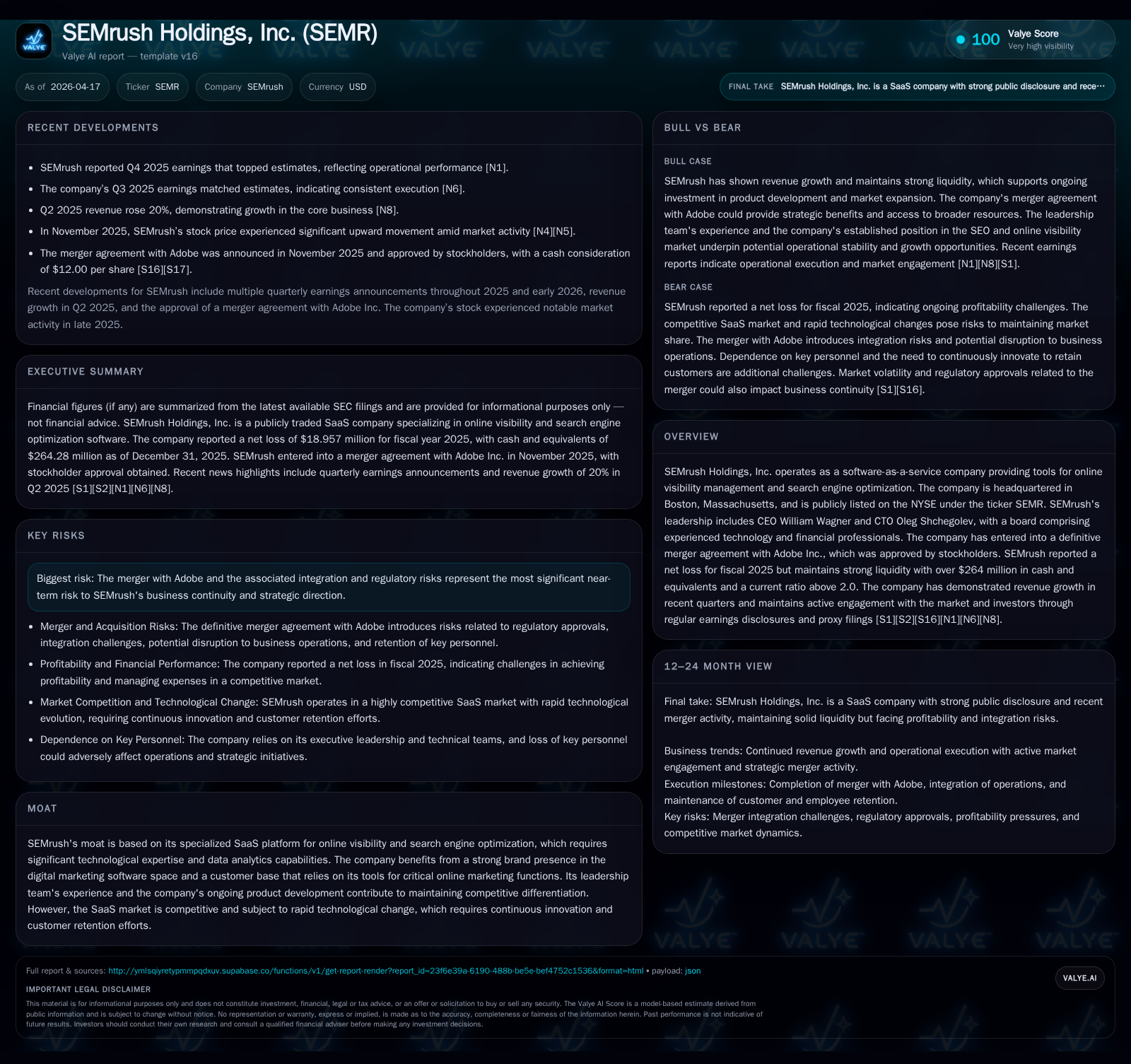
SEMrush Holdings, Inc. has exhibited a volatile profitability trajectory from 2022 through 2025, marked by a return to operating losses in its latest fiscal year despite strong growth in operating cash flow. The company maintains a solid liquidity position with over $264 million in cash and equivalents and a healthy current ratio above 2.0. Its definitive merger agreement with Adobe underscores significant strategic shifts but also introduces integration and regulatory risks. Investors should monitor quarterly revenue trends, merger-related milestones, and customer retention metrics as key signals of future performance.
From Losses to Cash Generation: Tracing SEMrush’s Recent Financial Journey
SEMrush’s financial history between fiscal years 2022 and 2025 reveals pronounced volatility particularly evident in its earnings metrics juxtaposed against improving cash flows. Operating income shifted dramatically from a steep loss of about $36.4 million in FY2022 to earnings of roughly $8.3 million in FY2024 — only to reverse into a $22.8 million loss by end-2025 ([F1]). This ebb and flow is echoed by net income figures which swung from a loss exceeding $33.8 million in 2022 to positive territory at approximately $8.2 million in FY2024 before retreating once again to an $18.9 million net deficit for FY2025 ([F1]).
Despite these swings, the company’s operating cash flow paints an encouraging picture: from negative cash flow of around $9.6 million in 2022 to progressively stronger inflows culminating near $59.6 million by December 31, 2025, marking roughly a 26.8% year-over-year increase between FY2024 and FY2025 ([F1]). This divergence suggests important non-cash charges or working capital efficiencies underpinning liquidity enhancement even as accounting profits vacillate.
Capital expenditures have been similarly adjusted downwards—dropping over half from $4.2 million in FY2022 down to just under $1.8 million by FY2025 ([F1]), pointing toward more restrained investment behavior or optimization efforts possibly influenced by the ongoing merger process.
Historical performance (annual)
| FY | Net ($mm) | CFO ($mm) | OpInc ($mm) | Capex ($mm) | Net YoY |
|---|---|---|---|---|---|
| 2025 | -19 | 60 | -23 | 2 | -330.2% |
| 2024 | 8 | 47 | 8 | 4 | +766.9% |
| 2023 | 1 | 8 | -8 | 2 | +102.8% |
| 2022 | -34 | -10 | -36 | 4 |
Source: SEC companyfacts cache [F1].
Capital returns and efficiency (annual)
| FY | FCF ($mm) | ROE% |
|---|---|---|
| 2025 | 58 | -6.6 |
| 2024 | 43 | 3.2 |
| 2023 | 6 | 0.4 |
| 2022 | -14 | -16.9 |
Source: SEC companyfacts cache [F1].
The table above consolidates key annual financial metrics reflecting SEMrush's mix of profit volatility offset by strengthening operational liquidity.
Operational Shifts Behind 2025 Profitability Swings
While SEMrush delivered robust cash generation for FY2025, the persistence of negative operating and net income points to structural expense pressures not immediately absorbed into accrual-based profitability measures ([F1],[S1]). Factors potentially contributing include escalated research & development costs aimed at innovation within their SEO and online visibility platforms—critical for maintaining competitive differentiation—as well as intensified sales & marketing spend related to customer acquisition or retention ahead of integration with Adobe.
Further compounding profitability pressures could be non-cash expenses such as stock-based compensation or amortization of acquired intangible assets noted within SaaS peers’ cost structures, although specific line item disclosures are limited ([S1]). Contrasting cash flows suggest that working capital management has been efficiently handled but that earnings remain affected by investments supporting future scalability.
Strategic Impact of the Pending Adobe Merger
SEMrush’s trajectory is substantially shaped by its definitive merger agreement with Adobe Inc., approved by stockholders following extensive proxy disclosures ([S1],[S16],[S19]). This deal positions SEMrush as a wholly owned Adobe subsidiary upon completion.
This transaction promises considerable strategic benefits including access to Adobe’s vast ecosystem and resources with expected synergies around digital marketing software offerings.[Company-native context: SaaS integrations often grapple with channel realignment challenges where legacy sales incentives must recalibrate.] However, integration risks loom large: alignment of technology stacks; retention of key personnel critical for niche SEO expertise; preservation of client relationships during transition phases; and navigating regulatory approvals under antitrust statutes all represent critical factors influencing successful deal closure ([S4],[S7],[S8],[S19]).
Legal proceedings initiated by certain stockholders alleging material omissions or misrepresentations around the transaction introduce litigation risk further complicating timing and certainty ([S15],[S19]).
2026 Outlook: Market Expectations and Key Uncertainties
Explicit forward-looking financial guidance is not provided within available sources; however, SEMrush signals confidence through stated intentions related to product expansion, anticipated demand growth for SEO and visibility tools within evolving AI-driven search environments, and continued investments calibrated against margin realizations ([N1],[S5]).
Key uncertainties stem from pace/success of integration-related initiatives including harmonizing sales approaches within Adobe distribution channels; sustaining R&D momentum amid reorganization; and adapting product roadmaps responsive to competitive algorithmic changes across major search engines ([N1],[S5]). Market watchers should carefully monitor quarterly revenue progression alongside margin trajectory and engagement metrics disclosed during upcoming earnings releases.
Capital Allocation Priorities: Liquidity, Returns, and Shareholder Value
SEMrush closed FY2025 with compelling liquidity: cash plus equivalents total approximately $264 million against current liabilities near $154 million yielding a current ratio above 2x—a signifier of strong short-term solvency ([F1]). The firm expanded its shareholders' equity base progressively over four years climbing from about $200 million to roughly $289 million through FY2025 ([F1]).
Return on equity remains negative (-6.6%) reflecting the net loss position despite sizable equity capital deployed ([F1]). Free cash flow after capex stood at an estimated $57.8 million for the year ending December 31, 2025, underscoring effective operational cash conversion even amidst reported losses ([F1]).
Dividend payments have not been issued reflecting typical Sas lifecycle reinvestment priorities rather than yield-focused distributions; share buybacks occur sporadically aligned with liquidity availability and capital return philosophy common amongst growth SaaS entities ([S9],[S12],[S16],[S23]). Equity awards form a significant part of executive compensation supporting retention during pivotal corporate events ([S14]).
Assessing SEMrush’s Competitive Position in Digital Marketing SaaS
At its core, SEMrush operates a specialized SaaS platform focused on online visibility management and search engine optimization tools heavily reliant on proprietary data analytics capabilities for algorithmic insight extraction ([S1]). Such technical complexity establishes high customer switching costs as clients integrate SEMrush tools deeply into their digital marketing workflows.
Additionally, the company benefits from brand recognition within digital marketing circles alongside proven scalability afforded by its cloud infrastructure—a critical backbone enabling responsiveness across diverse international client bases.[Sector-native observation: Effective SaaS platforms combine extensible APIs facilitating ecosystem integrations which SEMrush leverages for market stickiness.] Nonetheless, continuous innovation remains indispensable given rapid shifts in search engine algorithms impacting SEO strategies.
Risks on the Horizon: Regulatory, Integration, and Market Disruptions
Documented risks sharply focus on transaction execution: the need for antitrust clearances such as those under the Hart-Scott-Rodino Act; fulfillment of closing conditions including absence of material adverse effects post-agreement; potential disruptions stemming from key personnel attrition or client defection during transition phases; contract assignment clauses with third parties posing deal execution challenges; escalating legal expenses arising from proxy litigation; cybersecurity threats targeting SaaS operators; labor cost dynamics especially amid inflationary pressures—all constitute an interconnected risk matrix threatening business continuity ([S4],[S7],[S8],[S19]).
The company acknowledges uncontrollable external influences including economic cycles impacting enterprise IT budgets as well as technological shifts mandating agile R&D responses necessary for sustained competitiveness.
Looking Forward: Metrics and Milestones Investors Should Monitor
While official forecasts remain undisclosed publicly, stakeholders should prioritize tracking sequential quarterly revenue growth rates coupled with gross margin stability—early indicators of successful post-merger operational alignment. Additionally monitoring customer retention rates will shed light on integration impact on client loyalty amid platform consolidation.
Cash flow sustainability consistent with prior years’ positive trajectories will be critical given ongoing investments required for product innovation within AI-enabled SEO arenas. Management commentary throughout earnings calls particularly addressing synergy realization timelines will provide essential transparency into deal value capture progress.
Product development milestones under new ownership warrant close observation as SEMrush navigates expanding capabilities aligned with Adobe’s broader digital experience strategy. Any regulatory updates or litigation outcomes directly affecting merger completion timing should also command investor attention given their fundamental consequences on company prospects.
This analysis is based exclusively on factual disclosures derived from SEC filings including annual and quarterly reports complemented by recent proxy materials without conjecture or external market assumptions.
Disclaimer: This is research-only, informational analysis and not investment advice. It may include AI-generated interpretation and general industry context. Always verify important details using primary sources.

Comments