
TransCode Therapeutics Battles Financial Strain While Advancing RNA and Immuno-Oncology Pipelines
Clinical progress in RNA therapeutics and strategic acquisitions bolster pipeline as cash runway tightens.
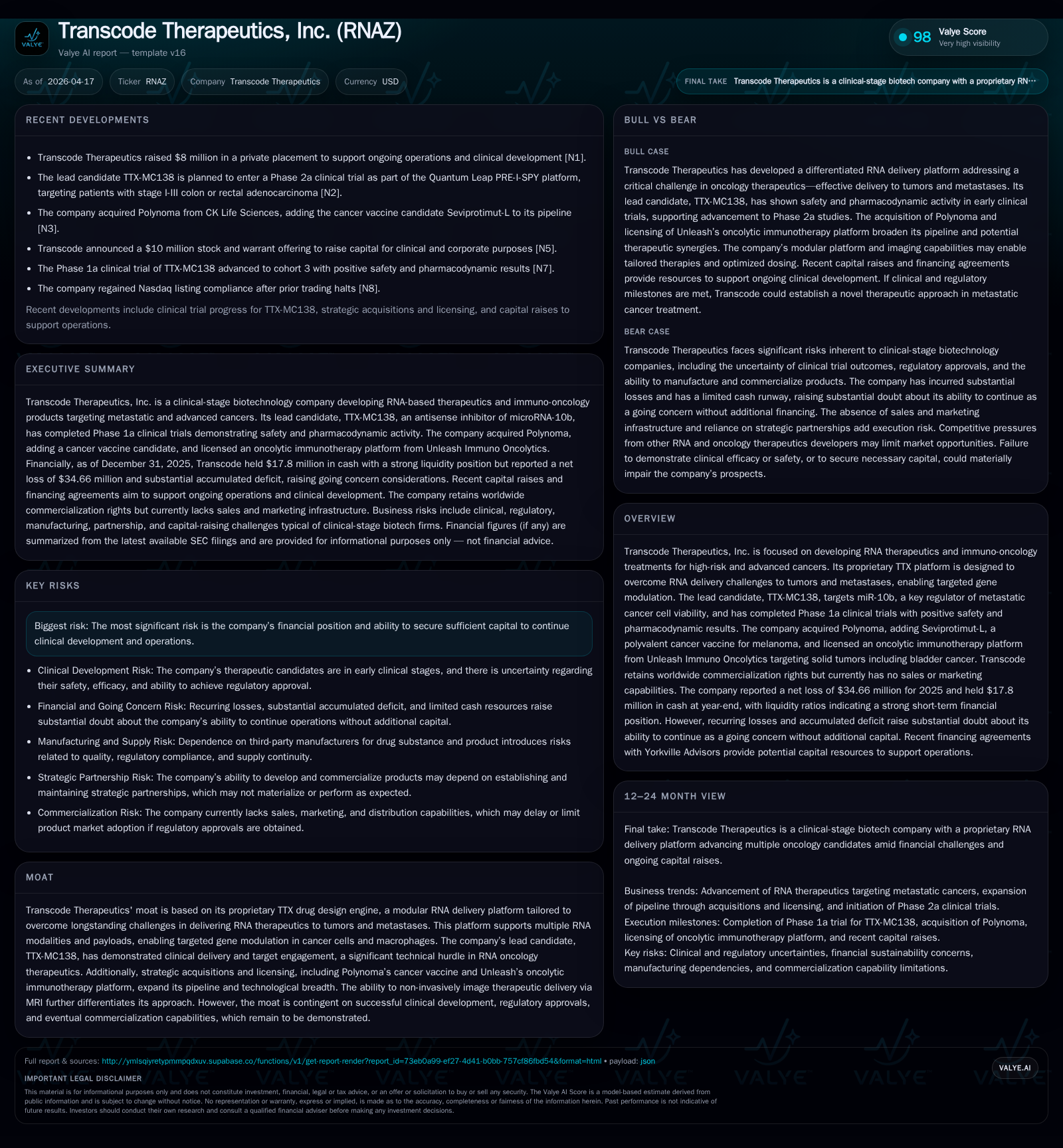
TransCode Therapeutics, Inc. is a clinical-stage biotech focused on RNA therapeutics and immuno-oncology for aggressive cancers, with a proprietary delivery platform enabling targeted gene modulation. Their lead asset, TTX-MC138, recently completed Phase 1a trials showing safety and target engagement. The 2025 acquisition of Polynoma expanded their oncology vaccine portfolio. Despite promising clinical milestones, TransCode is reporting rising net losses and tightening liquidity, underscored by a $17.8 million year-end cash position and an $8 million capital raise in early 2026. Continued development depends heavily on securing further financing amid regulatory and commercialization hurdles.
Company Overview
TransCode Therapeutics operates as a clinical-stage biopharmaceutical company pioneering RNA-based therapeutics alongside immuno-oncology treatments tailored for high-risk and advanced cancers [S1]. Its proprietary TTX platform is designed to overcome barriers in targeting RNA payloads directly to tumor tissues and metastases. The lead clinical asset using this platform is TTX-MC138, an antisense inhibitor directed against microRNA miR-10b, which modulates metastatic cancer cell survival. Completion of the Phase 1a clinical trial demonstrated positive safety and pharmacodynamic effects, attesting to successful RNA delivery — a significant technical hurdle in oncology therapeutics development.
Complementing this RNA-centric approach, TransCode acquired Polynoma in October 2025, integrating Seviprotimut-L into its portfolio — a polyvalent melanoma vaccine previously administered safely to more than one thousand patients in clinical trials [S1]. This vaccine aims to reduce recurrence risk for stage IIB/IIC melanoma where options remain limited.
Historical Financial Performance
The company remains pre-revenue, investing heavily into research and development as reflected by widening operating losses. Operating income worsened from -$15.66 million in 2024 to nearly -$27.98 million in 2025 — a nearly 79% increase in losses year-over-year [F1]. Net income deteriorated from approximately -$16.75 million in 2024 to -$34.66 million in 2025 — a decline exceeding 100%, driven primarily by expanded clinical activities post-acquisition alongside administrative expansion [F1].
Operating cash flow also reflected escalating burn rates; CFO moved from negative $13.3 million to negative $19.5 million between these years while capital expenditures declined sharply from about $21,700 to $6,660 consistent with its virtualized operational model relying on outsourced R&D [F1]. Equity turned positive again reaching approximately $10.3 million by end-2025 after dipping negative the previous year due largely to capital raises supporting clinical pipelines [F1].
Historical performance (annual)
| FY | Net ($mm) | CFO ($mm) | OpInc ($mm) | Capex ($) | Net YoY |
|---|---|---|---|---|---|
| 2025 | -35 | -20 | -28 | 6660 | -106.9% |
| 2024 | -17 | -13 | -16 | 21761 | +9.7% |
| 2023 | -19 | -18 | -19 | 35609 | -5.6% |
| 2022 | -18 | -16 | -19 | 100919 |
Source: SEC companyfacts cache [F1].
Capital returns and efficiency (annual)
| FY | FCF ($mm) | ROE% |
|---|---|---|
| 2025 | -20 | -335.4 |
| 2024 | -13 | 830.0 |
| 2023 | -18 | -1130.3 |
| 2022 | -16 | -542.0 |
Source: SEC companyfacts cache [F1].
Note: Revenues are nil as TransCode is pre-commercialization.
Growth Drivers and Future Outlook
Near-term growth prospects hinge on advancing TTX-MC138 through upcoming clinical stages including a planned Phase 2a trial indicated by management intentions [S1]. This candidate’s mechanism—silencing miR-10b to target micrometastatic niches—addresses an unmet need in metastatic oncology that could unlock substantial market opportunities if efficacy signals mature.
Potential synergistic value may be derived from combining TTX-MC138 with Seviprotimut-L given complementary tumor-targeting versus immune priming modalities planned for preclinical research stage efforts [S1]. However, progress depends heavily on securing additional funding amid high R&D expenses and navigating regulatory uncertainties internationally.
Capital Structure and Funding Considerations
As of December 31, 2025, TransCode held approximately $17.8 million in cash against current liabilities of about $3.49 million, yielding a current ratio near 6.29 — underscoring adequate short-term liquidity following significant financing activities during the year [F1][S21]. In early April 2026, the company raised an additional $8 million through a private placement aimed at supporting ongoing operations and clinical advancement plans [N1].
No dividends have been declared or paid historically nor are expected given the early-stage status typical for platform biotech innovators [S1][F1]. Capital expenditures remain minimal due to reliance on contract research organizations (CROs) and third-party manufacturing rather than owning physical production assets.
Dependence on external financing poses ongoing risks should capital markets tighten or investor appetite diminish given the high cash burn associated with advancing clinical programs [S21]. Future equity issuances may dilute shareholders while debt arrangements could impose operational constraints.
Regulatory Environment & Legal Risks
TransCode operates within a complex regulatory landscape governed primarily by FDA standards but also influenced by foreign authorities where approvals may be sought eventually [S9][S24]. Compliance challenges include adherence to good manufacturing practices (cGMP), adverse event reporting requirements post-approval, pharmacovigilance obligations, and potential REMS-imposed restrictions.
The company must also navigate U.S. healthcare fraud and abuse laws including the Anti-Kickback Statute and False Claims Act that regulate interactions with healthcare providers/payors aimed at preventing unlawful inducements or false claims submissions — exposure which will increase upon commercialization activities . Compliance failures could result in severe penalties including fines or exclusion from federal reimbursement programs materially impairing business viability.
International regulations such as GDPR affecting data privacy during multinational trials add further compliance complexity requiring robust internal controls accounting for evolving legislation [S23].
Commercialization Prospects & Infrastructure Challenges
Currently lacking sales force or marketing capabilities, TransCode will need partnerships or internal buildouts assuming product approvals materialize [S15]. Developing commercial teams specialized in oncologic therapeutics represents both significant cost and organizational complexity given competitive scarcity of skilled personnel able to educate oncologists on novel RNA therapeutics or vaccines.
Market acceptance remains uncertain pending demonstration of differentiated efficacy/safety profiles versus established standards-of-care therapies relevant here.
Pricing negotiations under government programs such as Medicare/Medicaid will be pivotal since reimbursement decisions directly shape provider uptake impacting volumes post-launch amid broad drug pricing reforms and cost containment pressures across US states and foreign markets alike [S12][S15].
This analysis is based solely on publicly available information including SEC filings (Forms 10-K and 8-K) as well as news sources cited herein; it does not constitute investment advice or recommendations.
Disclaimer: This is research-only, informational analysis and not investment advice. It may include AI-generated interpretation and general industry context. Always verify important details using primary sources.

Comments