
XMax Inc. Targets AI Expansion While Recovering From Furniture Market Pressures
XMax balances its stabilized furniture revenues with a strategic pivot into AI amid ongoing industry headwinds.
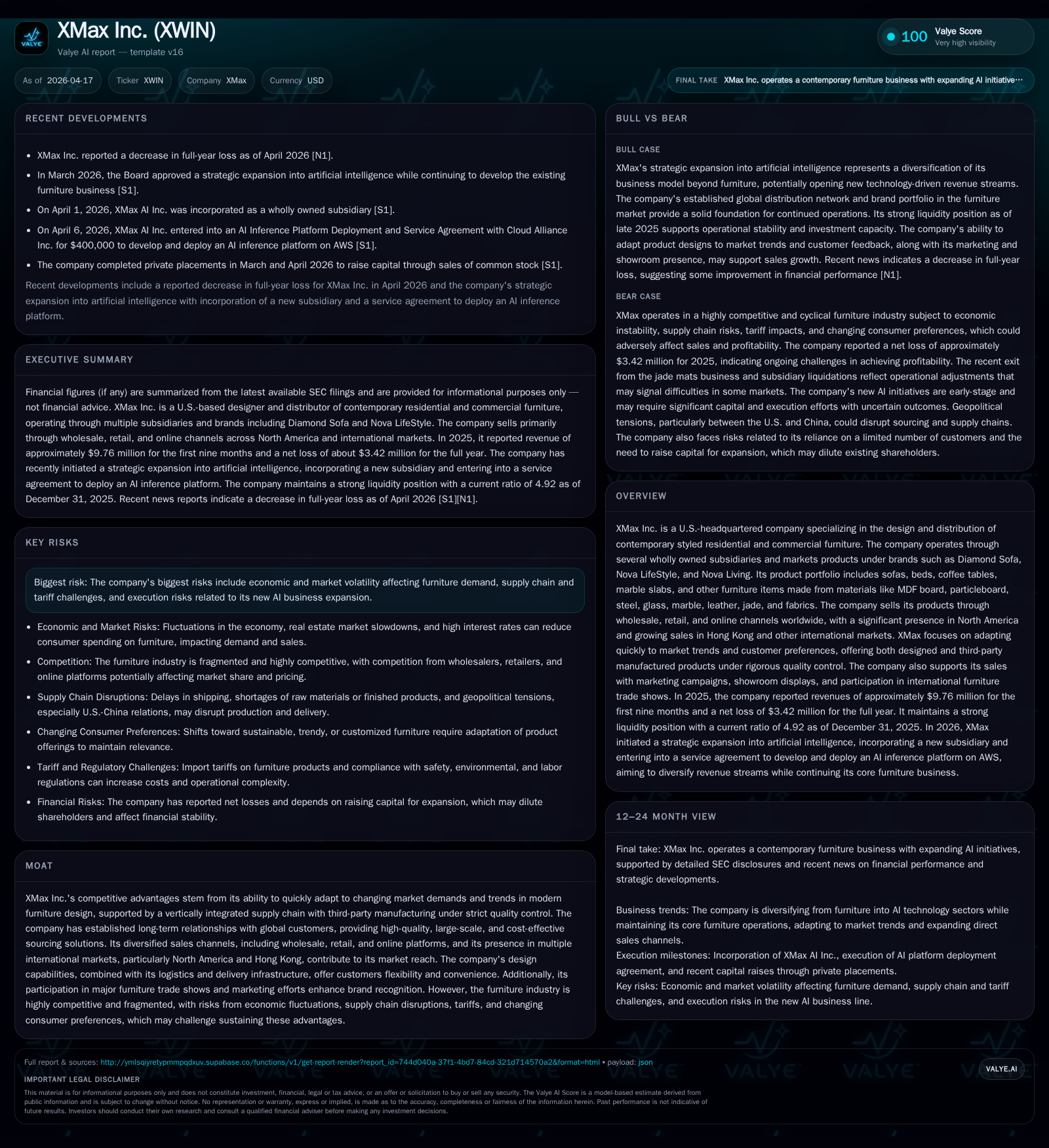
XMax Inc. has demonstrated relative revenue stability with near flat sales around $12.7 million from 2022 through 2025, while significantly improving operating and net losses. The company’s pivot into high-growth AI markets in early 2026 represents a bold diversification strategy in response to cyclical pressures on its core furniture business, which remains challenged by tariff costs, supply chain risks, and demand variability. Capital allocation reflects restrained spending and negative cash flows, indicating operational constraints even as management seeks scale in new AI ventures.
Financial Performance and Operating Challenges: A Historical Overview
XMax Inc.’s financial trajectory from fiscal year (FY) 2019 through FY2025 demonstrates notable stabilization in revenue coupled with a progressive improvement in profitability metrics—albeit still reporting net losses. Total revenues held close to $12.7 million as of FY2022 [F1], representing a material contraction from the pre-pandemic level of approximately $22 million in FY2019 but remaining mostly flat thereafter through FY2025 (a -0.5% year-over-year change between FY2024 and FY2025). This top-line steadiness comes after the company undertook strategic phasing out of low-margin products and customers with slow payment histories while emphasizing higher margin designs and direct retail channels [S15].
Operating losses significantly narrowed from a large negative $16.2 million recorded in FY2022 to an improved -$1.9 million loss by FY2025—a roughly 64% year-on-year positive swing between the last two full years reported [F1]. Net income progression mirrored this trend marked by shrinkage of net losses from -$17.1 million to -$3.4 million over the same timeframe [F1]. The narrowing deficits indicate better cost control and inventory management initiatives amidst challenging sales volumes.
Underlying these results is a vertically integrated supply chain model leveraging third-party manufacturing under strict quality controls allowing flexibility in managing costs and product development cycles—an operational lever helping the company respond faster to changing modern furniture trends [S24]. However, persistent gross margin pressure stemming from tariff escalations and input cost volatility weighed heavily on overall profitability.
Historical Financial Summary (FY2019-FY2025)
Historical performance (annual)
| FY | Net ($mm) | CFO ($mm) | OpInc ($mm) | Capex ($) | Net YoY |
|---|---|---|---|---|---|
| 2025 | -3 | 0 | -2 | 14121 | +38.5% |
| 2024 | -6 | -1 | -5 | +28.0% | |
| 2023 | -8 | -2 | -6 | +54.8% | |
| 2022 | -17 | -5 | -16 | 8772 |
Source: SEC companyfacts cache [F1].
Capital returns and efficiency (annual)
| FY | FCF ($mm) | ROE% |
|---|---|---|
| 2025 | 0 | -12.2 |
| 2024 | -178.1 | |
| 2023 | -1556.0 | |
| 2022 | -5 | -258.7 |
Source: SEC companyfacts cache [F1].
Geographic Shifts and Customer Diversification in Sales Channels
A significant shift occurred between geographic sales concentration from FY2024 to FY2025 underscoring XMax’s efforts to diversify beyond North America reliance—historically accounting for nearly all sales (97%) through bulk wholesale distribution via long-standing subsidiaries like Diamond Bar [S4][S9]. By FY2025 however North America’s share dropped sharply to about half (52%), while Hong Kong surfaced dramatically comprising nearly half (~47%) of total revenues [S4][S9]. This realignment signals strengthened penetration in Asian markets alongside increased internet retail emphasis under the Diamond Sofa brand presence via third-party online shopping portals directly targeting U.S. consumers [S24].
Such re-balancing mitigates customer concentration risk somewhat; nevertheless the emergence of one customer accounting for more than 10% of total sales during FY2025 represents a new focal point for potential dependency compared to none before that year [S4]. This highlights a transitional phase where strategic priority turns towards expanding direct retailer accounts and enhancing digital commerce capabilities—which could reduce vulnerability inherent in reliance on a few large distributors or wholesale buyers.
Sales channels now encompass broad wholesale networks serving multi-national retailers alongside rising direct-to-retail initiatives aiming to capitalize on branding power developed via trade shows like Las Vegas Market and High Point Market exhibitions where product launches are staged annually [S24].
Strategic Pivot into Artificial Intelligence: Rationale and Execution
March 2026 marked a watershed with XMax’s Board endorsing an ambitious venture into artificial intelligence sectors including AI software/hardware development infrastructures as well as cloud-based GPU compute services supporting enterprise-grade AI agent deployments [S13][N1]. This strategic initiative is designed both as revenue diversification counterweighting cyclicality observed in furniture retailing markets and as alignment with technology sector growth dynamics widely viewed as secular tailwinds.
Integration of XMax’s existing design prowess alongside marketing competence serves as foundational synergy enabling a measured yet comprehensive approach toward emerging AI opportunities spanning model access orchestration and high-performance compute provisioning contracts signed notably with Cloud Alliance Inc., targeting AWS cloud placement at a fixed fee basis initiating April's deployment [S13][N1].
However significant execution risks loom given AI market fragmentation combined with capital intensity requirements driving infrastructure acquisition cost pressures tied closely to global supply constraints on advanced GPUs—critical components subject to geopolitical restrictions limiting immediate scalable availability [S15][S18]. Hence while promising long-term prospects exist through joint ventures or acquisitions funded potentially by fresh capital raises pending operational milestones; substantial challenges remain around establishing commercial footholds faster than competitive peers entrenched within hyperscale ecosystems.
Risk Landscape Spanning Economic, Supply Chain, and Litigation Factors
Macroeconomic weaknesses bearing down on discretionary consumer spends remain paramount headwinds restricting furniture demand elasticity across several key territories including the U.S., Malaysia (prior operations concluded), China plus emerging markets reshaping sourcing contours due to tariff impositions introduced since early-2025 ranging broadly up to nearly seventy percent on Chinese goods [S6][S8][S18][N1]. These duties inflate landed costs propagating margin compression even as pricing strategies contend with intensifying discount pressures from competitors benefiting from alternative production locations albeit facing quality control trade-offs noted across Southeast Asian manufacturers versus established Chinese origins [S17].
Supply chain unpredictability involving logistics delays compounded by pandemic aftermaths also stresses inventory replenishment cycles impairing fulfillment commitments—factors that bear close watching particularly if consumer confidence wanes amid interest rate hikes affecting housing starts critical to furniture consumption patterns known for seasonal variances typically peaking during fourth quarter calendar periods [S10].
On regulatory fronts unresolved shareholder derivative litigations hailing from historic accounting controversies were mostly put behind following insurance-funded settlements totaling $750K executed early-2025; yet residual reputational damage plus possibility of new suits continue diverting management attention and increasing legal expenditure burdens marginally impacting bottom line outcomes going forward [S11][S16].
Capital Allocation Profile: Investment, Cash Flow, and Shareholder Returns
Despite narrowing operating losses fiscal cash flow metrics portray continued negative generating status—with operating cash flow improving massively from negative $5.4 million at end-of-2022 down to only about negative $446K by end-of-2025 reflecting working capital efficiencies but not full operational profitability yet reached [F1]. Correspondingly capital expenditure dipped steeply culminating at an estimated low double-digit thousands figure exemplifying deferred investment likely designed around conservatism given ongoing restructuring moves concurrent with capital conserving objectives pending scaling of new tech ventures such as XMax AI Inc constructed only recently in Nevada during April-2026 timeframe [F1][S13].
No dividends have been declared or distributed historically; share repurchases were sporadic pre-pandemic but have halted entirely last few years indicating focus squarely upon reinvestment/expansion priorities rather than shareholder returns at this stage reflecting typical early turnaround capital allocation strategies found among companies balancing legacy portfolio remediation alongside nascent growth areas within broader market constraints [F1][S14].
Return on equity approximates negative twelve percent (-12%) attributable largely to persistent net income shortfalls offsetting accumulated equity base reaching near $28 million end-of-2025 highlighting that substantial earnings recovery would be essential before more normalized capital returns manifest sustainably without dilutive financing techniques applied externally [F1].
What to Watch: Future Milestones, Growth Catalysts, and Potential Bottlenecks
Without explicit public financial guidance disclosed so far by management or Board statements outside general strategic frameworks ([N1],[S13]), investors should monitor key qualitative indicators including:
- Scaling trajectory and commercialization timeline of new AI service lines deploying software/hardware/cloud compute platforms;
- Further reduction progress of net losses coupled with margin improvements driven by furniture direct-to-retail distribution expansions;
- Growth momentum within e-commerce channels featuring Diamond Sofa brand online avenues encouraging greater customer engagement;
- Developments pertaining to lingering or novel litigation impacts that may affect financial resource deployment or executive focus;
- Effects from evolving tariff policies potentially easing or intensifying costs influencing gross margins particularly if manufacturing re-sourcing gains pace away from China toward other Asian suppliers;
- Customer mix shifts especially if reliance on any single outsized client extends beyond current levels raising concentration risk concerns. Collectively these factors will contour XMax’s ability to validate its dual-track future oriented around technology-enabled diversification anchored atop stabilized core furnishing operations.
Disclaimer: This analysis is based strictly on publicly available data including company filings and reputable news sources as cited. It does not constitute investment advice or recommendations but aims at understanding company strategy alongside enterprise risks within reported disclosures provided up until April 17th, 2026.
Disclaimer: This is research-only, informational analysis and not investment advice. It may include AI-generated interpretation and general industry context. Always verify important details using primary sources.

Comments