
Citi Trends: Resurgence and Reinvention in Off-Price Retail Serving Black Communities
Citi Trends pivots on its culturally tuned merchandising and community-rooted stores to transform recent financial headwinds into a platform for growth.
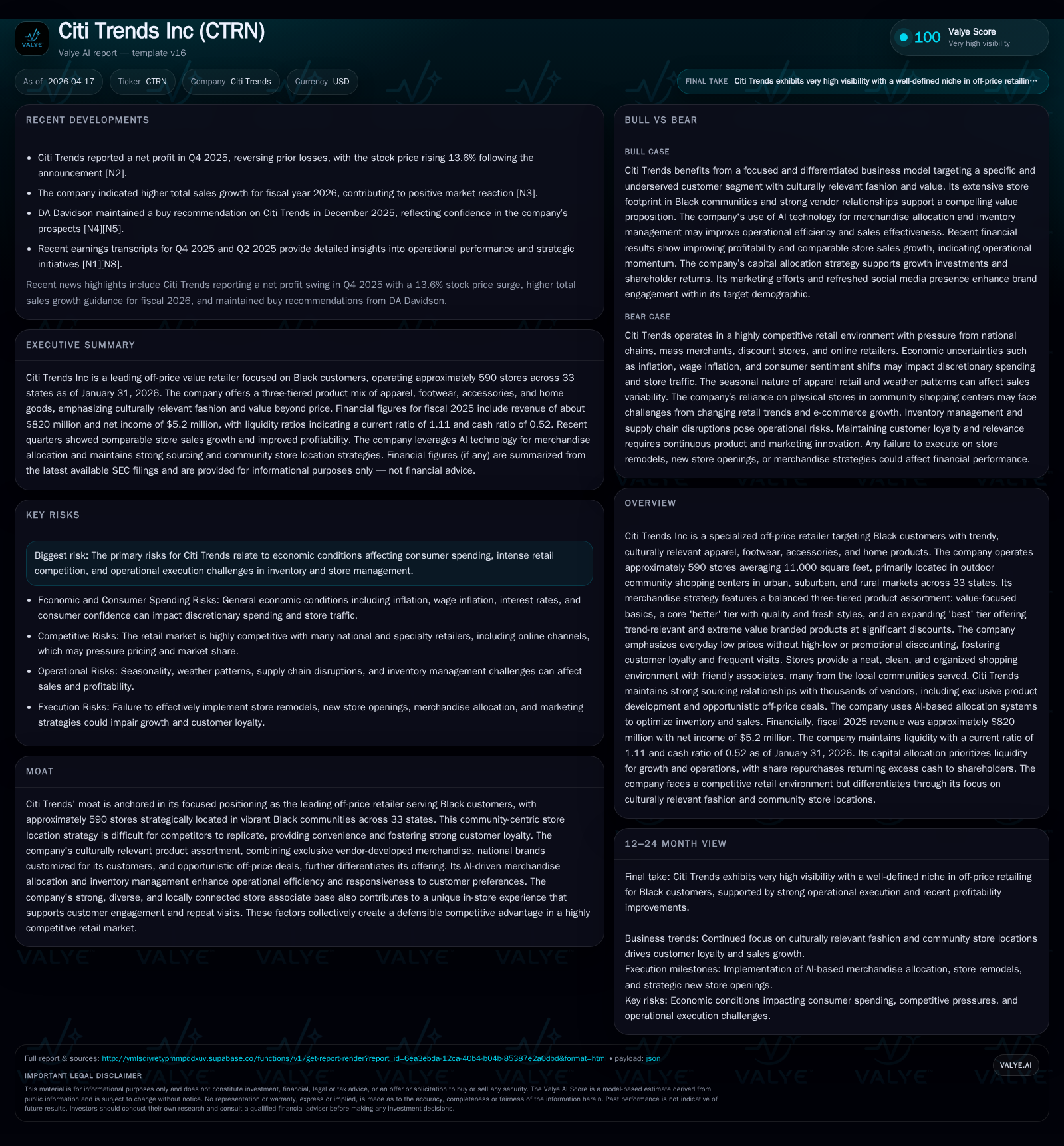
Following several challenging years marked by losses, Citi Trends returned to operating income profitability in FY2025, fueled by an 8.9% revenue increase and a rebound in operating cash flow. Its distinct positioning as the leading off-price retailer for Black customers leverages culturally relevant product assortments and a deep community store footprint that drives customer loyalty. Looking ahead, management emphasizes AI-enhanced inventory allocation, store remodel programs, and selective new store expansion to sustain momentum amid economic uncertainties.
Revenue and Earnings Recovery: Analyzing Historical Financial Performance
Citi Trends reversed multi-year operating losses with an 8.9% increase in revenue to approximately $820 million in fiscal 2025 (ending January 31, 2026), following revenues of $753 million in FY2024 and a trough during pandemic-impacted years [F1]. This resurgence was paralleled by operating income swinging from a loss of nearly $39.5 million in FY2024 to a positive $3.85 million in FY2025, underscoring operational improvement including better merchandise margins and cost discipline.
Operating cash flow further exemplifies this recovery trajectory by jumping from a negative $3.8 million to a robust positive figure exceeding $20 million [F1]. Such cash generative capacity underpins reinvestments into the business including capital expenditures that more than doubled year-over-year to over $20 million.
This financial rebound signals that Citi Trends has begun resolving previous execution challenges while leveraging its community-attuned value proposition for growth.
Historical performance (annual)
| FY | Rev ($mm) | CFO ($mm) | OpInc ($mm) | Capex ($mm) | Rev YoY |
|---|---|---|---|---|---|
| 2025 | 820 | 21 | 4 | 20 | +8.9% |
| 2024 | 753 | -4 | -39 | 10 | +0.7% |
| 2023 | 748 | -10 | -19 | 15 | -5.9% |
| 2022 | 795 | 6 | 75 | 22 |
Source: SEC companyfacts cache [F1].
Capital returns and efficiency (annual)
| FY | Buybacks ($mm) | FCF ($mm) |
|---|---|---|
| 2025 | 6 | 1 |
| 2024 | 4 | -14 |
| 2023 | 10 | -24 |
| 2022 | 10 | -17 |
Source: SEC companyfacts cache [F1].
All figures sourced from [F1].
Merchandise Strategy and Community-Centric Positioning Driving Customer Loyalty
Citi Trends' merchandising philosophy centers on a balanced three-tier assortment designed to meet the nuanced preferences of its Black customer base [S1][S5][S6][S7][S16]. At the foundational level is the 'value' tier targeting budget-conscious shoppers with quality basics. The 'better' core tier comprises quality fashion-forward styles that refresh frequently to maintain relevance.
A noteworthy expansion is occurring in the 'best' tier—offering both trend-relevant products at prices substantially below specialty retail and 'extreme value' branded merchandise sold at steep discounts between 50% to 75% off MSRP [S1][S8]. This creates a treasure hunt shopping experience characterized by exciting discoveries of branded goods at astonishing price points.
The company eschews high-low pricing or promotional discount campaigns common elsewhere; instead it commits to everyday low ticketed prices that reinforce shopper trust while encouraging frequent visits [S6]. Their product mix spans women’s, men’s and children’s apparel plus footwear and home products—solidifying Citi Trends as a family destination reflective of the community's lifestyle [S16].
Additionally, culturally relevant styling curated specifically for Black consumers delivers more than price savings—it instills "Cultural Cachet" that helps maintain strong engagement alongside high shopping frequency [S5][S6][S7]. Friendly store associates drawn from local communities enhance this connection through service imbued with local knowledge.
Store Network Footprint and Distribution Infrastructure as Market Moats
The retailer's approximately 590 stores span 33 states across urban centers as well as suburban and rural markets where vibrant Black communities reside [S1][S14][S18]. The average selling footprint is about 11,000 square feet per location—a size enabling broad product display without overwhelming shoppers.
Citi Trends strategically chooses outdoor community shopping centers often anchored by grocery or dollar stores—ensuring accessibility and convenience for its target demographic [S1][S18][S19]. The selection of previously occupied retail sites combined with competitive rents creates cost efficiencies while embedding stores deeply within communities.
This hyper-local presence is difficult for larger omnichannel competitors or online players lacking physical proximity to replicate effectively—forming a meaningful barrier to entry exploiting convenience preferences of Citi Trend’s clientele .
Supporting this extensive network are two large distribution centers totaling over one million square feet combined capacity located in Darlington SC and Roland OK [S5]. These hubs facilitate multiple weekly shipments per store enabling the fresh merchandise flow needed to sustain excitement around trending fashion items.
Forward Growth Drivers: Expansion Plans and Market Opportunities
Management envisions continued momentum through several strategic levers highlighted in recent earnings disclosures [N1][N3][S7]. Comparable store sales growth targets remain prioritized amidst evolving consumer habits that favor their curated offerings.
Selective unit expansion plans will focus on densifying existing markets where brand awareness is mature while cautiously entering demographically aligned new geographies utilizing AI-assisted market analytics predicting sales within ~90% accuracy [S19][S21]. This disciplined approach balances scale ambitions with financial rigor.
Simultaneously deploying AI-driven inventory allocation systems companywide enables sharper precision matching assortments to specific store-level demands; reducing markdown necessity while improving inventory turns [S25]. Expanding marketing initiatives aim to deepen brand association with joy-themed cultural narratives targeting the primary Black customer base reinforced via social media outreach launched recently under @wearecititrends [S5].
This blend of data-enhanced operational tactics married with culturally resonant marketing forms the backbone of Citi Trends’ growth model going forward.
Operational and Economic Headwinds Impacting Prospects
Despite clear progress risks remain from broader macroeconomic dynamics described in SEC filings [S2][S4][S20][S23]. Inflationary pressures especially wage inflation raise store labor cost burdens which represent significant fixed expenditure components that can compress margins if not carefully managed.
Additionally tariffs impacting sourcing costs complicate timely inventory procurement given off-price retail’s reliance on opportunistic vendor relationships procuring close-outs or excess stock at discounts .
Retail apparel’s seasonal nature amplifies first/fourth quarter sales dependence; unpredictable weather shifts could skew traffic patterns further adding volatility to quarterly results [S2][S22]. Lastly legal contingencies referenced pose typical but non-material uncertainty factors subsumed within operational risk oversight parameters [S4].
These elements underscore ongoing vigilance needs balancing aggressive market engagement with protection against external shocks.
Capital Deployment, Shareholder Returns, and Financial Health
Capital allocation reflects prudent navigation during turnaround recovery phases prioritizing reinvestment while modestly rewarding shareholders with buybacks totaling approximately $6.3 million in FY2025 after scaled back repurchases the prior year ($3.7M) [F1][S13][S15]. No dividend payments were reported recently which aligns with conserving capital during profitability restoration stages.
Maintaining healthy liquidity is evident in the reported current ratio hovering around 1.11 indicating sufficient short-term asset coverage relative to liabilities without excess idle cash drag [F1]. The company generated roughly $624k free cash flow (operating cash flow minus capex) last fiscal year—a nascent but positive sign marking incremental financial flexibility gains post-loss era.
Return on equity approximates 4.5%, reflecting early-stage profitability stabilization; room exists for improvement contingent on gross margin leverage from product mix evolution and operating expense scaling control as the business advances beyond pricing-led recovery towards structural earnings strength [F1].
What to Watch: Key Milestones and Market Signals
Absent explicit quantitative guidance beyond broad qualitative outlooks provided during Q4 FY2025 earnings calls [N1], key performance indicators warrant close scrutiny:
- Same-store sales growth rates indicating sustained demand traction amid economic cycles,
- Inventory turnover metrics driven by effectiveness of newly implemented AI allocation systems,
- Margin progression particularly related to markdown reductions,
- Impact assessments from ongoing store remodel projects refining shopping experience,
- Consumer confidence shifts influencing discretionary purchase patterns relevant for apparel retailers focused on minority demographics,
- Expansion pace adherence aligned with disciplined site selection criteria leveraging data analytics tools.
These milestones collectively will validate management’s strategy execution credibility or signal areas requiring recalibration going forward .
Disclaimer: This analysis synthesizes public SEC filings ([F1],[S#]) and news reports ([N#]) up to April 17th, 2026 without forecasting or investment recommendations intended for professional use only.
Disclaimer: This is research-only, informational analysis and not investment advice. It may include AI-generated interpretation and general industry context. Always verify important details using primary sources.

Comments