
KNOT Offshore Partners LP: Expansion and Earnings Amid Maritime Market Currents
Specialized shuttle tanker operations and meticulous charter management fuel KNOP’s financial progression amid debt refinancing hurdles.
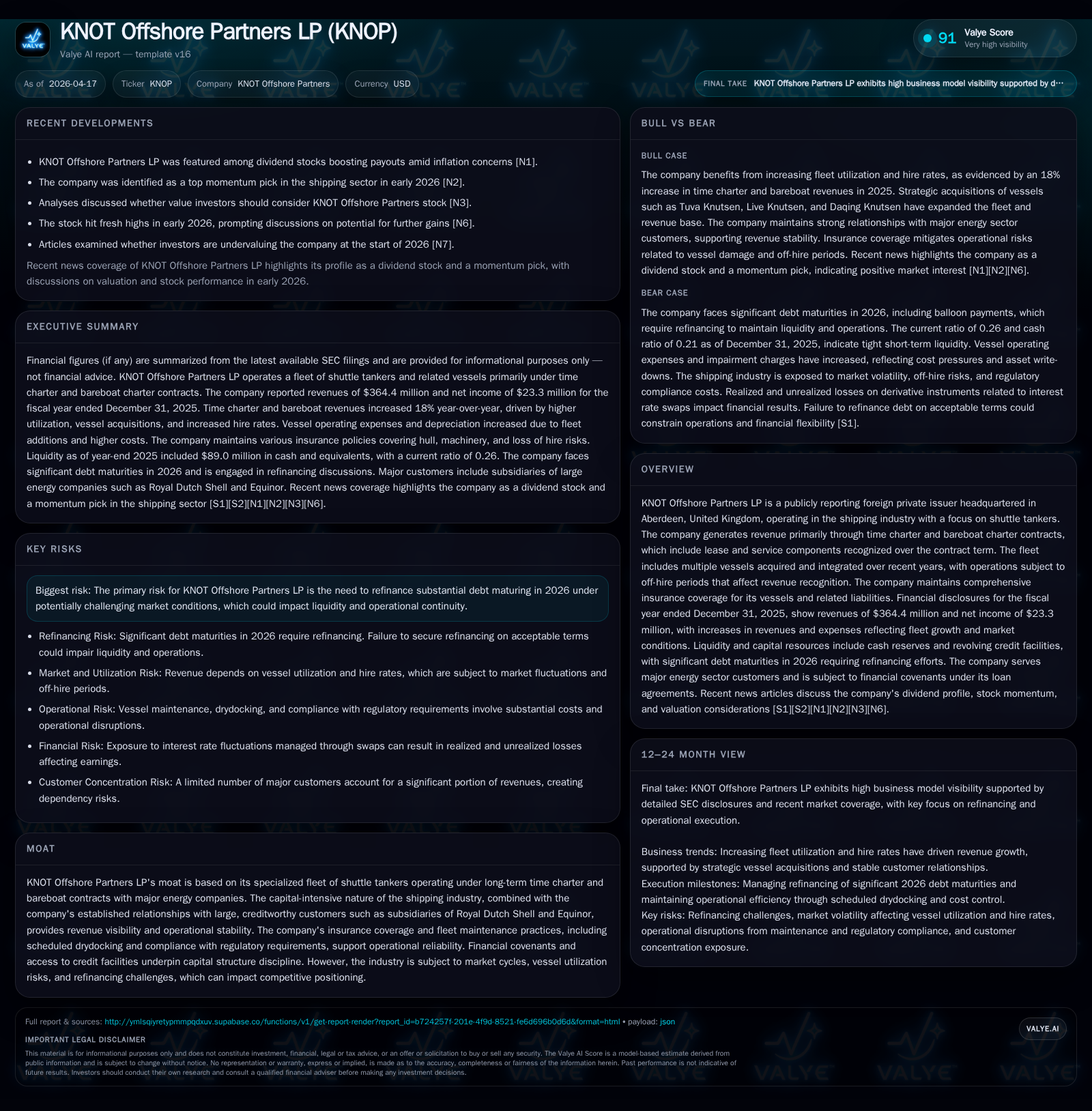
KNOT Offshore Partners LP (KNOP) has demonstrated steady revenue growth driven by strategic fleet expansion and long-term charter contracts with major energy clients. The company’s accounting of lease and service revenue components supports predictable cash flows, reinforced by rigorous operational practices including drydocking and insurance coverage. Despite solid profitability and increased operating cash flow, KNOP faces significant debt maturity obligations in 2026 requiring refinancing under competitive market conditions. Maintaining covenant compliance and liquidity will be critical as the partnership balances expansion ambitions with capital structure discipline.
Historical Financial Growth: Revenue and Earnings Trends
KNOT Offshore Partners LP exhibited consistent financial improvement from 2022 through 2025. Revenue rose from approximately $268.6 million in 2022 to $364.4 million in 2025, reflecting a 14.4% increase year-over-year between 2024 and 2025 [F1]. Operating income increased to $84.65 million in 2025, up 16.1% from the prior year’s $72.92 million [F1]. This followed a rebound after a dip in operating income in 2023.
Net income reversed previous losses to post $23.3 million in 2025, a 65% increase over $14.07 million recorded in 2024 [F1]. Operating cash flow also grew nearly 14% year-over-year to $155.7 million, supporting strong internal liquidity [F1]. These improvements align with fleet acquisitions and renewed charter contracts expanding revenue and improving margins.
Historical performance (annual)
| FY | Rev ($mm) | Net ($mm) | CFO ($mm) | OpInc ($mm) | Rev YoY | Net YoY |
|---|---|---|---|---|---|---|
| 2025 | 364 | 23 | 156 | 85 | +14.4% | +65.4% |
| 2024 | 319 | 14 | 137 | 73 | +9.6% | +141.0% |
| 2023 | 291 | -34 | 132 | 25 | +8.2% | -158.5% |
| 2022 | 269 | 59 | 101 | 66 |
Source: SEC companyfacts cache [F1].
Approximate free cash flow (FCF) calculated as operating cash flow less estimated capital expenditures; exact capex not detailed [F1].
Fleet Composition and Operational Drivers
KNOP operates a specialized shuttle tanker fleet primarily under long-term charters to major energy companies [S1]. Recent acquisitions include Tuva Knutsen (September 2024), Live Knutsen (March 2025), and Daqing Knutsen (July 2025), significantly expanding capacity [S6][S18]. Vessels undergo scheduled drydockings every five years until age fifteen, then every thirty months thereafter to maintain regulatory compliance—critical for operational availability [S1].
Off-hire periods—when vessels are unavailable due to maintenance or repairs—suspend hire payments under time charters but incur costs partially borne by KNOP [S1]. Loss of hire insurance protects earnings beyond fourteen days of off-hire up to six months per vessel [S1].
The fleet mix includes time charters combining lease and service elements alongside bareboat charters treated solely as operating leases without off-hire provisions, requiring careful fleet management to minimize downtime [S1].
Charter Contracts: Revenue Recognition Nuances
KNOP’s revenues stem predominantly from long-term time charters blending lease components recognized on a straight-line basis over contract terms with service revenues recognized over time as services are delivered [S1][S24][S26]. Major clients include subsidiaries of Royal Dutch Shell and Equinor.
Bareboat charters provide full vessel control to charterers at fixed daily rates recognized evenly over contract duration without off-hire allowances [S1]. Spot voyage revenues occur sporadically but represent a minor share.
Revenue excludes periods when vessels are off-hire under time charters since no hire accrues then; bareboat charters do not allow off-hire adjustments [S1]. This hybrid approach supports forward earnings visibility while managing operational variability.
Capital Structure Overview and Debt Maturity Profile
As of December 31, 2025, KNOP held approximately $959.6 million in interest-bearing debt across multiple secured term loan facilities backed by mortgages on vessels [S19]. Notable facilities include:
- A $345 million loan facility maturing September 2026 with a balloon payment of approximately $220 million,
- A $240 million facility maturing June 2028 repayable quarterly,
- Several other secured loans maturing between late-2026 to beyond-2030 tied to individual vessels such as Synnøve Knutsen ($71M) due October 2030 .
Financial covenants consistently require minimum liquidity thresholds (e.g., $15 million base plus increments based on vessels nearing contract expiration), positive working capital excluding short-term installments on long-term debt, minimum book equity ratio around 30%, and EBITDA-to-interest coverage above roughly 2.5x [S4][S7][S12].
Refinancing risk centers on approximately $383 million of principal maturing in calendar year 2026 concentrated on loans secured against five shuttle tankers including the Tordis Knutsen group vessels [S20][S15]. Management is engaged in negotiations but acknowledges uncertainty given credit market dynamics.
Liquidity Position and Covenant Compliance
At fiscal year-end 2025, cash totaled about $89 million augmented by roughly $48 million undrawn revolving credit lines providing near-term liquidity exceeding $137 million [F1][S10]. However, current liabilities substantially exceeded current assets resulting in a low current ratio near .26 largely due to balloon payments falling due within twelve months [$426M current liabilities vs ~$111M current assets] [F1].
All borrowing covenants were met at year-end with active focus on maintaining liquidity buffers tied dynamically to charter contract tenors ensuring compliance amid variable expenses like drydockings or voyage costs [S11][S15]. Breaches could trigger mandatory prepayments or facility cancellations.
Dividend Policy and Shareholder Returns
Dividends have been consistently paid supporting shareholder returns while balancing capital retention for growth initiatives [N1][F1]. Recent dividend increases reflect investor demand for yield amid inflationary pressures [N1].
Share repurchases have occurred modestly relative to dividend distributions indicating prioritization of dividend payouts over buybacks given capital allocation preferences for fleet investments and debt servicing [F1].
Outlook: Navigating Refinancing Risks Amid Steady Operations
Future prospects hinge on sustained vessel utilization within niche shuttle tanker markets serving offshore oil production primarily in Brazil and the North Sea where client counterparties exhibit credit strength supporting contract renewals [S24][N1].
Significant debt maturities concentrated in late 2026 pose refinancing challenges that will shape capital structure decisions; management expresses confidence based on historic refinancing success but notes no guarantee given evolving interest rate environments and lender appetites [S15][N1].
Scheduled drydockings will require sizable capital outlays impacting free cash flow while any unplanned off-hire could disrupt expected hire receipts warranting close monitoring.
Key Metrics for Upcoming Monitoring Periods
Investors should track:
- Progress on refinancing negotiations addressing ~$383 million maturing debt in late 2026,
- Vessel utilization rates including off-hire days affecting hire revenue accruals,
- Timing and cost execution of scheduled drydockings within next twelve months,
- Renewal outcomes for expiring long-term charters indicating revenue stability,
- Quarterly operating margin trends reflecting voyage expense variations or changes in borrowing costs,
- Leverage ratios post-refinancing affecting covenant headroom.
These indicators will illuminate KNOP’s ability to sustain momentum while managing concentrated debt refinancing risks.
This analysis relies exclusively on verifiable data from KNOT Offshore Partners LP SEC filings through December 31, 2025 ([F1], [S#]) alongside recent market reporting ([N1]). No investment advice or price forecasts are included.
Disclaimer: This is research-only, informational analysis and not investment advice. It may include AI-generated interpretation and general industry context. Always verify important details using primary sources.

Comments