
Hall Chadwick Acquisition Corp’s $207M Trust Sparks Focused Pursuit in Tech and Critical Minerals
HCAC, a Cayman Islands blank check company, raised over $213 million in late 2025 aiming to combine with firms in technology, energy, and critical minerals sectors.
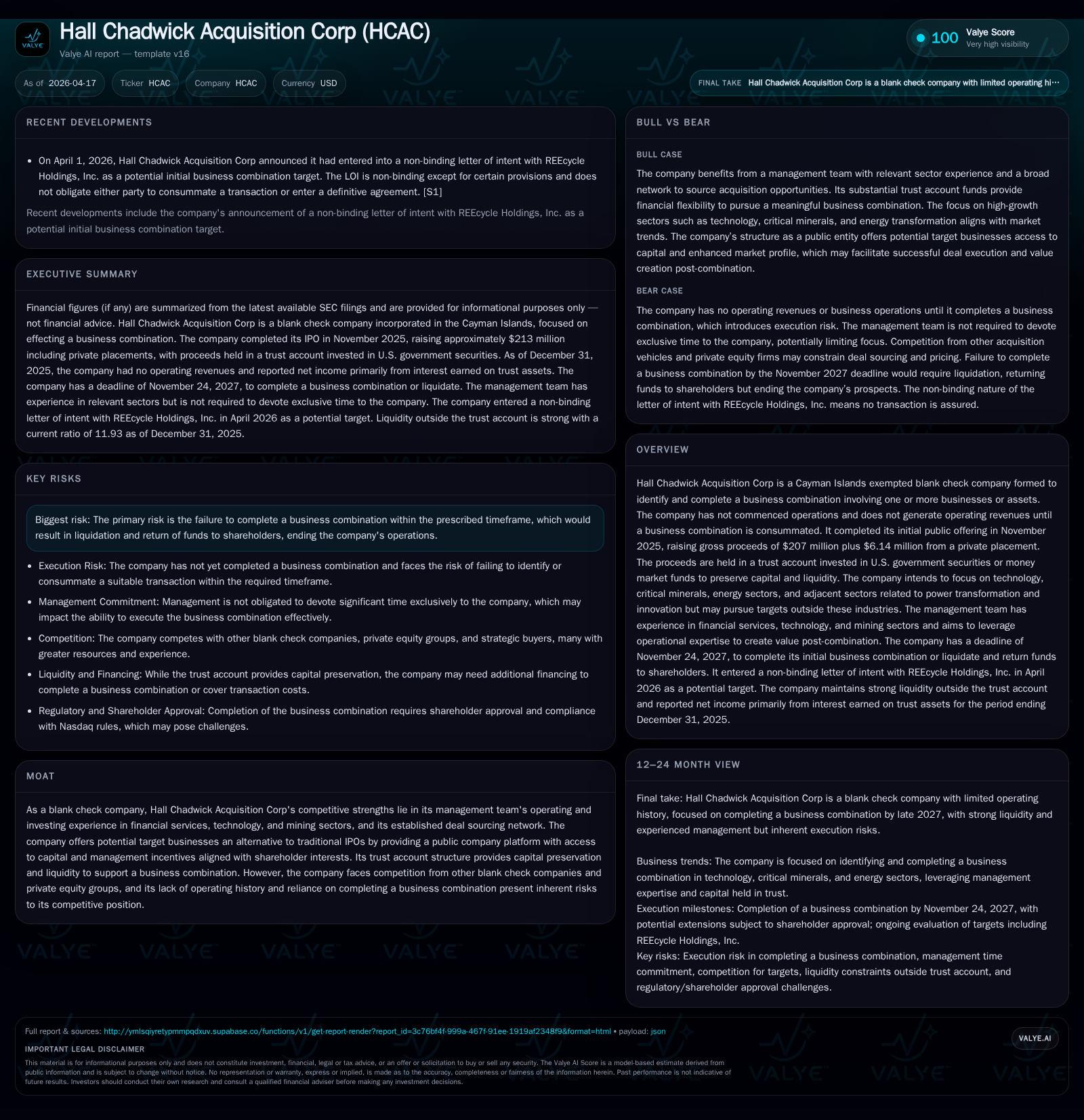
Hall Chadwick Acquisition Corp (HCAC) emerged as a special purpose acquisition company (SPAC) in late 2025, raising $207 million through its IPO along with additional private placement proceeds. The company has not yet generated operating revenue and exists primarily to identify and complete a business combination within two years. Its management team leverages experience in financial services, technology, and mining to target growth sectors including technology transformation, critical minerals, and energy innovation. With over $207 million secured in a trust account invested conservatively, the firm is positioned for flexibility but faces inherent risks typical of SPACs related to deal completion timelines. HCAC’s near-term milestones include progressing from a non-binding letter of intent signed in April 2026 towards consummating a business combination that meets Nasdaq’s valuation criteria.
Overview and Business Model
Hall Chadwick Acquisition Corp (HCAC) is a Cayman Islands exempted blank check company formed on May 22, 2025, with the sole purpose of effecting an initial business combination. The company raised gross proceeds of approximately $207 million through an initial public offering (IPO) on November 24, 2025, selling 20.7 million units at $10 each. Concurrently, it raised about $6.14 million from private placement units sold to insiders (Hall Chadwick Capital LLC and CCM). The total proceeds (net of a $13.55 million aggregate in offering expenses) are held in a trust account invested primarily in U.S. government securities and money market funds to maintain capital preservation and liquidity until consummation of the business combination [S1][S9][S25].
HCAC has not commenced operations nor generated revenues since inception; all value creation depends on identifying and completing an acquisition within approximately two years after IPO [S1]. Management has focused on sectors tied to technology innovation, critical minerals vital for electrification and renewable energy transitions, and adjacent areas relating to power transformation. However, the company is not restricted from pursuing targets outside these verticals [S1][S13].
Historical Performance and Financials
As a SPAC without active operating businesses prior to closing a transaction, HCAC's results consist mainly of interest income earned on the trust account balanced against operating expenses associated with being a public entity.
Historical performance (annual)
| FY |
|---|
| 2025 |
Source: SEC companyfacts cache [F1].
- Operating loss of $133K reflects formation costs offset by interest income.
- Net income positive at ~$653K driven by interest on marketable securities ($786K), less operational expenses [F1].
- Cash flow from operations used $195K primarily for administrative expenses.
- Cash held outside the trust account totaled approximately $631K at year-end for working capital needs; the trust account held over $207 million [F1][S6][S9].
The company's current ratio stands strong at almost 12x reflecting negligible liabilities (just over $59K) versus current assets (~$711K), highlighting ample short-term liquidity excluding the trust [F1].
ROE calculates negatively at -9.6%, consistent with startup-phase investment losses vs equity base [F1]. Given no revenue-generating operations this metric is largely irrelevant until post-acquisition performance unfolds.
Future Growth Prospects
HCAC’s potential growth hinges entirely on consummating a value-accretive merger or acquisition with one or more target companies that fit its strategic focus. The management team will look for businesses demonstrating:
- Strong leadership teams aligned with long-term shareholder value creation.
- Near-term inflection points such as product innovation cycles or operational scaling opportunities.
- Potential for organic growth combined with inorganic add-on acquisitions.
- Market niches or differentiated competitive positions which create barriers to entry.
- Financial profiles supporting cash flow growth and margin expansion.
A major development was the April 1, 2026 announcement of entering into a non-binding letter of intent (LOI) with REEcycle Holdings Inc. This proposed de-SPAC transaction values REEcycle around $600 million before shareholder redemptions from HCAC’s side [S3][S10][S13]. REEcycle operates in sectors closely aligned with HCAC’s stated thematic interests (critical minerals recycling).
Successful completion would generate pro forma combined entity scale sufficient to access additional capital markets for further growth initiatives including acquisitions or expansion programs.
Key Milestones and Guidance
While explicit guidance on timing or details beyond the LOI is unavailable, key upcoming checkpoints include:
- Due diligence progress ahead of definitive agreement execution.
- Equity holder votes approving the business combination terms if required per Nasdaq rules.
- Remaining cognizance of November 24, 2027 deadline before mandatory liquidation if no deal closes [S1].
Given market volatility impacting SPAC valuations broadly, shareholder redemptions could materially affect deal economics; thus monitoring redemption rates will be critical .
The deferred underwriting fees totaling approximately $8.28 million become payable only upon successfully closing the business combination underpinning incentives aligned with deal execution [S1][S9].
Capital Structure and Returns Analysis
HCAC maintains rigorous segregation of IPO proceeds within its trust account ensuring capital preservation pending deployment into an acquisition or liquidation back to shareholders.
The company holds no long-term debt but retains flexibility via its Sponsor commitment to provide up to $2.5 million in working capital loans convertible into post-merger units if necessary for transaction-related expenses [S8][S18].
Cash balances outside the trust suffice for ongoing administrative overhead estimated between $20K-$35K monthly [S24], supporting due diligence travel and legal costs incurred pre-deal closure.
Without revenue streams at present, traditional profitability metrics remain theoretical; however, the firm’s structure as an emerging growth/smaller reporting company offers relief from extensive disclosure burdens while maintaining investor protections intrinsic to SPAC frameworks [S11][S15].
No dividends or buyback programs are applicable prior to business combination completion given absence of distributable profits or shares outstanding beyond nominal pre-IPO Class B shares held by sponsors [F1][S19].
Competitive Strengths and Risks
HCAC leverages a management team experienced across financial services, technology innovation cycles, and mining—relevant expertise given their sectoral focus helps source proprietary deals and assess valuation synergies effectively [S13][S14]. Their broad network enhances deal sourcing probability above average blank-check peers less familiar with these industries.
Nonetheless, HCAC competes against numerous other SPACs as well as private equity vehicles targeting similar themes—making speed and execution precision paramount amid compressed deal timelines .
Principal risk remains failing to consummate an initial business combination within mandated timeframe leading to forced liquidation returning principal less any permitted deductions—inherently limiting upside absent successful deal closure [S1][S20]. Furthermore:
- Market fluctuations impacting target valuations or financing conditions;
- Potential misalignment between public investor expectations vs post-merger operational realities;
- Sponsor conflicts or dilution if working capital loans convert into equity;
- Regulatory uncertainties affecting transaction approvals.
These factors collectively emphasize HCAC’s current trajectory as contingent mostly on near-term transactional success rather than organic operations.
Summary Table: Annual Financial Highlights (USD)
| FY | Operating Income | Net Income | Cash Outside Trust | Trust Account Balance | Current Assets | Current Liabilities |
|---|---|---|---|---|---|---|
| 2025 | -133,353 | 652,923 | 631,366 | ~207.79M | 710,677 | 59,550 |
| Operating income negative reflects formation costs; net income positive driven by interest accrued on trust investments. |
Conclusion
Hall Chadwick Acquisition Corp currently serves as a well-capitalized blank check entity strategically positioned to pursue transformative acquisitions within high-growth technology-enabled sectors critical to energy transition and innovation ecosystems. While lacking operational history or revenue streams typical of traditional companies hampers financial metric relevance now, the sizable IPO trust plus management’s sector experience provide important structural advantages. Nonetheless vigilance around execution risks including deal timing constraints remains essential going forward as HCAC pushes toward closing its first business combination potentially redefining its path from nascent SPAC toward operating enterprise.
This report is intended solely for informational purposes based on publicly available data as of April 17, 2026. It does not constitute investment advice or recommendations.
Disclaimer: This is research-only, informational analysis and not investment advice. It may include AI-generated interpretation and general industry context. Always verify important details using primary sources.

Comments