
ZTO Express’s Strategic Network Pipeline Supports Resilient Growth Trajectory
ZTO Express leverages its extensive network infrastructure, capital discipline, and diversified service mix to sustain growth despite competitive and regulatory headwinds.
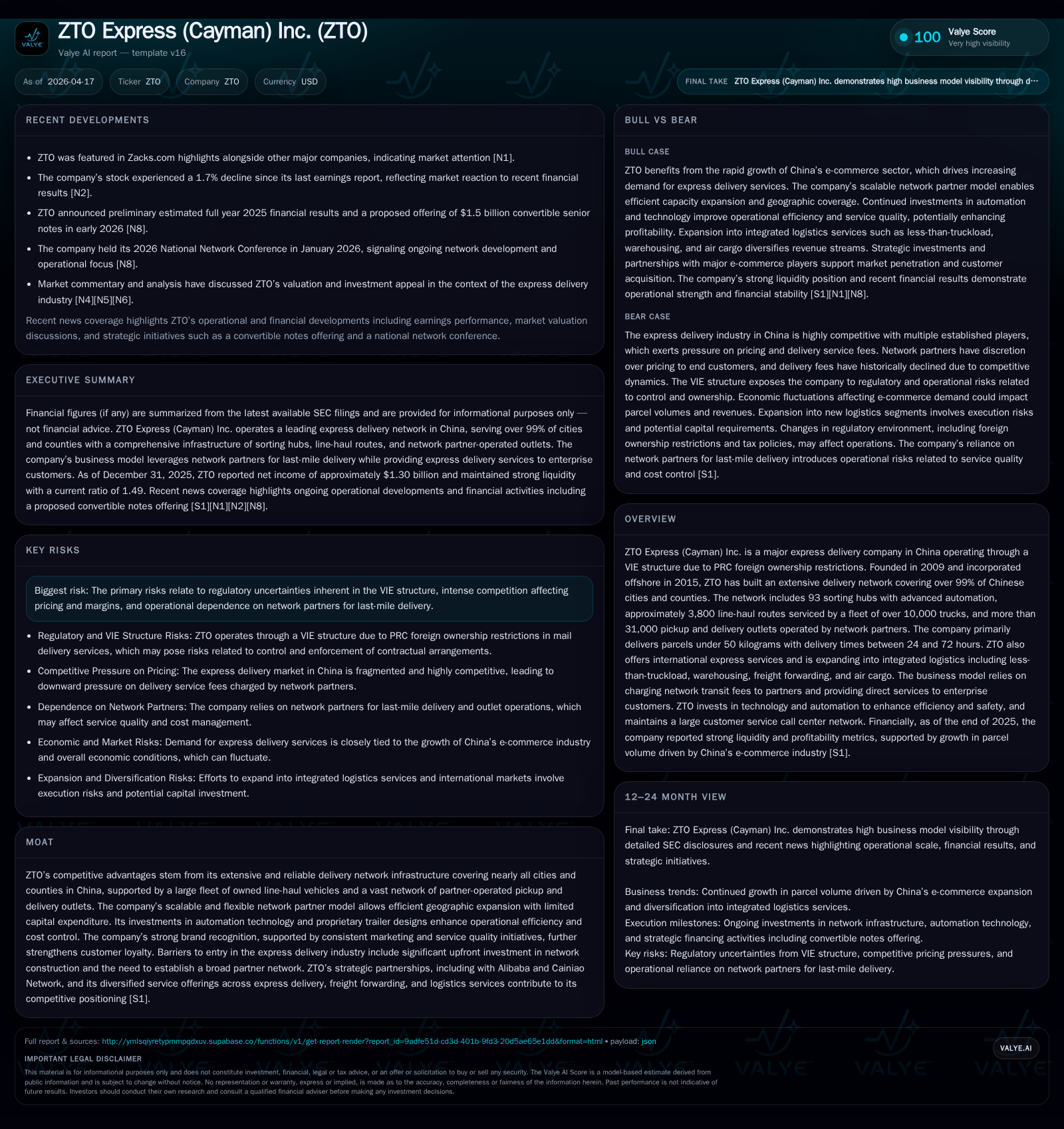
ZTO Express (Cayman) Inc., a leading Chinese express delivery firm operating via a VIE structure, reported strong top-line growth of 42.4% in 2025 driven by parcel volume expansion and network scale. Margin pressures persist amid stiff pricing competition and increasing operating costs, reflected in a 7.2% decline in operating income despite rising net income. The company is pursuing integrated logistics services such as less-than-truckload shipments and international freight forwarding to diversify revenue streams. Capital allocation balances measured capex with robust free cash flow generation supporting dividends and share buybacks, underpinning an approximate 13.7% ROE. Key near-term focus areas include navigating regulatory uncertainties tied to the VIE framework and ongoing expansion of logistics capabilities.
Foundations of Growth: Historical Revenue and Margin Drivers
ZTO Express has demonstrated a robust growth arc characterized by a substantial increase in revenues alongside margin pressures that reflect evolving market dynamics. In the fiscal year ending December 31, 2025, consolidated revenue climbed impressively by approximately 42.4% compared with the prior year [F1]. This surge was driven largely by expanded parcel volumes supported by ZTO’s vast delivery infrastructure which extends coverage to over 99% of cities and counties across China [S4].
However, this top-line acceleration was accompanied by a contraction in operating income, which fell by about 7.2% compared to 2024 [F1]. The decline juxtaposes the pricing environment where intense competition among express delivery providers pressured network partners’ delivery service fees charged to shippers downward [S5]. Concurrently, cost inflation factors influenced margins; labor-related expenses increased partly due to wage hikes while investments in automation led to higher depreciation charges within sorting hubs [S6]. For context, net income still progressed positively with a rise of roughly 7.5%, emphasizing operational scale advantages partially offsetting compressed operating margins [F1].
Table: Historical Annual Financial Performance
Historical performance (annual)
| FY | Net ($mm) | CFO ($mm) | OpInc ($mm) | Capex ($mm) | Net YoY |
|---|---|---|---|---|---|
| 2025 | 1299 | 1711 | 1498 | 746 | +7.5% |
| 2024 | 1208 | 1566 | 1613 | 714 | -2.0% |
| 2023 | 1232 | 1882 | 1410 | 920 | +24.8% |
| 2022 | 987 | 1664 | 1122 | 1025 |
Source: SEC companyfacts cache [F1].
Capital returns and efficiency (annual)
| FY | Div ($mm) | Buybacks ($mm) | FCF ($mm) |
|---|---|---|---|
| 2025 | 179 | 966 | |
| 2024 | 768 | 159 | 852 |
| 2023 | 292 | 142 | 962 |
| 2022 | 192 | 12 | 640 |
Source: SEC companyfacts cache [F1].
Notes: All financials are full-year totals; revenue for years other than 2017 not explicitly available but YoY changes indicate growth magnitude per [F1]. CFO is Operating Cash Flow; Capex is capital expenditure.
Decoding the Network Effects: Operational Backbone and Unit Economics
ZTO's operational model capitalizes on an extensive and hybrid network structure combining directly owned sorting hubs and line-haul vehicles with a broad partner-operated last-mile outlet system [S4]. Its network includes approximately 93 advanced sorting facilities enhanced with automation technologies that reduce per parcel handling times while improving throughput.
The unit economics hinge critically on "network transit fees" charged from ZTO to its network partners who run pickup and delivery outlets across China’s diverse regions [S5]. These partners maintain full discretion over their local pricing strategies based on economic conditions and competitive intensity; this flexible fee sharing mechanism accommodates regional market variations but also introduces variability in unit yields [S4]. The last-mile delivery fees paid to partners constitute a significant cost component typically passed through from shippers.
Efficiencies arise from ZTO's increasing fleet ownership—especially high-capacity trailer trucks—boosting load factors on line-haul routes thereby lowering unit transportation costs despite stable absolute spending levels on logistics [S6,S16]. Additionally, sorting hub cost per unit lowered marginally as automation offsets incremental wage inflation.
Beyond express parcel services under 50 kilograms with next-day or two- to three-day delivery windows domestically [S4], ZTO pursues diversification through less-than-truckload (LTL) heavy cargo shipments and freight forwarding especially within key Southeast Asian and African corridors [S4,N9]. The recent acquisition of China Oriental Express enhances cross-border freight forwarding capabilities serving Hong Kong-Shenzhen gateways offering integrated solutions beyond parcel delivery [N3,S4]. This multi-pronged approach reflects growing attention to balancing the challenges of declining unit parcel prices against new higher-margin logistics verticals.
Facing Market Forces: Competition, Pricing Dynamics, and Regulatory Risks
The competitive landscape is notably fierce with established rivals such as YTO Express, STO Express, SF Express as well as platform-own logistics like JD Logistics vying aggressively on price and service quality [S22]. This relentless competition compresses delivery fees partners can charge end customers forcing downward adjustments in ZTO's network transit fees although allowing corresponding tiered flexibility at local partner level [S5,S22]. Larger e-commerce giants may also increasingly internalize logistics functions posing additional threat to third-party operators like ZTO.
Regulatory caution arises primarily from the company's reliance on a Variable Interest Entity (VIE) contractual structure mandated by PRC restrictions on foreign ownership in mail delivery services [S1,S9]. Legislation such as the Overseas Listing Trial Measures imposed in 2023 require filings with Chinese regulators for overseas listing activities that add compliance complexity [S9,S24]. Furthermore, the Holding Foreign Companies Accountable Act (HFCAA) presents risks linked to audit inspection access given PCAOB's historical difficulties inspecting auditors based in mainland China; while recent improvements have avoided immediate delisting risk for ZTO’s shares presently traded on US exchanges [S9].
Operational dependency on network partners creates execution vulnerabilities — partner attrition or failure could disrupt last-mile service continuity impacting customer satisfaction and hence reputational capital critical to differentiation in this sector [S22]. Meanwhile strict cybersecurity regulations necessitate continued investments ensuring data protection given sensitivity of customer information handled across platforms [S9,S24].
Integrated Logistics Ambitions: Building Beyond Parcel Delivery
In response to structural price pressures within core express parcel offerings, ZTO strategically pivots toward integrated logistics encompassing LTL shipments targeting bulky freight markets domestically alongside burgeoning international routes notably Southeast Asia and Africa where e-commerce penetration is rising but less mature internationally [N9,S4]. Warehousing services complement this portfolio extension offering end-to-end distribution solutions facilitating customer retention.
Air cargo represents another expanding segment reflecting demand for premium faster freight solutions aligning with ZTO's ambitions beyond traditional ground-based express parcels [S4,N3]. The freight forwarding segment acquired through China Oriental Express bolsters cross-border connectivity between mainland China’s manufacturing bases and global trade hotspots leveraging Hong Kong’s logistics hub status [N3].
These initiatives are carefully calibrated attempts to leverage ZTO’s core competencies—their dense domestic network infrastructure combined with digital platform capabilities—for capturing adjacent markets characterized by distinct unit economics less susceptible to commodity-like price erosion seen in mass parcel transport [N9,S21]. Nonetheless these expansions entail execution risks including client acquisition hurdles and operational integration complexities as well as potential incremental capital spending requirements.
Reinvestment Strategy, Capital Deployment, and Shareholder Returns
Despite capital expenditure demands averaging approximately $745 million annually driven largely by upgrading sorting hubs' automation technology and modernizing the line-haul fleet favoring fuel-efficient high-load vehicles, ZTO consistently generates strong operating cash flow which exceeded $1.7 billion in 2025 representing a roughly 9.3% increase year-over-year [F1,S17]. This translated into substantial free cash flow approximating $966 million enabling balanced reinvestment alongside shareholder returns.
Since instituting a semiannual dividend regime starting March 2024 targeting payout ratios above 40% of distributable profits from prior years’ adjusted net income—with an enhanced total return policy encompassing both dividends and share repurchases aiming for an aggregate minimum of 50% annual adjusted net income—the company has materially ramped distributions paying out around $768 million dividends in 2024 while repurchasing shares worth $179 million in calendar year 2025 [F1,S17].
Equity bases expanded moderately reflecting retained earnings accumulation resulting in an estimated return on equity near 13.7%, signaling effective capital utilization amid reinvestment cycles according to reported figures [F1]. Structural constraints exist stemming from PRC foreign investment laws restricting direct capital movements from offshore parent entities into domestic affiliates complicating liquidity management but these are mitigated through contractual arrangements typical of VIE frameworks employed across numerous Chinese technology-linked companies [S1,S14,S17].
What to Watch: Upcoming Milestones and Potential Catalysts
Key forthcoming events include the Annual General Meeting slated for June 16, 2026 during which governance developments may be disclosed providing enhanced clarity on oversight particularly given pressures related to compliance with evolving PRC listing regulations [S3,N1]. Market participants should monitor ongoing margin trajectories as ability to manage cost inflation versus pricing intensity remains pivotal.
Expansion metrics relating to integrated logistics footprints such as LTL volume growth or air cargo segment profitability could signal success or challenges around diversification strategies pursued since late-stage maturity signals within core express parcels warrant exploration of adjacent markets [N9,N13,S21]. Regulatory developments around VIE listings remain material; any shifts impacting permissible overseas listings or audit inspection regimes under HFCAA may significantly affect share liquidity status at U.S exchanges warranting close observation [S9,S24,N1].
Finally sustainability efforts aligned with corporate social responsibility initiatives leveraging technology-driven efficiency improvements might emerge as qualitative differentiators supporting brand reputation amongst increasingly discerning merchants reliant on reliable logistic infrastructures [S20].
This analysis synthesizes publicly available financials filed with U.S. SEC alongside corporate disclosures without extrapolations or speculative forecasts. It offers insight into ZTO Express’s operational model nuances amid China's complex regulatory environment without providing investment advice or recommendations.
Disclaimer: This is research-only, informational analysis and not investment advice. It may include AI-generated interpretation and general industry context. Always verify important details using primary sources.

Comments