
Greenway Technologies Grapples with Financial Strain While Advancing Proprietary GTL Innovations
Greenway Technologies faces acute liquidity constraints as it pushes forward with its patented gas-to-liquids systems aiming for commercialization.
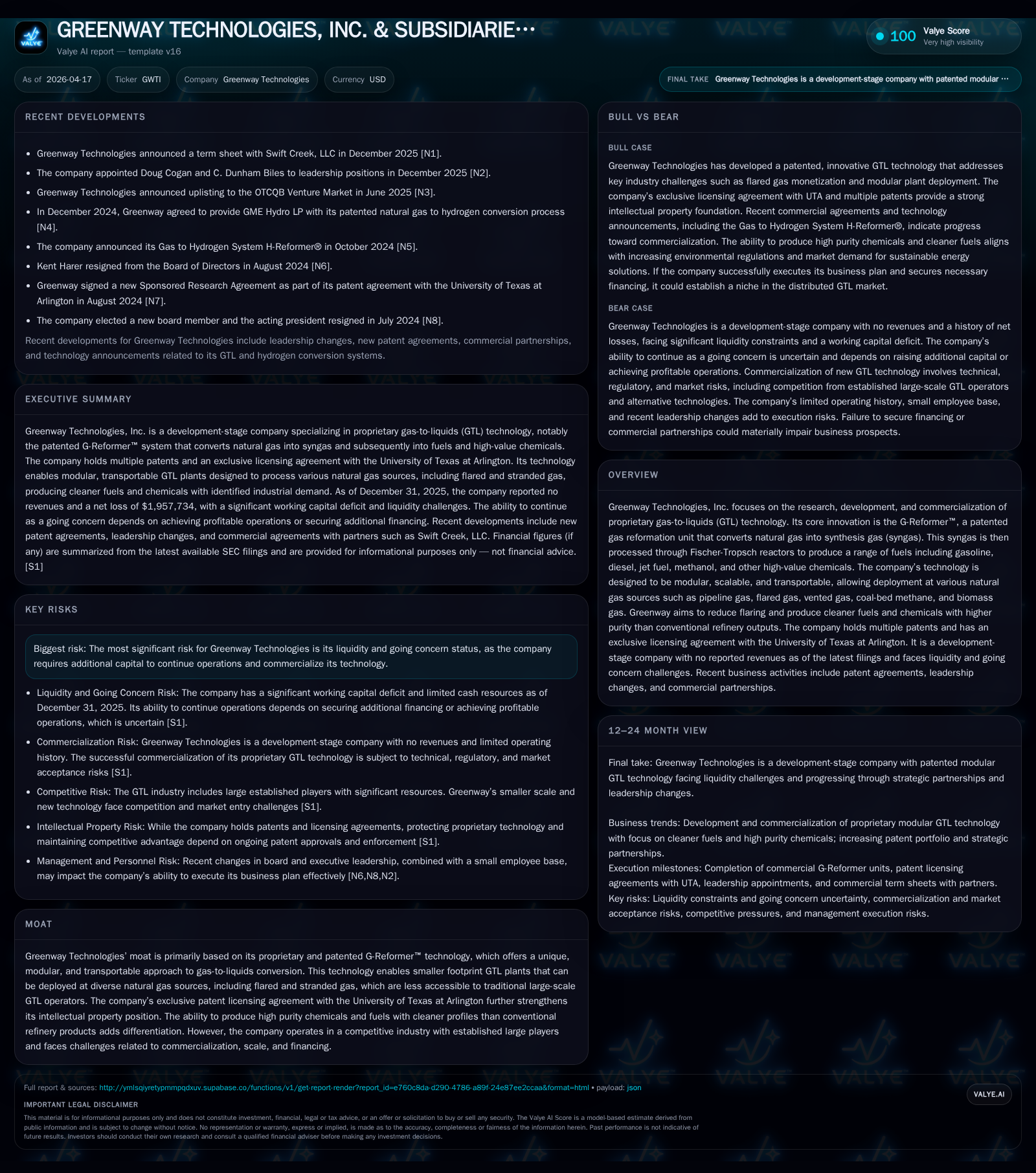
Greenway Technologies, Inc. is pioneering modular gas-to-liquids (GTL) technology via its patented G-Reformer™, designed to convert diverse natural gas sources into cleaner fuels and chemicals. Despite technological promise backed by multiple patents and university partnerships, the company has yet to generate revenue and continues to incur substantial operating losses and negative cash flows. Its capital structure is strained by high current liabilities exceeding $14 million, negligible cash reserves, and persistent liquidity risks, forcing management to seek additional financing amidst ongoing legal settlements and operational hurdles. The near-term outlook hinges critically on securing funding, achieving third-party certifications, and closing commercial deals.
Innovative Gas-to-Liquids Technology and Patent Stronghold
Greenway Technologies operates within an emerging niche of modular gas-to-liquids (GTL) conversion technology aimed at converting low-value natural gas streams into cleaner liquid fuels and chemicals. Central to its offering is the proprietary G-Reformer™, a gas reformation unit employing Fractional Thermal Oxidation™ (FTO™), patented under U.S. patents issued in 2013 and 2014. This unit converts various types of natural gas—including pipeline gas, flared/vented emissions, coal-bed methane, and biomass-derived gases—into synthesis gas (syngas). When paired with Fischer-Tropsch reactors and catalysts, this syngas enables the production of gasoline, diesel, jet fuel, methanol, hydrogen, and high-value specialty chemicals such as n-Hexane through n-Tridecane alcohols.
The technology's modularity distinguishes it from traditional large-scale GTL plants which typically require extensive infrastructure and are economically viable only at scale. Greenway's patented design allows for transportable micro-plant deployment sized specifically to stranded or flared gas sites—a critical advantage given the industry's push to reduce flaring for environmental compliance. The company has also cultivated a strong IP position through exclusive licensing agreements with the University of Texas at Arlington (UTA), where significant validation testing took place in its Conrad Greer Laboratory setting. However, Greenway remains in development stage without revenue-generating operations or commercial-scale sales deployments as of the latest filings [S1], [S25].
Financial Trajectory: Persistent Losses Amid R&D Investment
Financial data underscores Greenway’s status as a research-heavy developmental enterprise facing mounting operational expenses without offsetting revenues. Over fiscal years 2022 through 2025, the company reported zero revenues consistently while posting growing operating deficits: operating income deteriorated from approximately -$942k in 2022 to -$3.7 million in 2025—a severe annual decline of roughly 313% between 2024 and 2025. Net losses followed a similar trend escalating by about 29% year-over-year to nearly $2 million in 2025.
Operating cash outflows rose sharply (about -60% YoY), reaching roughly -$710k as of FY2025 despite no capital expenditures being recorded for recent years. This reveals continued high burn rates predominantly driven by R&D expenses ($1.2 million incurred in 2025 compared to just $50k in prior year) aimed at advancing technology readiness levels and preparing for commercialization efforts.
Historical performance (annual)
| FY | Net ($) | CFO ($) | OpInc ($mm) | Net YoY |
|---|---|---|---|---|
| 2025 | -1957734 | -710289 | -4 | -29.3% |
| 2024 | -1513568 | -444223 | -1 | +4.2% |
| 2023 | -1580735 | -302663 | -1 | -4.5% |
| 2022 | -1512692 | -496654 | -1 |
Source: SEC companyfacts cache [F1].
Capital returns and efficiency (annual)
| FY | ROE% |
|---|---|
| 2025 | 13.9 |
| 2024 | 11.6 |
| 2023 | 13.1 |
| 2022 | 14.1 |
Source: SEC companyfacts cache [F1].
These financial trends are typical of early-stage technology developers heavily investing in product validation but highlight sustainability concerns absent revenue growth or significant capital infusion [F1], [S13].
Capital Structure and Liquidity Risks Shaping the Horizon
Greenway’s balance sheet reflects acute liquidity stress threatening short-term survival without rapid capital procurement. Total current liabilities stood at approximately $14.13 million at year-end 2025—all classified as current—while total current assets summed to just $46,753 primarily representing prepaid expenses rather than liquid cash reserves. Critically, cash on hand was reported at a scant $850.
This imbalance yields a near-zero current ratio signaling high risk of insolvency if new financing does not materialize swiftly. Notes payable are heavily weighted toward interest-bearing debt from related parties; convertible notes were fully settled during the period reducing that exposure.
Management has publicly acknowledged ongoing efforts to raise capital through equity offerings or debt issuances but cautions these processes are lengthy with uncertain outcomes—an existential challenge compounded by market conditions for penny stocks characterized by volatility and limited liquidity on OTCQB exchange.
Legal proceedings have added layers of contingent liabilities exceeding $950k relating to past litigation settlement obligations with founders and affiliates further constraining financial flexibility.
Absent successful fundraising or operational breakthroughs yielding positive cash flows, Greenway faces jeopardy on meeting financial obligations including interest payments secured against vital intellectual property collateral underpinning its core technology platform [F1], [S4], [S7], [S9], [S14], [S16].
Obstacles on the Path to Commercial Deployment
Beyond financing hurdles lie substantial operational barriers typical for firms pioneering novel energy technologies targeting disruptive alternatives to incumbent refinery processes.
Greenway must obtain third-party engineering certifications essential for customer validation—a prerequisite before wide-scale licensing or product sales can occur. Regulatory clearances related to environmental standards for synthetic fuels remain potential gatekeepers imposing both cost burdens and timelines outside direct control.
Customer acquisition presents challenges given entrenched preferences within oil & gas operators accustomed to traditional GTL suppliers offering established economies of scale.
Moreover, absence of directors’ and officers’ liability insurance due to market rate surcharges heightens governance concerns potentially impairing recruitment of experienced board members needed for governance robustness amid expanding commercial complexity.
Litigation histories involving former executives have resulted in ongoing legal payments structured over multiple years adding uncertainty that could distract management focus from core development objectives during this critical juncture of business maturation [S1], [S5], [S12].
Evaluating Growth Potential Against Industry Competition
Economically, Greenway’s value proposition hinges on arbitrage opportunities created by discrepancies between oil pricing benchmarks ($30–60 per barrel range modeled internally) versus lower-cost abundant natural gas resources often flared due to lack of nearby infrastructure.
This model theoretically unlocks economic returns unavailable to traditional large-scale GTL producers tied to centralized mega-facilities demanding massive upstream integration.
However the zero reported project revenues underscore that these macroeconomic tailwinds have yet to translate into realized growth or commercial scale implementations; competitive pressure remains fierce from incumbents with deeper pockets who may innovate or price aggressively against modular entrants.
Greenway’s strategic focus on licensing smaller independent oil & gas operators as early adopters reflects a niche market penetration approach though success depends heavily on navigating complex commercial contracts amid volatile commodity markets affecting operator capital spending patterns.[F1], [S1], [S6],[S25].
Strategic Capital Allocation and Shareholder Return Policies
The company maintains conservative capital allocation policies reflective of its developmental state without dividend payments or share buyback programs available given ongoing losses and negative free cash flow dynamics.
Equity issuances form the backbone of funding alongside some convertible debt historically used for bridging operational needs.
Approximated ROE measured by dividing FY2025 net loss by shareholders' deficit results in about +13.9%, an accounting artifact indicating net loss relative to deeply negative equity rather than positive profit generation or return enhancement.
Further complexity arises due to accrued liabilities toward former insiders totaling around $1.67 million integrated within total consolidated liabilities impacting perceived shareholder value stability.[F1],[S19],[S23]
Disclaimer: This is research-only, informational analysis and not investment advice. It may include AI-generated interpretation and general industry context. Always verify important details using primary sources.

Comments