
Niu Technologies Sustains E-Scooter Sales Growth Amid Regulatory and Competitive Pressures
NIU's mixed financial results reflect product portfolio shifts, operational efficiencies, and evolving China market dynamics.
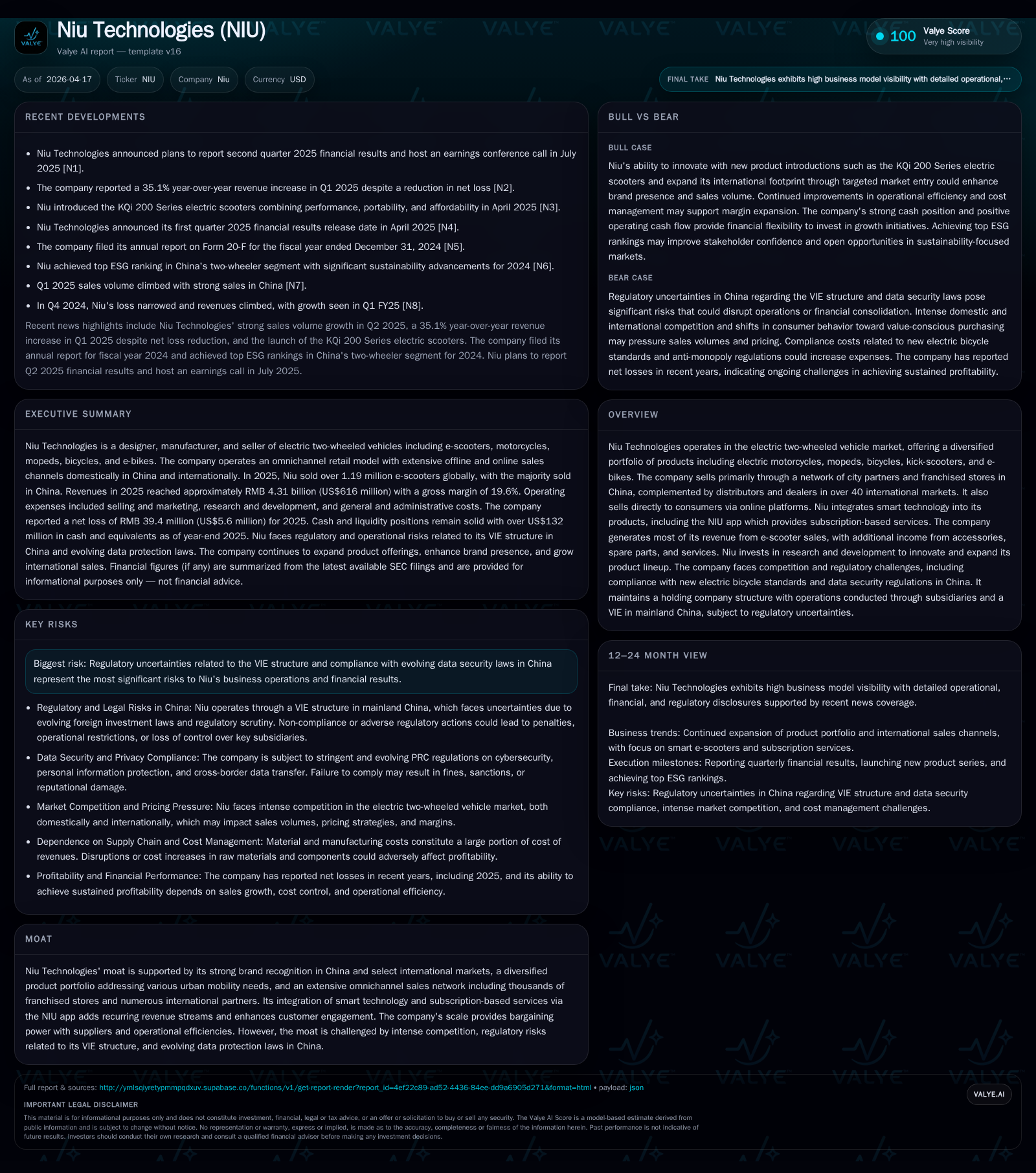
Niu Technologies operates a diversified electric two-wheeled vehicle portfolio with a strong China-focused presence complemented by over 40 international markets. The company returned to growth in 2024 and expanded e-scooter sales significantly in 2025 despite regulatory challenges including the New Electric Bicycle Standard impacting compliance costs. NIU’s revenues grew 31% in 2025 on higher domestic sales and new product launches, supported by improved gross margins from cost controls and product mix. Operational leverage improved, with rising operating cash flow exceeding capital expenditures for the first time in years, yet NIU remains unprofitable with a net loss narrowing to $5.6 million in 2025 from prior multi-year larger losses. Strategic focus on smart technology integration, expanding retail network and enhancing recurring app-based services underpin growth potential, though regulatory risks tied to China’s evolving data security laws and VIE structure remain significant.
Company Overview and Business Model
Niu Technologies is a prominent player in the electric two-wheeled vehicle market, offering a diverse range of products including electric motorcycles, mopeds, bicycles, kick-scooters, and e-bikes. The company's revenue depends predominantly on the sale of smart e-scooters which integrate IoT features accessible through the NIU app—a platform that drives subscription-based recurring revenues post one-year included periods.
NIU employs an omnichannel retail strategy combining offline sales through a robust network of city partners—in China alone comprising 623 city partners managing over 4,540 franchised stores across some 320 cities—and an array of international distributors, dealers, and retailers spanning more than 40 countries [S1]. Direct-to-consumer online sales augment this footprint.
Historical Performance and Growth Drivers
Between 2023 and 2025, Niu demonstrated solid unit growth across its core e-scooter segment, scaling total unit sales from approximately 709,800 to nearly 1.2 million units—representing a compound annual uplift driven mostly by domestic expansion [S1][S20]. Its product mix shifted towards premium series such as the NQi series which accounted for over 41% of total units sold in 2025 compared with only ~5.6% in 2023 [S1]. This reflects an emphasis on higher value propositions intended to capitalize on consumption upgrades despite prevalent consumer value-consciousness.
Historical performance (annual)
| FY | Net ($mm) | CFO ($mm) | OpInc ($mm) | Capex ($mm) | Net YoY |
|---|---|---|---|---|---|
| 2025 | -6 | 51 | -13 | 25 | +78.7% |
| 2024 | -26 | 7 | -34 | 16 | +30.9% |
| 2023 | -38 | 13 | -45 | 11 | -433.9% |
| 2022 | -7 | -18 | -13 |
Source: SEC companyfacts cache [F1].
Capital returns and efficiency (annual)
| FY | FCF ($mm) | ROE% |
|---|---|---|
| 2025 | 25 | -4.4 |
| 2024 | -9 | -20.7 |
| 2023 | 2 | -24.9 |
| 2022 | -3.8 |
Source: SEC companyfacts cache [F1].
Revenue growth was chiefly fueled by increasing e-scooter sales volume which rose by almost one-third in both years between FY23-FY25—924k units sold in FY24 climbing to over a million units sold domestically plus incremental international sales of ~80k units in FY25 [S1]. The domestic retail network's expansion played a pivotal role here: franchised stores increased from roughly 3,735 at end-2024 to more than 4,540 at end-2025 [S1].
Accessory and spare parts revenues trended positively but held a steady share at roughly ~7% of total revenues [S22]. Meanwhile service revenues linked primarily to the NIU app’s subscription model also grew modestly but remained below ~3% contribution [S22].
Margin Dynamics and Cost Controls
NIU experienced margin pressure during FY24 amid intense competition and regulatory changes specifically related to the full roll-out of China's New Electric Bicycle Standard that elevated compliance costs across the industry [S1]. Consequently gross margin declined noticeably from a robust ~21.5% in FY23 down to ~15.2% in FY24.
In FY25 however, operational improvements coupled with stricter control over component sourcing costs—particularly following the unwinding of lithium battery price inflation—enabled gross margin recovery back towards ~19.6% [S26]. Material cost management was supported by the company leveraging scale advantages with multiple qualified suppliers while introducing automation technologies within its manufacturing process lines [S8][S10]. Cost efficiencies reflected inversely in cost per unit trends which dipped from RMB3,018 per scooter in FY24 to RMB2,906 per scooter in FY25 [S15].
While overall selling & marketing expenses rose sharply driven mostly by heightened advertising spend and hiring primarily aimed at reinforcing brand presence amid tougher competition—these expenses as a percentage of revenue edged up only modestly to about ~15.7% [S21][S26]. Research & development efforts stabilized around ~4% of revenue supporting ongoing new product introductions aligned with shifting consumer preferences.
General & administrative expenses meanwhile witnessed significant contraction percentage-wise—from around ~9% of revenue in FY23 down to just above ~2% in FY25—largely through reductions in allowances for doubtful accounts and prudently managed staffing levels [S21][S16].
Profitability Trends & Cash Flow Outlook
Despite consistent revenue gains, Niu remains unprofitable at the operating level though operating losses have shrunk sequentially: operating losses improved from approximately $44 million negative in FY23 through $34 million negative in FY24 down to near $12 million negative last fiscal year [F1]. Net losses similarly narrowed significantly—from roughly negative $38 million net income loss in FY23 down to negative $26 million last year before settling near negative $5.6 million net loss for FY25 [F1].
Notably operating cash flow recovered decisively producing positive free cash flow (~$25 million) for the first time since at least FY22 with CFO surging by over sixfold year-over-year driven both by higher collections efficiency as well as inventory management improvements [F1][S18]. This favorable cash conversion dynamic is crucial given NIU’s capital expenditure ramp: capex grew sharply (+55%) reaching roughly $25 million last year reflecting investments into production facilities expansions plus R&D related equipment upgrades supporting product innovation cycles [F1][S14][S19].
Capital structure remains sufficiently liquid with ample cash balance totaling over $130 million at end-FY25 alongside revolving secured bank credit facilities that are currently drawn but well collateralized mostly through deposits amid China's stringent currency controls affecting offshore fund transfers originating from onshore operational profits via VIE controlled entities [S4][S5][F1].
Key Growth Prospects
Looking forward into calendar year ’26 and beyond, sustainable volume growth will hinge on several interlinked factors:
- Continued rollout of innovative new smart scooter models tailored for domestic premium consumers spearheading higher average selling prices.
- Further leveraging omnichannel sales strategies expanding both offline city partner networks plus bolstered digital direct-to-consumer engagement.
- Incremental market share gains internationally leveraging brand recognition supported by co-branding partnerships particularly targeting EU/US/Southeast Asia where emerging regulatory frameworks favor low-emission micro-mobility solutions.
- Expansion of recurring revenue streams via enhanced functionalities within the NIU app boosting subscription conversion rates post initial bundled periods.
- Cost containment measures furthering gross margin improvements especially via smarter supply chain agility around raw material procurement.
Principal Risks & Challenges
NIU faces acute regulatory uncertainties centering on:
- The evolving Chinese regulatory landscape for electric vehicles mandated under standards such as GB17761-2024 which impose compliance costs potentially limiting small competitors but also squeezing margins broadly across players including NIU.
- Heightened scrutiny surrounding variable interest entity structures used for foreign listings; any adverse interpretations or restrictions could materially impair profit repatriation affecting investment flexibility [S12][S13][S16].
- Increased regulatory oversight on data security frameworks impacting NIU's digitally integrated service offerings including compliance with cybersecurity review mandates around algorithm transparency & cross-border data transfer controls documented since early ‘22 / ‘23 under CAC guidelines creating execution risks around customer data monetization strategies [S12].
- Intensifying competitive pressures both domestically from entrenched motorcycle manufacturers pivoting into electrification along with burgeoning startups backed by tech giants lowering entry barriers.
- Operational risks associated with accelerating overseas expansion compounded by local consumer preferences variability and compliance with heterogeneous import regulations.
Capital Allocation Policy & Shareholder Returns
The company historically has not declared dividends given prevailing net losses summed across multiple years combined with PRC restrictions—subsidiaries must allocate portions of after-tax profits toward statutory reserves limiting distributable earnings—and contractual limitations arising from secured borrowings governing subsidiary debt issuance constraining downstream capital flows [S16][S14][F1].
NIU prioritizes reinvestment focusing on scale growth initiatives: store expansion programs raise distribution density while capex funding supports manufacturing automation enabling structurally lower costs per unit alongside sustained R&D programs aimed at future-proofing product technology suites matching urban micro-mobility trends.
No publicized plans exist currently regarding share buybacks or dividend initiation; shareholders should monitor disclosures closely as positive free cash flow generation trends mature.
Summary Assessment & What To Watch Next (Analysis)
Niu Technologies exhibits clear market leadership characteristics predicated on diversified product offerings tailored for varied urban mobility contexts coupled with deep market penetration especially across Chinese tier-one-to-three cities supported by extensive franchise partner channels plus growing app-based smart service monetization.
The company has demonstrated capacity to reverse margin compression stemming from regulatory cycle turbulence via adaptive cost controls while returning strong top-line growth fuelled primarily domestically albeit international expansion remains nascent with limited contribution shifting downward proportionally (~7% revenue share) yet strategically important long-term.
Key monitoring areas include:
- The trajectory of further regulatory tightening centered on data security compliance obligations impacting app services revenue potential plus structural risk around China’s clampdowns on overseas-listed firms employing VIE ownership arrangements.
- Execution effectiveness around new product pipeline launches alongside promotion spend efficiencies driving same-store-sales gains within franchise networks sustaining volume momentum without disproportionate expense inflation.
- Ability to scale international distribution partnerships gaining traction against formidable legacy competitors particularly throughout Southeast Asia and Europe where micromobility policies increasingly favor EV adoption.
- Progression toward sustained positive profitability once absorption of upfront capex spikes recedes permitting stable earnings growth aligned with improving gross margins..
As these factors unfold within an intensely competitive yet opportunity-rich sector niche focused on urban green mobility solutions underpinned by digital connectivity platforms—Niu Technologies’ financial performance will continue reflecting both cyclical headwinds alongside underlying secular drivers marking it as a key barometer of next-gen electric two-wheeled vehicle developments rooted predominantly within China’s rapidly evolving consumption economy landscape.
This analysis is based on available information through April 17th, 2026 from SEC filings [F1]–[S29], providing no investment advice but aiming for comprehensive coverage consistent with buy-side research standards.
Disclaimer: This is research-only, informational analysis and not investment advice. It may include AI-generated interpretation and general industry context. Always verify important details using primary sources.

Comments