
Atour Lifestyle Expands Scale: Financial Growth and Franchise Dynamics in China’s Hospitality Market
Atour leverages its manachise model, retail integration, and loyalty program to sustain growth amid competitive and fixed-cost pressures.
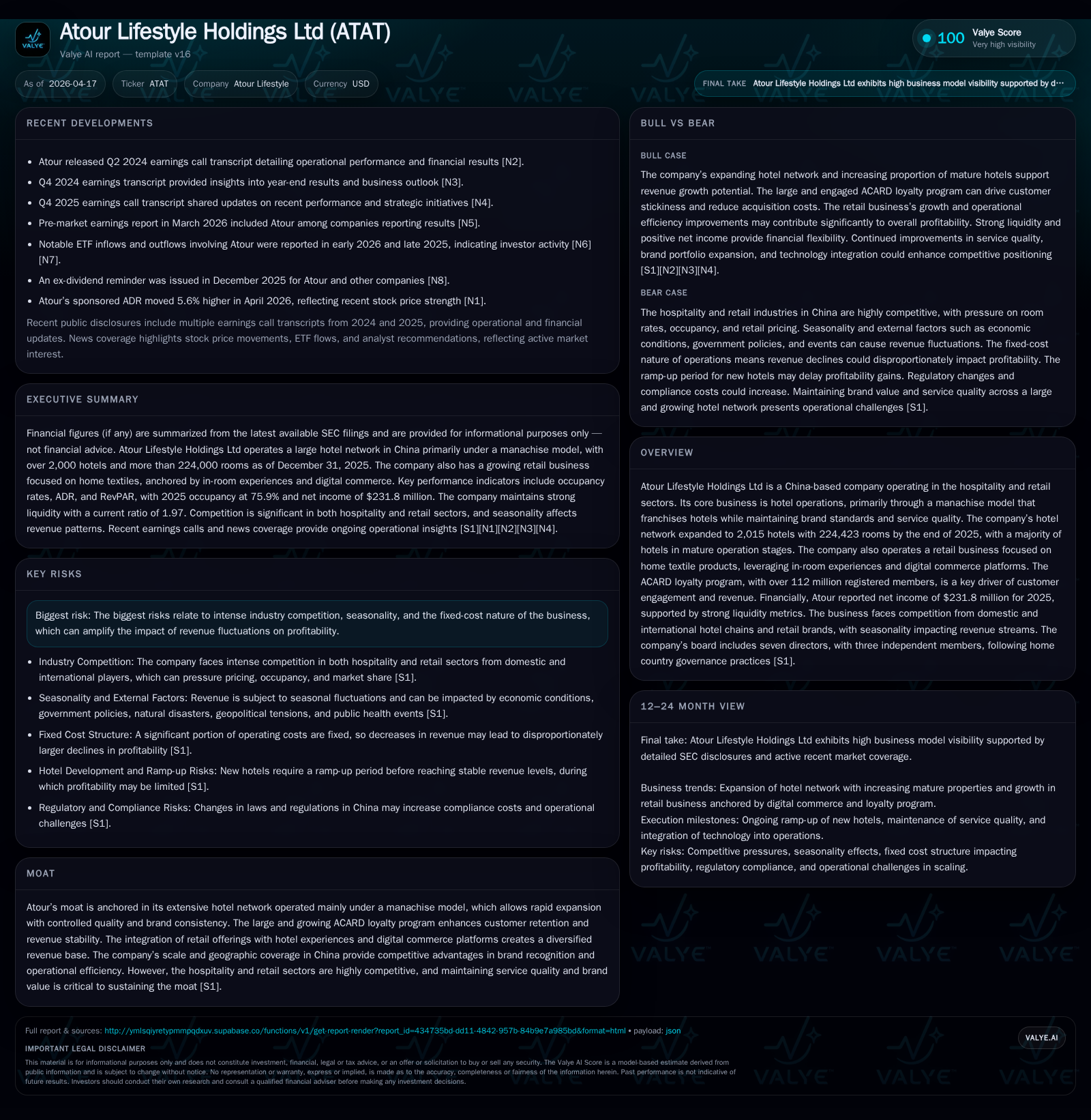
Atour Lifestyle Holdings rapidly grew its hotel network to over 2,000 properties by the end of 2025, driven mainly by its manachise franchise model balancing expansion with quality control. Its retail operations complement hospitality offerings, diversifying revenue. Financial results show significant operating income and net profit growth in 2025, supported by strong cash flow and liquidity. Key growth drivers include a rising share of mature hotels and a large ACARD loyalty program enhancing customer retention. Competitive intensity and fixed costs remain challenges. Future prospects depend on continued franchising success, retail scaling, and service consistency.
Expansion of Hotel Network: Growth Drivers and Operational Model
Atour Lifestyle Holdings Ltd significantly expanded its hotel network between December 2023 and December 2025. The total number of hotels rose from 1,210 to 2,015, while total rooms increased from approximately 138,000 to over 224,000 [F1][S11][S20]. This growth was predominantly achieved through the company's manachise franchise model—a hybrid approach combining management oversight with franchising—that facilitates rapid expansion while maintaining brand standards across properties [S1][S5].
By the end of 2025, mature hotels—operating longer than six months—composed about 61.5% of the portfolio, up from roughly 55% two years prior [S14]. Mature hotels generally generate more stable revenues as they move beyond the ramp-up phase characterized by lower occupancy rates [S14]. Approximately 28% of hotels were still in development and around 10.6% in ramp-up stage at that time [S14], reflecting a healthy pipeline for future growth.
This staged approach aligns with industry norms where new hotels typically require about six months to reach stable occupancy levels. Atour’s ability to franchise desirable locations on commercially favorable terms remains critical for sustaining network expansion while managing operational quality [S5].
Retail Business Integration: Enhancing Revenue Diversity Through In-Room and Digital Channels
Atour's retail segment centers on home textiles and lifestyle products designed for guest room use. This segment complements hospitality operations by generating additional revenue streams through an omni-channel marketing strategy that includes both traditional in-room exposure and expanding digital commerce platforms targeting direct-to-consumer sales [S1][S5].
While this dual-channel approach meets evolving consumer preferences for seamless purchasing pathways, it introduces complexity in supply chain management and fulfillment logistics—areas requiring efficient execution to protect margins given inherent fixed costs related to procurement and warehousing [S5]. Incremental scale benefits may accrue if demand grows as planned.
Financial Performance Recap: Revenue, Operating Income, and Profitability Trends
From FY2022 through FY2025, Atour demonstrated marked improvement across key financial metrics based on audited figures [F1]. Operating income soared from $23.9 million in FY2022 to nearly $330 million in FY2025—a reflection of effective operating leverage as revenues scaled without proportional cost increases.
Net income rose from $14.2 million in FY2022 to $232 million in FY2025, with a year-over-year increase of approximately +32.7% from FY24 to FY25 [F1], signaling disciplined cost management amid competitive pressures.
Operating cash flow expanded healthily to about $285 million (+20.5% YoY), while capital expenditures remained modest at roughly $12.3 million but increased nearly 60% year-over-year as development projects progressed [F1]. The implied free cash flow—operating cash flow minus capex—was approximately $273 million for FY25, indicating strong internal cash generation.
Historical performance (annual)
| FY | Net ($mm) | CFO ($mm) | OpInc ($mm) | Capex ($mm) | Net YoY |
|---|---|---|---|---|---|
| 2025 | 232 | 285 | 330 | 12 | +32.7% |
| 2024 | 175 | 236 | 222 | 8 | +68.3% |
| 2023 | 104 | 280 | 130 | 6 | +630.0% |
| 2022 | 14 | 41 | 24 | 5 |
Source: SEC companyfacts cache [F1].
Capital returns and efficiency (annual)
| FY | Div ($mm) | FCF ($mm) | ROE% |
|---|---|---|---|
| 2025 | 273 | 45.1 | |
| 2024 | 60 | 229 | 43.1 |
| 2023 | 21 | 274 | 35.6 |
| 2022 | 36 | 8.2 |
Source: SEC companyfacts cache [F1].
Return on equity approximated at ~45%, reflecting efficient capital utilization amid rapid growth [F1]. Liquidity remains strong with cash & equivalents totaling $472 million and a current ratio near two at fiscal year-end [F1].
Capital Allocation Practices: Shareholder Returns, Cash Flow Management, and Capex Priorities
Atour exhibits disciplined capital allocation balancing growth investments with shareholder returns [S6–S9][F1]. Dividend payments rose substantially from about $21 million in FY23 to nearly $60 million in FY24 consistent with increasing free cash flow availability [F1]. There is no evidence of significant share buyback programs during this period.
Capital expenditures have been controlled relative to operating cash flow with a focus on developing hotels under the manachise model rather than heavy investment in owned properties [F1][S6], preserving liquidity while supporting network expansion.
Market Competition and Seasonality Impact on Operating Metrics
Atour faces intense competition within China’s hospitality sector from domestic chains and international brands competing on room rates, location convenience, brand recognition, service offerings, and lifestyle amenities [S4][S5]. The retail segment competes with numerous established home textile brands differentiated by design innovation, pricing strategies, and distribution channels.
Seasonality affects both segments: hospitality revenues are typically lower in the first quarter due to New Year holidays but peak during July-August summer travel months [S4]. Retail sales tend to surge during Q2 and Q4 aligned with major e-commerce promotional events coinciding with holiday spending patterns [S4][S5]. These cyclical patterns necessitate agile inventory management and promotional planning.
Loyalty Program Significance and Customer Retention Strategies
The ACARD loyalty program is a cornerstone of Atour's customer engagement strategy boasting over 112 million registered members by end-2025 [S1][S11]. Its tiered digital platform spans all hotel brands facilitating unified rewards accumulation which strengthens guest retention.
Growing membership supports direct bookings that reduce reliance on third-party channels lowering acquisition costs while stabilizing revenues through repeat patronage effects—a critical competitive advantage among mid-scale Chinese hospitality operators.
Data-driven loyalty initiatives further enhance ancillary revenue opportunities such as retail product sales by leveraging guest profiles developed during stays.
Operational Efficiency Versus Fixed Cost Structure: Margin Implications
Atour's hotel operations entail substantial fixed costs including rent under long-term leases and base salaries that do not fluctuate proportionately with revenue changes [S5][S17]. Similarly, retail operations incur fixed procurement contracts alongside warehousing/logistics overheads limiting margin flexibility absent volume scale.
Profitability thus exhibits cyclicality linked closely to occupancy rates or retail turnover fluctuations requiring vigilant cost controls to mitigate margin compression risks during demand downturns common in discretionary sectors.
Outlook for Network Growth and Retail Segment Development
Looking ahead beyond FY25, company disclosures emphasize continued expansion via manachise franchising targeting prime urban locations alongside geographic diversification [N2][N3][S2]. The retail business aims to broaden product assortments while deepening digital platform engagement for sustained growth.
Challenges include limited prime hotel locations and inflationary pressures on input costs which could moderate expansion pace unless offset by strategic supplier partnerships or operational efficiencies.
Maintaining high service standards remains paramount for preserving brand equity amid intensifying competition.
Key Milestones Ahead: Monitor Earnings Trends & Regulatory Environment
Upcoming quarterly earnings will be important indicators for same-hotel performance metrics and ACARD membership trends closely tied to profitability signals [N3][S1]. Regulatory developments affecting franchising or e-commerce frameworks may also impact operational strategies.
Competitive dynamics including potential international entrants warrant attention as they may influence pricing power requiring strategic adjustments within Atour’s business model [N5].
This report synthesizes data through April 17, 2026 using official SEC filings alongside reported earnings call transcripts without speculative assumptions or investment recommendations.
Disclaimer: This is research-only, informational analysis and not investment advice. It may include AI-generated interpretation and general industry context. Always verify important details using primary sources.

Comments