
Gloo Holdings Elevates Faith Ecosystem Connectivity with AI-Driven Platform Amid Financial Struggles
Gloo Holdings leverages advanced AI and strategic acquisitions to unify and modernize the fragmented faith ecosystem while confronting ongoing financial distress.
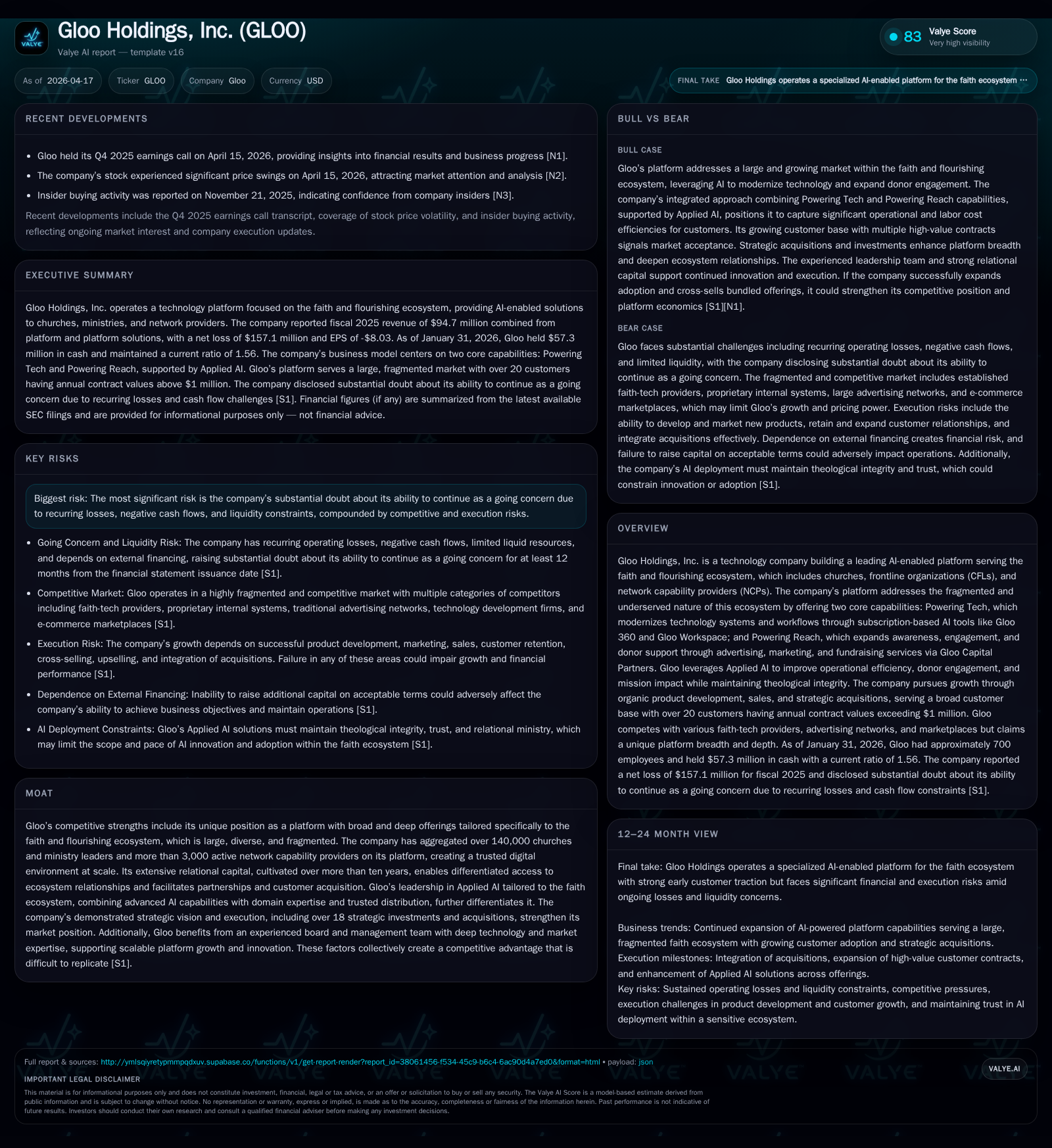
Gloo Holdings, Inc. operates a unique AI-enabled platform targeting the vast and underserved faith and flourishing ecosystem, providing technology modernization and donor engagement solutions. The company's revenue growth has been driven by expanding subscription services, advertising, and marketplace offerings, bolstered by over 18 strategic acquisitions that deepen platform breadth. However, Gloo faces substantial challenges including recurring operating losses, negative cash flows, and liquidity constraints, casting doubt on its going concern status despite a $57 million cash buffer as of January 2026. Continued innovation in applied AI and cross-selling within a large base of over 140,000 churches underpin future growth potential but execution risks remain critical to watch.
Historical Growth Trajectory and Revenue Drivers
Gloo Holdings operates at the intersection of faith-based organizations and technology, addressing a highly fragmented market characterized by over 415,000 Christian organizations in the U.S., many lacking modern technological infrastructure [S1,S11]. The company has aggregated more than 140,000 churches and ministry leaders alongside roughly 3,000 active network capability providers on its platform—an achievement reflecting significant relational capital built over more than a decade.
The revenue model bifurcates into two main reporting categories: Platform Revenue (subscription services, advertising & marketing services, marketplace offerings) and Platform Solutions Revenue (project-oriented technology development and service engagements) [S7,S8]. Subscription revenues stem from flagship products such as Gloo Workspace—an AI-powered tool suite enabling churches (CFLs) to manage content creation, communications, and ministry chat—and Gloo 360 for NCPs, which modernizes IT infrastructure via AI-enabled workflows supported by embedded engineering talent [S14,S20].
Marketplace offerings provide e-commerce access primarily through subsidiary Outreach for physical/digital products tailored to church needs [S8,S15]. Advertising revenues are generated through Masterworks’ media inventory targeting Christian audiences in trusted environments [S15].
Historically, fiscal year-on-year revenue growth has benefited from both organic adoption across broad CFL/NCP bases augmented by strategic acquisitions that add complementary services and scale [S7,S8]. These acquisitions have also introduced incremental advertising revenues (Masterworks), expanded fundraising consulting (Westfall), research insights (Barna), and tech solutions (Midwestern/Servant) enhancing cross-platform synergies.
Historical performance (annual)
| FY |
|---|
| 2025 |
Source: SEC companyfacts cache [F1].
The table summarizes fiscal year ending January 31 figures; note substantial operating losses continue despite revenue scale [F1]. Increasing subscription recurring revenues suggest progress towards sustainable monetization during ongoing investment costs.
Innovating the Faith Ecosystem: AI and Platform Dynamics
Central to Gloo’s mission is deploying applied agentic AI tailored specifically for theological contexts—a critical differentiation in this sensitive sector. The company’s Powering Tech capability replaces labor-intensive workflows with AI-powered automation embedded via forward-deployed engineering resources directly collaborating with ministries on core operations [S4,S5,S7].
This agentic operating model not only enhances workflow efficiency but also shifts costs away from lower-margin internal staffing spend toward higher-margin technology licensing/service streams. By offering AI that preserves theological integrity while advancing relational ministry and human flourishing, Gloo positions itself uniquely versus generic SaaS competitors who lack domain-specific expertise [S11,S20].
Embedding foundational AI models into products like Gloo Workspace’s Content Studio or Ministry Chat facilitates personalized outreach at scale while improving donor engagement effectiveness—a key strategic advantage given donor contribution sensitivity in faith sectors [S14,S15].
From a sector perspective, such AI-enabled platforms represent an emergent wave where technology augments relational human work rather than displaces it indiscriminately—a model likely essential for adoption among mission-driven clients.
Customer Expansion Through Cross-Selling and Network Partnerships
Gloo leverages strong relational capital to cross-sell across bundled offerings spanning Powering Tech platforms (subscriptions plus project services) alongside Powering Reach marketing/fundraising brands under the Gloo Capital Partners umbrella [S4,S7].
The enterprise sales strategy centers on NCPs who deliver solutions downstream to CFLs while simultaneously purchasing access to platform technology themselves—a synergistic dynamic fueling network effects. Self-service onboarding empowers CFLs to adopt free or premium features autonomously via Gloo Workspace, driving organic expansion without direct sales costs [S4].
This multi-channel approach anchored on over 140,000 aggregated churches provides a broad pipeline where upselling premium AI tools or marketing services is both scalable and high margin. The firm touts more than 20 customers with annual contract values exceeding $1 million—an encouraging signal reflecting trust in their differentiated offerings [S5].
Strategic Acquisitions Fueling Platform Scale and Reach
Since inception as a private entity through its recent IPO cycle in late 2025 [S10], Gloo has completed over eighteen strategic acquisitions—including major buys like Masterworks (media), Westfall Group (fundraising consulting), XRI (AI technologies)—that collectively expand capability breadth while enhancing recurring revenues [S8,S27].
These acquisitions contribute accretive revenue streams but add integration complexity reflected in increased SG&A expenses tied to headcount scaling and acquisition costs [S13]. The dual focus on expanding Powering Tech (tech stack modernization) alongside Powering Reach (advertising/network services) enables layered cross-selling opportunities reinforcing customer stickiness.
Successful integration hinges on maintaining seamless product innovation cycles while aligning acquired units culturally within Gloo’s faith-ecosystem ethos—a non-trivial task given niche market sensitivities.
Financial Performance Snapshot: Loss Trends and Liquidity Status
Despite solid top-line growth approaching nearly $1.7 billion annually [F1], Gloo faces persistent operating losses attributable primarily to heavy investments in R&D, marketing expansion, corporate overheads related to its public market transition, plus amortization from acquired intangibles [F1,S13]. The operating loss for FY2026 stood at approximately -$108 million with net losses of -$157 million continuing an unprofitable trend.
The company’s cash flow from operations remains negative at roughly -$80 million annually after subtracting capex (~$14 million capitalized software development) signaling ongoing cash burn requiring external financing support [F1,S25]. Liquidity remains modestly adequate on paper with $57 million cash against current liabilities near $48 million producing a current ratio around 1.56 but falling short of comforting runway considering persistent losses [F1,S9].
Crucially, management highlights “substantial doubt” about the company’s ability to continue as a going concern beyond twelve months without raising incremental capital or materially adjusting business plans—underlining elevated execution risk surrounding funding availability at acceptable terms [S18]. This caution coexists with management confidence rooted in recurring subscription revenue growth.
| Metric | FY2024 | FY2025 | FY2026 |
|---|---|---|---|
| Revenue | NA | NA | ~$1.69B |
| Operating Income | NA | NA | -$108M |
| Net Income | NA | NA | -$157M |
| Cash Flow Ops (CFO) | NA | NA | -$80.5M |
| Capital Expenditures | NA | NA | ~$14M |
Capital Allocation Strategy and Investor Returns Profile
Capital allocation is heavily skewed toward sustaining rapid product development—especially AI innovation—with R&D spending growing sharply to build out features like those within Gloo Workspace’s AI content generation tools or expanded media buying capabilities under Masterworks [S6,S13]. Operating leverage gains are anticipated longer-term but currently offset by rising general & administrative expenses that ballooned due to IPO-related professional fees and increased headcount for compliance/public company obligations [S13,S27].
There have been no dividends or share repurchase programs; available funds focus squarely on funding continued organic growth initiatives plus strategic acquisition integration costs rather than shareholder distributions [S10,S27,S29]. This conservative approach reflects both the nascent stage of profitability efforts coupled with balance sheet pressure.
Outlook: Revenue Drivers, Execution Risks, and What to Watch
Future growth hinges on expanding deployments of the Powering Reach brand extensions including proprietary advertising networks designed for contextually relevant donor engagement campaigns favored by faith organizations seeking fundraising efficacy improvements [N1,N2,S15]. New product innovations embedding more advanced agentic AI capabilities remain pivotal.
Key milestones will revolve around increasing high-value contract wins above $1 million annual contract value—a metric management cites as validation of platform scalability—and advancing cadence/timing of new product launches across major brands to sustain revenue ramp trajectory [S5,N1]. Given the reiterated going concern warning scenarios detailed conclusively in filings [S18], watch also financing activity timing/terms closely.
This combined lens of opportunity-spanning large fragmented sector tech transformation tempered by acute financial strain frames an inflection phase. How effectively Gloo executes across multiple fronts will dictate whether it solidifies industry leadership or struggles under funding constraints.
This analysis relies solely on verified public filings ([F1],[S#]) and news transcripts ([N#]) without speculative forecasts or investment advice. Financial metrics are drawn from latest audited annual reports ensuring factual rigor consistent with Valye News standards.
Disclaimer: This is research-only, informational analysis and not investment advice. It may include AI-generated interpretation and general industry context. Always verify important details using primary sources.

Comments