
Drugs Made In America Acquisition II Corp. Pursues Pharma Reshoring Amid Execution and Governance Challenges
DMII is a Cayman Islands-based blank check company with $500 million held in trust, targeting U.S. pharmaceutical manufacturing acquisitions to address supply chain vulnerabilities.
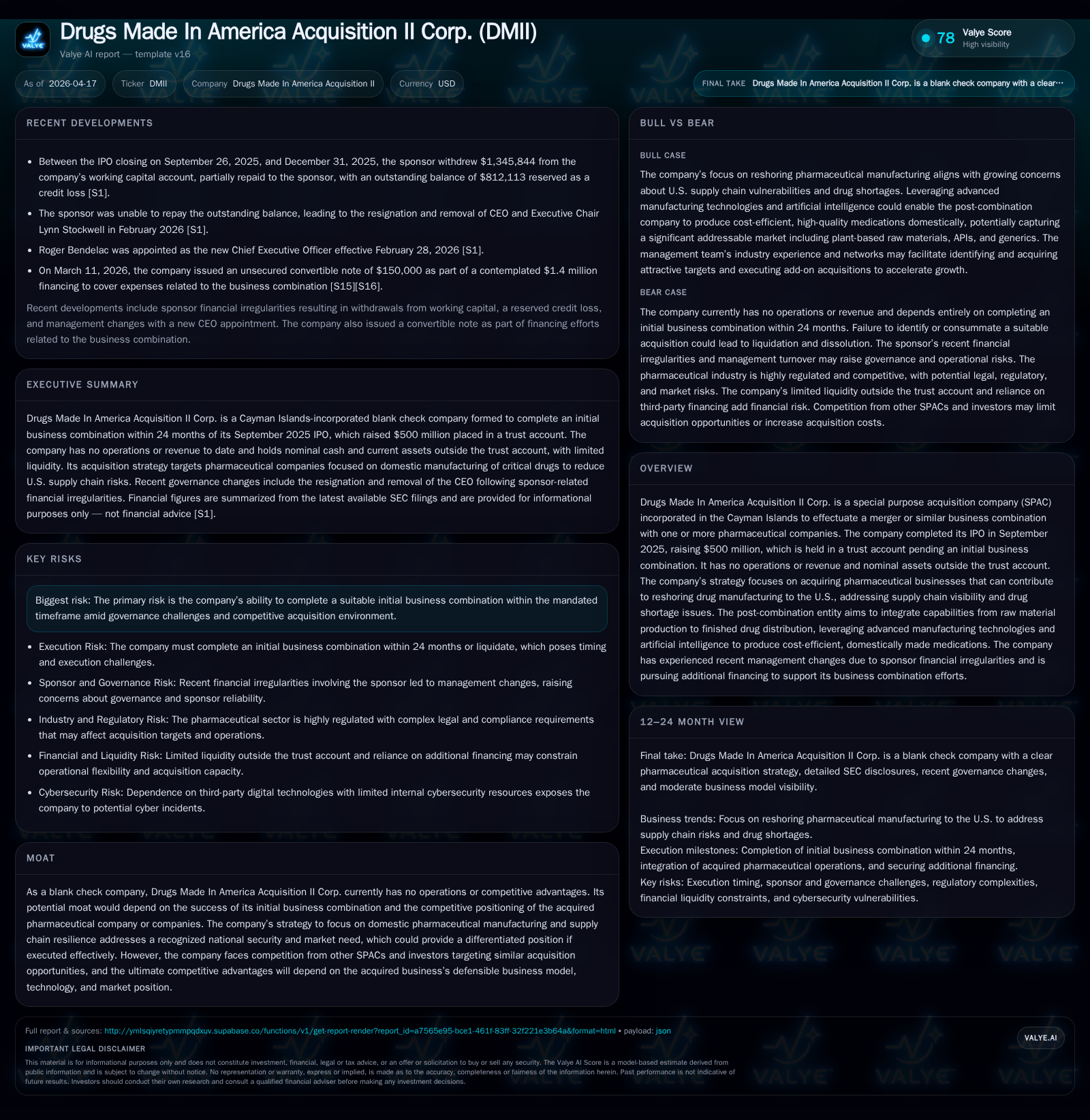
Drugs Made In America Acquisition II Corp. (DMII) is a special purpose acquisition company formed in 2024 and publicly listed in 2025, focused on acquiring and consolidating pharmaceutical businesses to reshore drug manufacturing in the United States. With $500 million raised in its IPO and held in trust, DMII currently operates as a shell company with no revenues or operations. Its strategic vision targets integrated domestic pharmaceutical production using advanced manufacturing and AI technologies to mitigate critical drug shortages. Governance issues led to leadership changes in early 2026, while intense competition and regulatory complexities pose significant execution risks. Returns depend entirely on the successful completion and performance of an initial business combination within the two-year deadline.
Company Background and Historical Financials
Drugs Made In America Acquisition II Corp. (NASDAQ: DMII) completed its initial public offering on September 26, 2025, raising gross proceeds of $500 million through the sale of 50 million units at $10 per unit. Each unit included one ordinary share and one-tenth of a right to receive an additional share upon consummation of an initial business combination. Concurrently, a private placement raised an additional $12 million from the sponsor and underwriter [S1][S9][S27].
Incorporated as a Cayman Islands exempted special purpose acquisition company (SPAC), DMII has no business operations or revenue to date. Nearly all assets consist of cash held in a trust account dedicated exclusively for use in completing a pharmaceutical-related merger or acquisition within about two years following the IPO [S1][F1]. The SEC classifies DMII as a shell company due to its lack of operational activities and nominal non-cash assets [S1].
The table below summarizes select financial metrics as of December 31, 2025:
Historical performance (annual)
| FY |
|---|
| 2025 |
Source: SEC companyfacts cache [F1].
*Note: The positive net income primarily reflects accounting effects related to sponsor transactions rather than operational earnings.
These figures underscore DMII's role as a capital vehicle rather than an operating entity.
Growth Strategy and Industry Focus
DMII aims to acquire one or more pharmaceutical businesses that can materially contribute to reshoring drug manufacturing within the United States. This focus addresses concerns raised by the U.S. Senate Homeland Security Committee regarding critical drug shortages stemming from overreliance on foreign suppliers concentrated geographically [S8][S17].
The envisioned post-combination company would integrate vertically—from sourcing plant-based active pharmaceutical ingredients (APIs) through drug manufacturing to distribution of finished generic medications domestically—leveraging advanced manufacturing processes supported by artificial intelligence for quality control and cost efficiency. The targeted market segments include an estimated $44 billion plant-based API industry alongside generic pharmaceuticals [S8].
DMII seeks targets exhibiting proven industry leadership with defensible business models capable of sustained free cash flow generation. Growth prospects include both organic expansion and platform-building through add-on acquisitions facilitated by DMII’s extensive industry network and capital access [S7]. Regulatory compliance remains a key consideration given the highly regulated nature of pharmaceutical manufacturing.
Corporate Governance and Management Changes
Following the IPO, sponsor misconduct involving withdrawals totaling approximately $1.35 million from working capital accounts without full repayment was uncovered between September and December 2025. This led to governance actions culminating in the resignation of CEO and Executive Chair Lynn Stockwell in February 2026. Roger Bendelac was appointed CEO thereafter [S22].
This episode highlights governance risks inherent in SPAC structures prior to initial business combinations where sponsors hold significant influence. Subsequent measures include standstill agreements aimed at stabilizing governance ahead of acquisition activity.
Capital Allocation and Deal Structure Options
After accounting for underwriting fees and assuming no redemptions, approximately $482.5 million remains available for investment purposes from the trust account [S6][S14]. DMII retains flexibility to consummate its initial business combination using cash, equity securities, debt financing, or combinations thereof tailored to target needs.
While no arrangements currently exist for additional financing, DMII may raise funds through private offerings concurrently with or following an initial business combination if deemed necessary [S5]. Shareholders will have redemption rights at approximately $10 per share during proxy votes approving any proposed combination or via tender offers if no vote is held [S10][S16][S23]. Failure to complete a qualifying transaction within roughly two years requires liquidation of trust funds under Cayman Islands law provisions prioritizing creditor claims [S12][S23].
Competitive Landscape and Risks
DMII operates in a competitive environment with multiple SPACs and strategic investors targeting pharmaceutical reshoring themes driven by government focus on supply chain security. This competition may limit access to attractive acquisition targets given financial constraints relative to larger competitors with deeper resources or existing industry footholds [S14].
Key risks include:
- Compressed timeline before mandatory liquidation absent deal closure
- Challenges sourcing suitably scaled acquisition candidates compliant with regulatory requirements
- Potential conflicts linked to founder ownership interests
- Volatility impacting investor sentiment toward SPACs broadly
- Complex legal and regulatory hurdles typical for pharmaceutical consolidations
- Reputational risks stemming from prior sponsor conduct affecting counterparty engagement
These factors collectively represent material execution risk that will determine whether DMII evolves beyond shell status into an operational platform creating shareholder value.
Returns & Capital Allocation Summary
As a pre-combination blank check entity without operational cash flows aside from interest earned on trust funds—which are restricted solely for merger purposes—DMII pays no dividends nor conducts share buybacks [F1][S4]. Reported net income largely reflects accounting transactions associated with sponsor arrangements rather than underlying profitability.
Return on equity stands negative at approximately -23.6%, reflecting startup expenses relative to minimal equity base absent operating earnings [F1]. Future shareholder returns will depend entirely on performance metrics realized by the acquired entity following consummation of the initial business combination.
This analysis is based exclusively on publicly available SEC filings as of April 17, 2026, without any non-public information or projections. It is provided solely for informational purposes and does not constitute investment advice or recommendations.
Disclaimer: This is research-only, informational analysis and not investment advice. It may include AI-generated interpretation and general industry context. Always verify important details using primary sources.

Comments