
CFN Enterprises' Strategic Shift to Wine and Beverage Faces Financial Constraints
CFN Enterprises rapidly transitioned from hemp and cannabis marketing to wine and beverage through acquisitions but struggles with liquidity and regulatory risks.
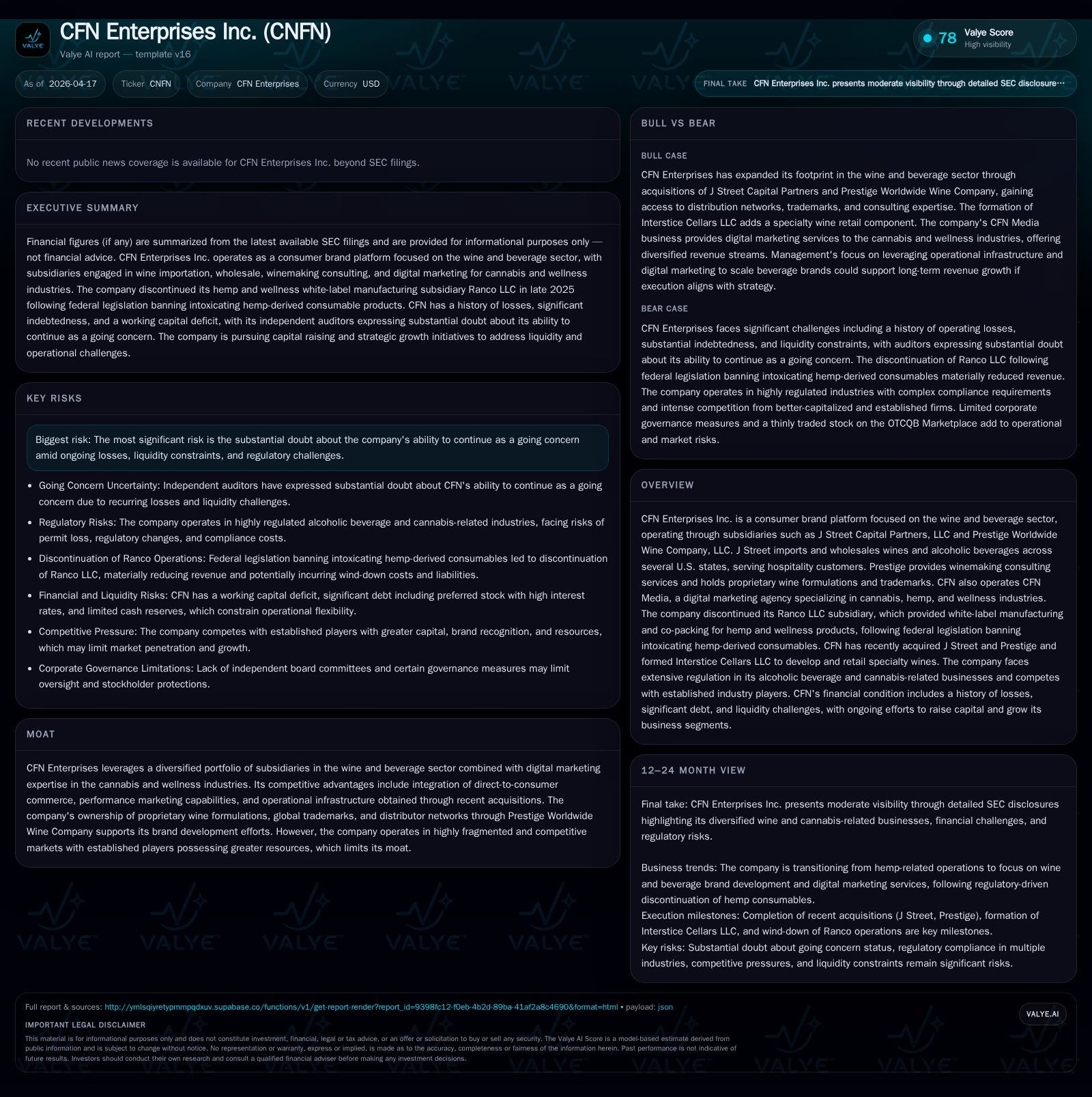
CFN Enterprises Inc. operates as a consumer brand platform primarily focused on the wine and beverage sector, following recent acquisitions of J Street Capital Partners and Prestige Worldwide Wine Company. The company exited its hemp-derived consumables manufacturing due to federal legislation banning intoxicating hemp products, substantially reducing revenue from discontinued operations. Despite growth in its wine and beverage operations, CFN faces significant financial distress characterized by consecutive net losses, negative cash flow, and substantial debt with working capital deficits. Additional challenges stem from intense competition, complex regulatory environments across alcohol and cannabis sectors, and uncertainties in capital access that cloud its going concern status.
Company Overview
CFN Enterprises Inc. (ticker: CNFN) has evolved into a consumer brand platform focused predominantly on the wine and beverage sector. The company’s transformation accelerated during 2025 with the acquisition of J Street Capital Partners, an importer and wholesaler of alcoholic beverages serving states including Nevada, New York, New Jersey, Florida, and California; along with Prestige Worldwide Wine Company, which provides winemaking consulting services alongside proprietary wine formulations, trademarks, and distribution relationships [S1][S7][S5].
Previous core operations centered around cannabis-related media marketing (CFN Media), cannabidiol manufacturing (CNP Operating), and white-label manufacturing for hemp/wellness products (Ranco LLC). However, following the passage of federal H.R. 5371 banning intoxicating hemp-derived consumables effective November 12, 2026, CFN discontinued Ranco’s operations by end-2025—a segment that had significantly contributed to prior revenues [S1][S7][S14].
Historical Performance
Revenue growth peaked in fiscal year 2024 at approximately $20.2 million driven largely by hemp-related manufacturing activities under Ranco. However, this momentum reversed dramatically in fiscal year 2025 as the company ceased Ranco operations resulting in reported revenues plummeting by roughly 99.8% to just over $36 thousand—reflecting principally continuing operations excluding discontinued business [F1].
Historical performance (annual)
| FY | Rev ($mm) | Net ($mm) | CFO ($mm) | OpInc ($mm) | Rev YoY | Net YoY |
|---|---|---|---|---|---|---|
| 2025 | 0 | -7 | 0 | -2 | -99.8% | -51.5% |
| 2024 | 20 | -4 | 0 | -2 | +471.5% | +71.8% |
| 2023 | 4 | -15 | -5 | -14 | -18.1% | -53.0% |
| 2022 | 4 | -10 | -1 | -8 |
Source: SEC companyfacts cache [F1].
Capital returns and efficiency (annual)
| FY | ROE% |
|---|---|
| 2025 | 48.4 |
| 2024 | 46.8 |
| 2023 | 633.9 |
| 2022 |
Source: SEC companyfacts cache [F1].
Net losses have been chronic throughout the period analyzed. The net loss expanded from nearly $4.3 million in 2024 to $6.5 million in 2025 despite dramatically reduced revenue due primarily to restructuring costs associated with discontinuing Ranco and investment investments related to new beverage assets [F1][S11]. Operating income improved slightly yet remained negative at about -$1.7 million in 2025.
Operating cash flow swung from a positive inflow of $442k in FY24 to an outflow near $86k in FY25 underscoring deteriorating operational efficiency post-restructuring [F1]. Capital expenditures dropped to zero in FY25 consistent with a scaling back of fixed asset investments [F1].
Business Segments & Growth Prospects
Post-discontinuation of Ranco’s white label hemp manufacturing business—due to both regulatory cessation caused by HR5371 legislation banning intoxicating hemp consumables nationwide—and the winding down of CNP Operating’s cannabidiol production over prior years [S1][S7], CFN’s growth prospects rely almost exclusively on its wine & beverage platform alongside CFN Media’s digital marketing service suite.
Wine & Beverage Operations: Acquisition of J Street (July 2025) brought established importer-wholesaler capabilities with distribution agreements spanning five states’ hospitality sectors including bars and casinos [S1][S7]. The subsequent purchase of Prestige Worldwide Wine Company added winemaking consulting services built upon proprietary formulations plus global trademarks and distributor clientele supporting brand development [S1][S5].
Interstice Cellars Formation: Management created Interstice Cellars LLC specifically to develop and retail specialty wines combining expertise across subsidiaries; this represents an integrated approach blending direct-to-consumer commerce with wholesale distribution [S1].
Marketing Platform: CFN Media continues digital marketing campaigns targeting cannabis/hemp/wellness clients leveraging performance advertising technology aimed at investor audiences [S7]. However despite expertise here revenue declined over recent periods owing to strategic prioritization shifts towards newly acquired beverage assets [S12][S26].
However growth trajectory is constrained by multiple factors:
- Intense competition from entrenched players within fragmented wine/spirits importation-distribution supply chains.
- Complex regulatory environment requiring maintenance of numerous federal/state licenses such as TTB permits and state alcohol control board approvals—with failure risking loss of critical operating permissions [S14][S16].
- Dependence on external financing given ongoing operational losses limiting capacity for organic reinvestment.
- Reduced revenue base post-Ranco complicates scaling efforts without injecting substantial incremental capital or expanding brand portfolio aggressively.
Financial Position & Capital Allocation
As of December 31, 2025:
- Cash balance stands low at approximately $198k.
- Current liabilities vastly exceed current assets yielding a perilous current ratio near 0.03 indicating severe short-term liquidity problems [F1].
- Total debt surpasses $7.5 million split between promissory notes—including significant past extensions—with portions currently in default involving subsidiaries notably CNP Operating’s obligations personally guaranteed by management [S3][S4][S6].
- Preferred stock obligations bear high interest rates (12%) escalating ongoing financing expenses [S1][S9].
Operating losses coupled with elevated financing costs contribute to negative retained earnings nearing $14 million negative equity—signaling deep value erosion balance sheet-wise [F1]. Management has refrained from paying dividends or conducting share repurchases amid liquidity constraints.
The company’s plan relies on:
- Raising additional debt or equity capital subject to availability given credit conditions and investor appetite.
- Growing recently acquired J Street business while managing overall operating expenses prudently.
- Pursuing strategic transactions including launching e-commerce wellness networks but these initiatives remain nascent.
Without material funding or operational turnaround success the firm continues facing existential threats due to solvency issues as highlighted by auditor going concern qualifications for both fiscal years ended December 31st for consecutive years [S1][S8][S17].
Industry Context (Analysis)
The U.S. wine importation/distribution market is dominated by national brokers with extensive channel partnerships including on-premise hospitality venues like casinos—where J Street currently operates—which demands scale efficiencies and branding expertise often inaccessible to smaller platforms such as CFN presently attempting consolidation via acquisitions.
Furthermore regulatory compliance acts as a high operational barrier; federally mandated permits under TTB combined with multi-state licensing necessitate continuous oversight incurring considerable administrative expense—a challenge amplified by CFN’s stretched resources given ongoing losses.
Meanwhile cannabis-related media marketing remains volatile due to Federal illegality persisting despite state-level legalization; this creates inherent client risk alongside unpredictable regulatory enforcement actions potentially impacting demand for sponsored content campaigns conducted by CFN Media.
Milestones & What To Watch (Analysis)
Absent explicit forward guidance disclosed in SEC filings or announcements:
- Success in integrating J Street’s wholesale distribution with Prestige’s winemaking consulting will be a key unlock for stabilizing revenues beyond disruptive legacy operations.
- Management's ability to secure necessary financing on reasonable terms or alternative forms of strategic partnerships will strongly influence survival odds.
- Regulatory license renewals remain critical checkpoints given their material impact on operating continuity.
- Monitoring quarterly cash flow trends post-Ranco wind-down will provide insight into operational leverage improvements or further deterioration.
Returns & Capital Allocation Summary
ROE approximates near-high levels negative territory (~48% loss based on latest net income vs equity), reflecting large historical accumulated deficits overshadowing modest asset bases [F1]. There are no indications of dividend distributions or share buybacks given pressing cash constraints.
Free cash flow remains negative driven by ongoing operating losses despite little capex outlay—likely reflecting minimal fixed asset investment amidst retrenchment efforts [F1]. Interest expenses remain substantial driven by preferred stock coupons alongside multiple defaulted notes impacting net profitability adversely [S11].
Overall capital allocation appears focused more on conserving liquidity than deploying capital toward growth until clearer profitability pathways emerge.
Risk Factors Overview
Key risks emphasized include:
- Material uncertainty surrounding continuing as a going concern attributable principally to cumulative losses exceeding equity base plus inadequate liquidity coverage [S14][S16].
- Regulatory complexity across alcoholic beverage production/importation coupled with licensing risks that could disrupt ongoing operations materially.
- Dependence on external financing exposed via defaults or need for onerous extensions may restrict strategic flexibility.[S13]
- Abrupt exit from previously core hemp manufacturing segment reduces historical revenue foundation while elevating reliance on newer unproven business units.
- Exposure related to Federal cannabis illegality risking client attrition or enforcement actions impacting CFN Media business viability.
Conclusion
CFN Enterprises Inc. is navigating a fundamental business model shift away from federal banned hemp consumables toward integrated consumer brands within highly competitive wine/beverage markets fueled by targeted acquisitions in late 2025. Nevertheless significant cultural change is accompanied by severe financial instability characterized by declining revenues since discontinuation of Ranco operations juxtaposed against persistent losses compounded by heavy debt burdens producing ongoing working capital crises.
The firm’s niche lies partly in blending proprietary winemaking IP/assets plus digital marketing know-how while leveraging distributor footprints; however realization depends heavily on successful integration execution plus stable funding access under stringent regulatory scrutiny across both alcoholic beverage controls and ancillary cannabis-related industries it serves digitally.
CFN's future hinges ultimately upon whether new business segments can ramp profitably fast enough amidst existing financial headwinds—a scenario fraught with uncertainties flagged repeatedly by independent auditors signaling existential viability concerns absent swift corrective action or fresh investor capital infusion.
This analysis is derived exclusively from publicly filed SEC reports up to April 17th, 2026 ([F1],[S#]) aligned solely for internal informational use without recommendation or investment advice implication.
Disclaimer: This is research-only, informational analysis and not investment advice. It may include AI-generated interpretation and general industry context. Always verify important details using primary sources.

Comments