
Nu-Med Plus Faces Critical Capital and Regulatory Hurdles in Developing Nitric Oxide Medical Devices
Nu-Med Plus holds patents for innovative nitric oxide devices but faces severe liquidity constraints and lengthy FDA approval processes impeding commercialization.
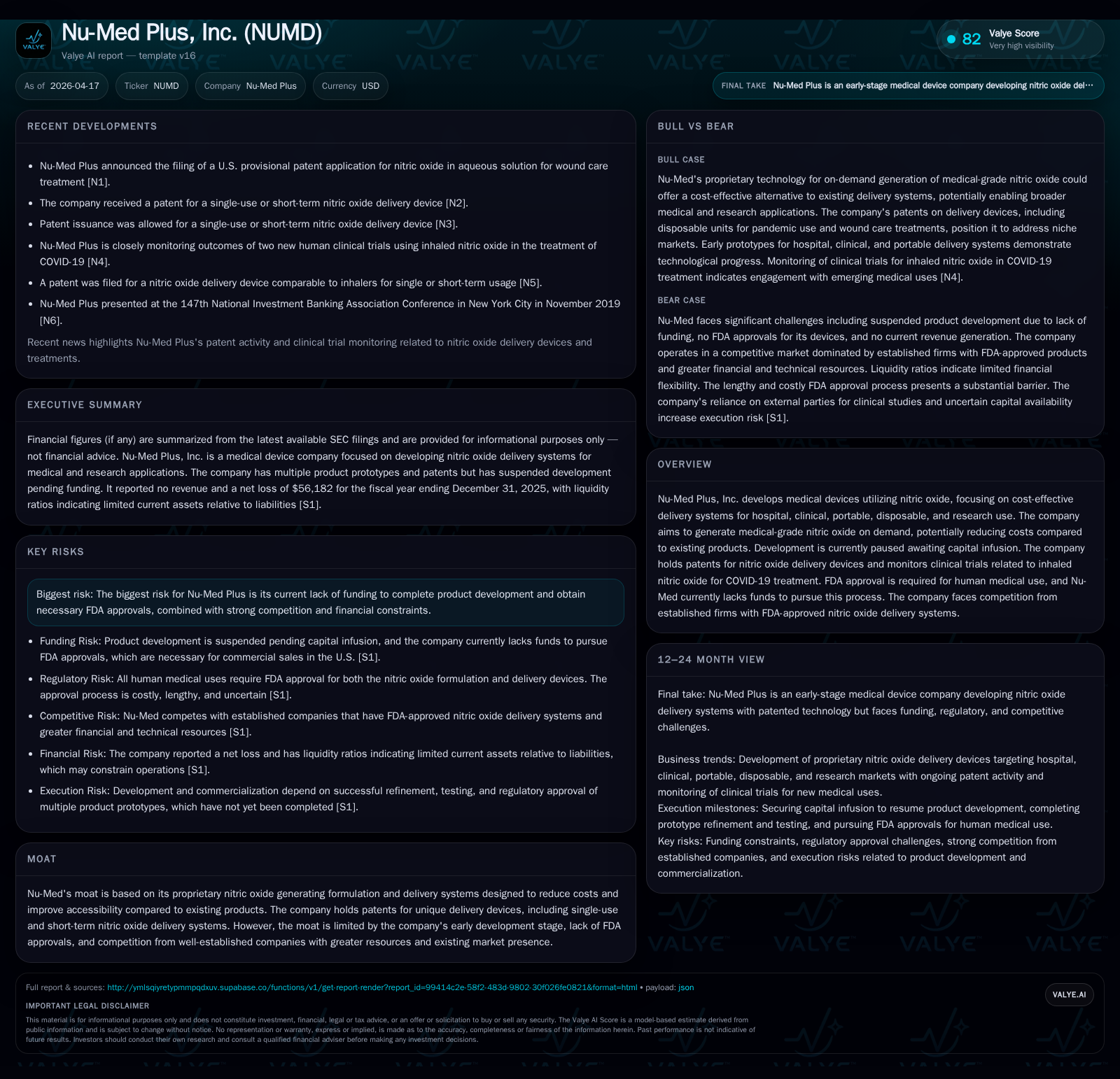
Nu-Med Plus, Inc. is an early-stage medical device developer focused on cost-effective nitric oxide delivery systems with patented technology. Despite initial lab setup and prototype development, the company has yet to generate revenue and struggles with substantial operating losses and a critically low cash runway of about two months. Nu-Med faces significant regulatory challenges requiring costly FDA approvals, which have stalled progress given the absence of sufficient capital. Competition from established firms with FDA-cleared products also limits market entry prospects. Key milestones include securing financing, advancing device testing, and initiating submission for regulatory clearance, all currently uncertain.
Tracking Nu-Med’s Unlaunched Growth: Development Progress to Date
Nu-Med Plus, incorporated in October 2011, focuses on developing medical devices utilizing nitric oxide (NO) delivery across hospital, clinical, portable, disposable, and research applications [S1,S12]. The company remains in early development without any revenue reported through at least 2020 [F1]. Initial capital was raised to establish a lab equipped for experimental work on proprietary NO generating formulations and delivery device prototypes [S1,S8].
Products under development include hospital bedside and clinical units, a mobile rechargeable NO gas delivery device, and research-use systems [S1,S12]. However, development activities are currently on hold awaiting further capital [S12].
Operating losses have persisted due to high R&D and administrative expenses without product sales [F1]. Losses narrowed from approximately -$182K in FY2022 to -$49K in FY2025 as management reduced spending [F1].
Proprietary Technology and Intellectual Property: Nu-Med’s Moat Explained
Nu-Med holds patents on nitric oxide generating compound formulations and delivery systems designed to lower costs relative to existing market offerings [S1,S18,S25]. Approved patents cover gas generators (#62-014866) and disposable delivery devices; a patent pending covers controlled delivery using diffusion membranes (#14529112) [S18]. These innovations aim to produce medical-grade nitric oxide "on demand," mitigating reliance on costly compressed gas cylinders containing impurities [S23].
Despite this technological foundation, none of the products have received FDA approval yet—a necessary step before human use—and significant technical refinement remains [S10]. Competition from companies with FDA-cleared devices limits Nu-Med’s market position [S25].
Capital Crunch: Evaluating Nu-Med’s Liquidity and Funding Challenges
As of December 31, 2025, Nu-Med reported current assets of $7,911 against current liabilities of $279,189 resulting in a current ratio of approximately 0.03—indicating severe liquidity stress [F1,S11]. Cash on hand was only $661 [F1].
Management disclosed sufficient cash for roughly two months’ operations post-fiscal year-end 2025 before requiring additional financing via equity or debt from investors or shareholders; traditional bank financing is unavailable due to financial weakness [S11,S14]. No commitments for such financing are currently secured.
Capital raising strategy involves phased tranches rather than lump sums to manage dilution amid uncertain total funding needs estimated at around $1.25 million for ongoing testing, patent filings, auditing, and development costs [S1,S8]. Actual capital requirements could exceed estimates depending on progress.
Regulatory Storm: FDA Approval Barriers and Development Timeline
Nitric oxide medical devices intended for human use are subject to stringent FDA Class II regulation requiring extensive preclinical testing, Investigational Device Exemption filings for clinical trials, and New Drug Application-like submissions demonstrating safety and efficacy [S9,S10,S15,S22]. Compliance with Good Manufacturing Practice standards will be necessary prior to commercial production [S9].
These processes typically span multiple years with unpredictable outcomes contingent on trial results and evolving regulatory standards. Testing costs alone are substantial and require secured funding not presently available [S1]. Iterative design changes during prototype development may further delay progress.
Competitive Terrain: Established Players vs. Nu-Med’s Innovative Devices
The market features entrenched competitors such as Mallinckrodt Inc., owner of Inomax—the sole FDA-approved NO delivery system primarily used for newborn pulmonary hypertension—and GeNO LLC with its FDA-cleared GeNOsyl platforms; Beyond Air is also developing air-derived NO generation technologies under clinical evaluation [S25]. These incumbents benefit from regulatory clearances, clinical data backing safety/efficacy, reimbursement arrangements, manufacturing scale, and deep financial resources.
Nu-Med aims to disrupt cost structures by enabling localized NO generation without reliance on pressurized gas cylinders—a potential advantage if clinically validated and approved. Nonetheless, competitor scale enables faster adaptation to market demands and sustains regulatory expenditure absorption beyond Nu-Med’s current capacity.
Financial Trajectory: Historical Operating Losses and Cash Flow Dynamics
Historical performance (annual)
| FY | Net ($) | CFO ($) | OpInc ($) | Net YoY |
|---|---|---|---|---|
| 2025 | -56182 | -47979 | -48955 | +17.8% |
| 2024 | -68345 | -4433 | -63331 | +45.6% |
| 2023 | -125526 | -66389 | -120526 | +3.6% |
| 2022 | -130167 | -38480 | -182167 |
Source: SEC companyfacts cache [F1].
Capital returns and efficiency (annual)
| FY | ROE% |
|---|---|
| 2025 | 20.7 |
| 2024 | 31.8 |
| 2023 | 85.5 |
| 2022 | 206.5 |
Source: SEC companyfacts cache [F1].
Operating losses have narrowed steadily since FY2022 but remain negative reflecting ongoing R&D investment without offsetting revenues [F1]. The reduction in net loss corresponds with lowered investor relations costs and filing fees alongside general expense cuts [F1,S7]. Operating cash flow deteriorated sharply in FY2025 driven by timing differences between expense recognition and cash disbursement amid sustained development activity.
Capital expenditures data post-2018 are limited but indicate minimal fixed asset investment consistent with an R&D-centric model rather than manufacturing expansion so far [F1].
Capital Allocation Strategies: Absence of Dividends and Buybacks
Nu-Med has not paid dividends due to persistent net losses requiring reinvestment into core operations rather than shareholder distributions [F1,S21]. Share repurchases occurred only during 2016-2017 totaling approximately $4K; no buyback programs have been executed since reflecting prioritization of capital preservation amid funding scarcity.
Shareholders’ equity declined substantially from approximately -$63K in FY2022 to -$271K at FY2025 year-end highlighting accumulated deficits exceeding new equity injections driven by continued losses [F1]. Future financings pose dilution risks investors should weigh carefully given likely expanded capital needs ahead of commercialization.
Looking Ahead: Key Milestones to Watch and Investment Implications
In the absence of explicit forward guidance or confirmed financing commitments,[N/A] critical upcoming milestones center on:
- Securing incremental capital tranches essential for resuming active product development including prototype refinement/testing;
- Progressing toward Investigational Device Exemption filings enabling clinical trials;
- Expanding intellectual property through additional patent applications enhancing competitive positioning;
- Preparing for multi-year FDA regulatory submissions involving extensive safety/efficacy studies;
- Potential early revenue generation via non-human research equipment sales supporting brand presence.
Given uncertain timing/availability of financing combined with complex regulatory hurdles compounded by competition from established firms possessing approved products suggests substantial execution risk persists near term.[S1]
This analysis relies solely on publicly filed documents up to April 2026 without speculative extrapolation beyond stated facts or company-provided forward-looking statements.
Disclaimer: This is research-only, informational analysis and not investment advice. It may include AI-generated interpretation and general industry context. Always verify important details using primary sources.

Comments