
KALA BIO Transforms from Ophthalmic Drug Development to AI-Driven Biotech Platform Amid Clinical Setbacks
Following termination of its lead ophthalmic asset, KALA BIO pivots to artificial intelligence solutions designed for biopharma research and compliance.
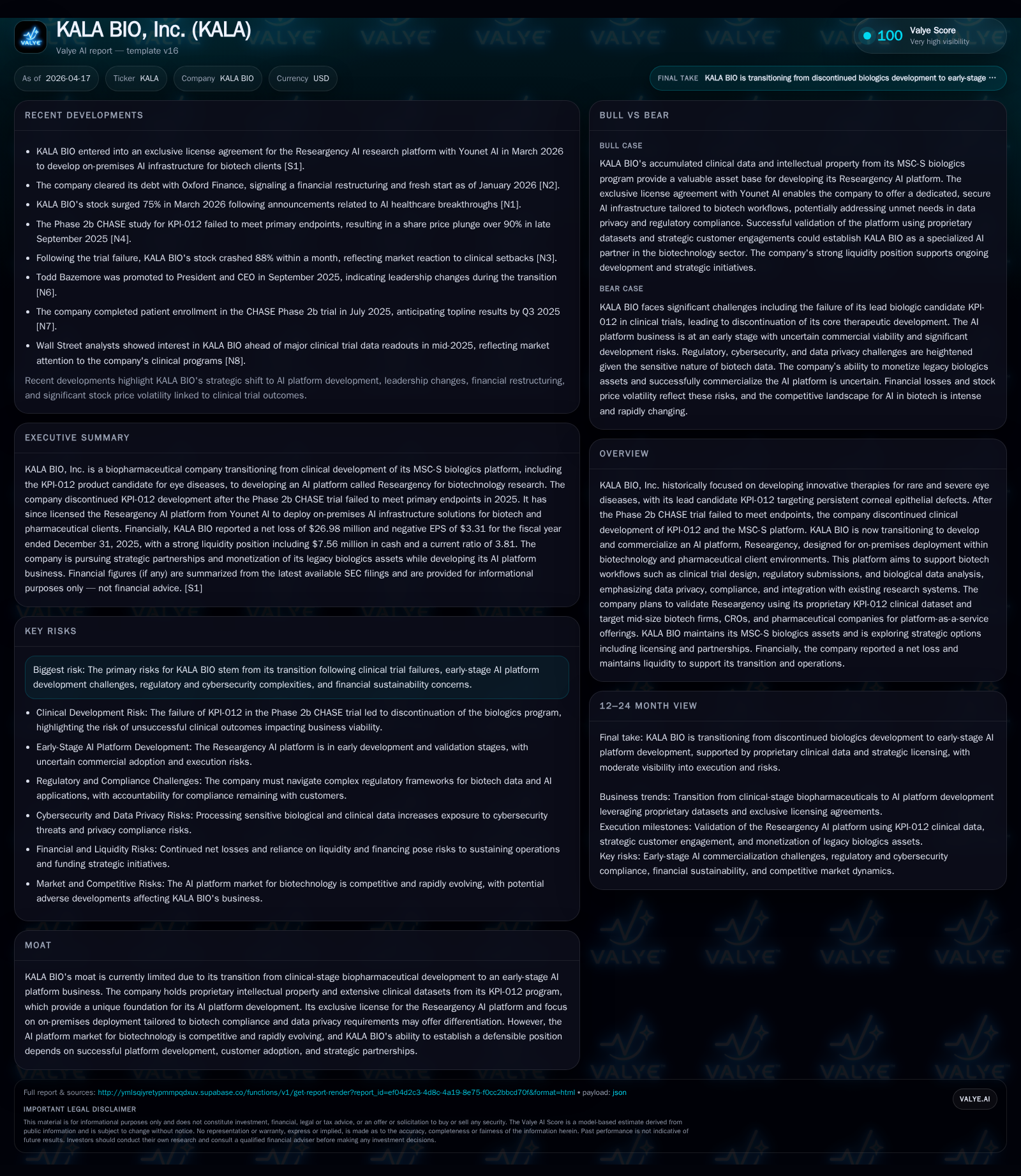
KALA BIO, once centered on developing KPI-012 for rare eye diseases, discontinued this clinical program after Phase 2b failure. The company is repositioning itself as a provider of an AI platform, Researgency, targeting mid-sized biotech and pharma clients with a focus on data privacy and integration. Financially, KALA continues to operate at a net loss with negative operating cash flow and limited capital reserves. Future growth hinges on successful AI platform validation, adoption by a competitive market, and sustainable funding.
Historical Performance and Clinical Development Background
KALA BIO’s origins lie in pioneering treatments for rare and severe ocular diseases. Its flagship clinical program was KPI-012, engineered to address persistent corneal epithelial defects—a niche indication where unmet medical needs are significant. Despite crossing into Phase 2b trials (notably the CHASE trial), this candidate failed to reach prespecified efficacy endpoints, leading to the discontinuation of KPI-012 development by early 2026 [S3]. Alongside this clinical failure, the company concurrently halted investigation of its mesenchymal stem cell secretome (MSC-S) platform.
Financially, KALA BIO has reflected these setbacks through sustained operating losses typical of clinical-stage biopharma entities. Operating income improved modestly year-over-year, narrowing from -$40.98 million in FY2024 to -$39.16 million in FY2025; net losses similarly improved from -$38.51 million to -$26.98 million [F1]. This contraction in losses corresponds partly to scaled-back clinical activities and administrative cost optimization.
The company's operating cash flow remained negative at approximately -$31.99 million in fiscal year 2025, closely tracking prior years’ burn rates and indicating intense cash use attributable to ongoing R&D expenses [F1]. No revenue has been recorded since inception through end-2017 data, underscoring that KALA has yet to commercialize any product or service substantially.
Historical performance (annual)
| FY | Net ($mm) | CFO ($mm) | OpInc ($mm) | Net YoY |
|---|---|---|---|---|
| 2025 | -27 | -32 | -39 | +29.9% |
| 2024 | -39 | -29 | -41 | +8.7% |
| 2023 | -42 | -28 | -40 | +5.9% |
| 2022 | -45 | -79 | -82 |
Source: SEC companyfacts cache [F1].
Capital returns and efficiency (annual)
| FY | ROE% |
|---|---|
| 2025 | -385.6 |
| 2024 | -312.3 |
| 2023 | -562.4 |
| 2022 | -236.2 |
Source: SEC companyfacts cache [F1].
Note: Cash figures for years prior to FY2025 are not disclosed.
Strategic Shift: From Biologics to AI Platforms
In response to halted clinical programs, KALA BIO initiated a strategic pivot toward artificial intelligence technologies designed specifically for drug discovery and development workflows within biotech and pharmaceutical companies [S3]. This new business line centers around Researgency—an AI platform intended for on-premises deployment in client environments rather than cloud-based models.
Researgency aims to facilitate key operational tasks such as optimizing clinical trial design parameters, aiding regulatory submission processes via intelligent document parsing and generation assistance, analyzing large biological datasets from diverse sources including genomic expression profiles, and ensuring stringent compliance with industry standards related to patient privacy (e.g., HIPAA) and data security protocols.
The company’s exclusive license agreement signed with Younet AI in March 2026 grants access to proprietary algorithms and architecture underpinning Researgency [S3]. By leveraging deep-learning methods adapted from Younet’s core tech stack—originally developed for healthcare applications—KALA seeks differentiation through tailored solutions aimed at mid-sized biotechnology firms and contract research organizations requiring robust integration within their research informatics infrastructure without sacrificing data governance controls.
Crucially, KALA possesses rich internal datasets accrued during its KPI-012 clinical trials that provide unique training material for validating Researgency’s predictive modules [N1]. Such proprietary datasets might serve as competitive moats against generic AI platforms lacking domain-specific knowledge or curated biopharmaceutical input.
Growth Prospects and Market Considerations
While AI-assisted drug development is attracting substantial industry investment, actual commercial adoption faces hurdles:
- Technology validation: Demonstrating meaningful improvements in trial design efficiency or regulatory success rates using Researgency remains essential before client traction can be achieved.
- Competitive environment: Established technology majors alongside emerging startups dominate AI healthcare analytics; carving out niche positions requires domain expertise and operational reliability.
- Regulatory complexity: Navigating FDA guidelines on software-as-a-medical-device (SaMD) categorization or digital health tools will influence platform acceptance.
- Cybersecurity and data privacy: On-premises deployment aims to secure sensitive biotech data but introduces IT infrastructure compatibility challenges.
KALA BIO's roadmap involves validating Researgency via retrospective analysis using its controlled historical clinical datasets followed by pilot partnerships targeting mid-tier biopharma customers willing to engage early adopter programs [N1][S3]. These milestones will be critical progress indicators.
Financial Standing and Capital Allocation
Despite the strategic pivot promising potential long-term value beyond its prior biopharmaceutical pipeline upside, KALA BIO remains financially challenged:
- It closed FY2025 with cash equivalents of approximately $7.6 million against current liabilities near $2.5 million—yielding a current ratio around 3.8x indicative of adequate short-term liquidity but limited financing bandwidth given ongoing losses [F1].
- Operating losses continue near $39 million annually with negative free cash flows estimated around -$33 million when factoring capital expenditures (historically low but expected steady temporarily) [F1].
- No dividends or share repurchase programs exist; all capital resources are funneled into sustaining R&D efforts supporting Researgency development.
The company's equity base contracted over recent years alongside losses reflecting accumulated retained earnings deficits trimmed from nearly $19 million positive equity at end FY2022 down toward roughly $7 million by end FY2025 [F1]. Financing alternatives could include additional equity raises or partnerships given absence of overt debt burdens publicly disclosed.
Conclusion: A High-Risk Early Entrant in Biotech AI Services
KALA BIO’s evolution traces an unusual arc—from specialized ophthalmic biologics development toward pioneering bespoke AI systems aimed at enhancing drug development workflows within regulated environments. This transition reflects adaptation necessity following failed clinical assets and recognition of rising importance of data-driven methodologies across pharmaceutical innovation cycles.
The value proposition lies notably in combining exclusive datasets with licensed advanced AI technology tailored for on-premises use cases—potentially addressing customer concerns not fully answered by cloud-first competitors. Yet nascent commercial activities combined with continuous cash burn impose substantial execution risk.
Investor focus should center on upcoming milestones surrounding Researgency validation outcomes, initial customer engagement evidence from mid-sized biotech or CRO clients, clarity regarding longer-term financing plans enabling ramp-up phases, and demonstration that KALA can navigate regulatory plus cybersecurity requirements intrinsic to healthcare IT deployments.
As it stands today—based strictly on disclosed financials and corporate communications—the company embodies a high-risk early entrant seeking disruptive relevance within the dynamic intersection of biotech R&D innovation processes and artificial intelligence technologies.
Disclaimer: This analysis is provided solely for informational purposes derived from publicly available documents dated up through April 2026; it does not constitute investment advice or endorsement of any securities mentioned herein.
Disclaimer: This is research-only, informational analysis and not investment advice. It may include AI-generated interpretation and general industry context. Always verify important details using primary sources.

Comments