
Core Laboratories: Navigating Regulatory Headwinds and Shifting Oilfield Economics
Its technical specialization and global reach provide resilience, yet future growth hinges on its ability to adapt to both client and environmental pressures.
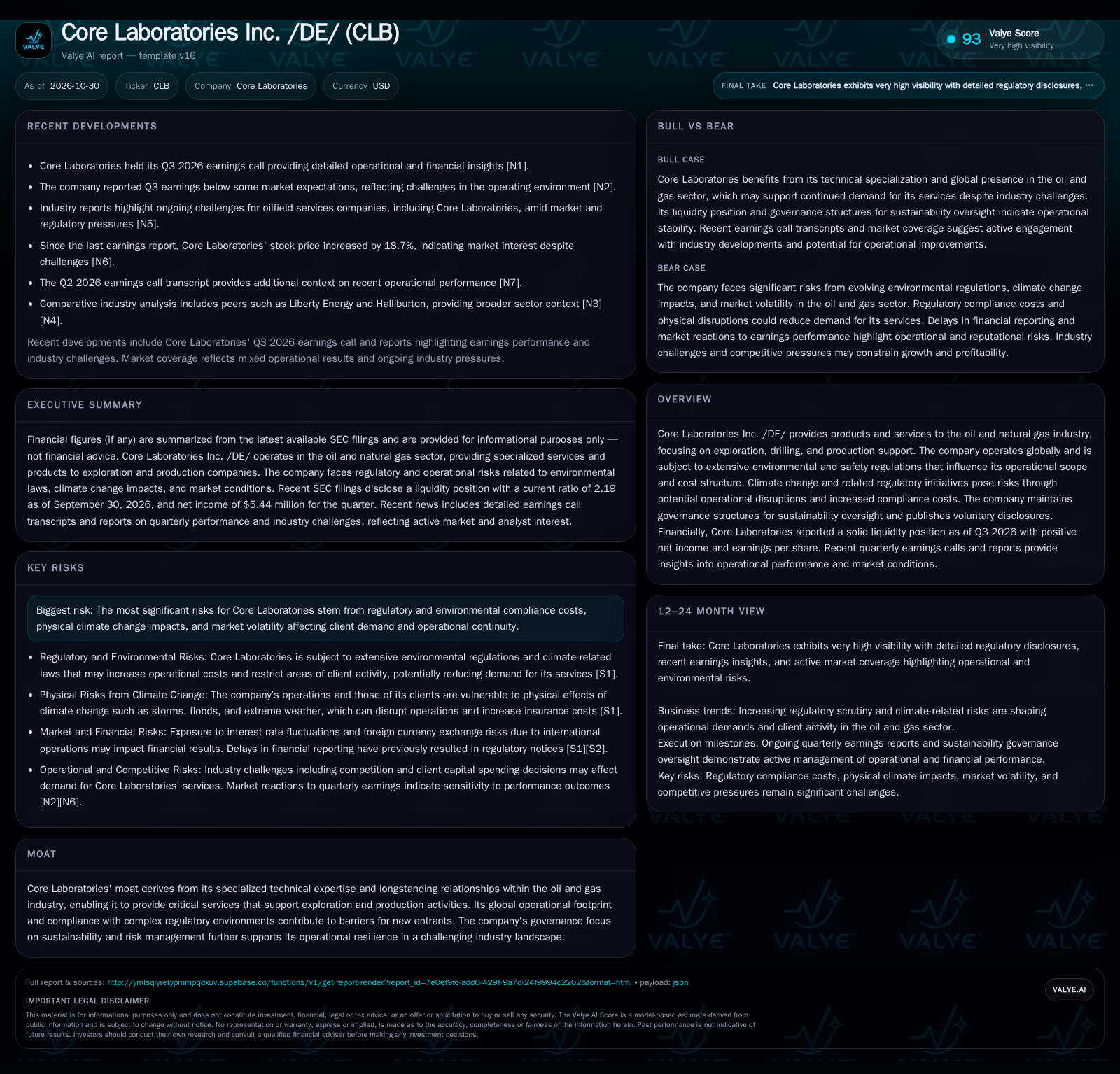
Core Laboratories posted a Q3 2026 net income of $5.44 million and reported liquidity-ratio trends of 2.19, but recent earnings missed expectations amid industry volatility and regulatory burdens. The company’s long-term value will depend on its capacity to leverage technical expertise, manage compliance costs, and adapt to a market shaped by decarbonization and client capital discipline. Watch for shifts in client spend, regulatory actions, and Core’s ability to sustain margins in a tightening oilfield services landscape. [S2] [N1] [N2]
Core Laboratories stands at a crossroads as 2026 draws to a close. The company’s latest quarterly results show continued profitability and a conservative liquidity profile, but the underlying industry environment is becoming more complex. Intensifying regulatory scrutiny, physical climate risks, and volatile client demand are reshaping the economics of oilfield services. While Core’s technical strengths and global relationships provide a degree of insulation, its future trajectory will likely be defined by its ability to evolve alongside both client needs and the regulatory landscape.
Recent Financials and Regulatory Dynamics Shape the Near-Term Outlook
As of September 30, 2026, Core Laboratories reported cash and cash equivalents of $21.4 million, current assets of $225.1 million, and current liabilities of $102.7 million, resulting in a current ratio of 2.19. Net income for the quarter was $5.44 million, with basic and diluted EPS of $0.12. The company reported cash and liquidity metrics for the period; these figures do not by themselves establish operating runway, investment capacity, financial flexibility, or financing capacity. The company has also faced regulatory scrutiny, including a NYSE notice for delayed financial filings earlier in the year, though it has since regained compliance. Environmental and climate-related regulations remain a significant risk factor, potentially raising costs and constraining demand for Core’s services as clients face pressure to decarbonize and restrict exploration in sensitive regions. [S1] [S2] [N1] [N2]
How Core Laboratories’ Service Mix and Cost Structure Influence Profitability
Core Laboratories generates revenue by providing specialized products and services that support oil and gas exploration, drilling, and production. The company’s economics are shaped by a mix of high-value technical services—such as reservoir description, production enhancement, and laboratory analysis—that typically command premium pricing due to their critical role in optimizing client assets. However, the business is highly sensitive to client capital spending cycles, which are driven by commodity prices, exploration budgets, and regulatory constraints.
Fixed costs are substantial, reflecting the need for advanced laboratory infrastructure, technical talent, and regulatory compliance. This creates operating leverage: as volumes increase, incremental revenue can drive outsized profit growth, but downturns quickly pressure margins. Variable costs include materials, labor for field services, and logistics, which can be managed to some extent but are subject to inflationary pressures and supply chain volatility. Capital needs are moderate relative to asset-heavy drilling peers, focusing on technology upgrades, equipment, and working capital rather than large-scale infrastructure. [S2]
Pricing power is limited by competitive intensity and client bargaining power, especially as exploration and production (E&P) clients focus on cost containment and shorter-cycle projects. Service differentiation and technical reputation can support above-average margins, but these advantages are eroded if regulatory costs rise faster than Core can pass them on to clients.
Technical Differentiation vs. Industry Commoditization: The Competitive Landscape
Core Laboratories’ competitive position is anchored in its technical expertise and long-standing relationships with global E&P clients. The company’s moat is built on specialized knowledge, proprietary methodologies, and regulatory compliance capabilities that are difficult for new entrants to replicate. However, within the oilfield services sector, barriers to entry have narrowed as digitalization, automation, and standardization increase. Large integrated peers and smaller niche providers both compete aggressively, with some able to undercut pricing or bundle services.
Switching costs for clients are moderate—while technical trust and data continuity matter, cost pressures can drive E&Ps to periodically rebid contracts or shift spend to lower-cost alternatives, especially during downturns. Technology substitution is a growing threat: advances in digital reservoir modeling, remote monitoring, and AI-driven analytics could erode demand for traditional laboratory services over time if Core does not continue to innovate.
Peers such as Liberty Energy and Halliburton face similar regulatory and market headwinds, suggesting that industry-wide performance will be shaped by both macro cycles and each firm’s ability to adapt service offerings. Core’s global reach and compliance record offer some resilience, but future differentiation will depend on continuous technical innovation and agility in responding to client decarbonization mandates.
Unlocking Value Through Decarbonization Solutions and Client Retention
Core Laboratories could outperform if it leverages its technical capabilities to help clients navigate the energy transition—developing new services for carbon capture, enhanced oil recovery with lower emissions, or advanced reservoir analytics that support decarbonization goals. If regulatory costs are contained or Core is able to pass them through via premium solutions, margins could stabilize or even expand.
A favorable causal chain would involve: (1) stable or rising client capital spend as oil prices recover or remain robust, (2) Core capturing share in specialized service lines tied to emissions reduction or regulatory compliance, and (3) successful retention of major global clients through differentiated offerings. Confirmation would come from rising service mix toward energy transition projects, improved gross margins, and commentary on contract wins linked to decarbonization or regulatory adaptation.
Falsification would occur if Core’s service mix remains static, margins are compressed by regulatory costs, or if client budgets shift decisively away from exploration and production support even as energy demand recovers.
Sustained Profitability Amidst Regulatory and Client Spending Volatility
The most plausible scenario is that Core Laboratories maintains modest profitability, with earnings fluctuating alongside client capital cycles and regulatory developments.
Industry volatility—driven by fluctuating oil prices, evolving climate policy, and periodic supply-demand mismatches—creates a ceiling on both volume and pricing. Core likely retains key client relationships but faces ongoing margin pressure as clients demand cost reductions and regulatory costs incrementally rise. Periodic operational setbacks, such as weather disruptions or supply chain snags, add to the noise.
Evidence supporting this scenario would include steady but unspectacular revenue growth, stable or slightly declining gross margins, continued positive net income, and regular commentary on compliance and cost management. Falsification would be indicated by sustained revenue contraction, negative cash flow, or a material loss of major client contracts.
Regulatory Escalation and Client Retrenchment Squeeze Margins and Growth
A negative scenario could unfold if regulatory costs and climate-related restrictions accelerate faster than Core’s ability to adapt, causing clients to curtail exploration spending or shift budget to alternative energy projects. In this world, Core faces shrinking addressable markets, margin erosion from compliance costs, and potential stranded assets if laboratory capacity goes underutilized.
Physical climate impacts—such as storms or extreme weather—could further disrupt operations, drive up insurance costs, and create episodic financial shocks. If industry peers consolidate or aggressively cut prices, Core may be forced to compete on price rather than value, compressing margins further.
Confirmation of this scenario would include a sharp drop in revenue, negative net income, rising compliance and insurance expenses, or evidence of asset impairments. Falsification would require demonstration that Core is not only maintaining but expanding its service mix and client spend despite regulatory headwinds.
Operational and Strategic Markers That Will Define Core’s Next Chapter
Quarterly revenue and net income trends, particularly their sensitivity to oil prices and client capital spending cycles.
Gross and operating margin evolution, with attention to the impact of regulatory compliance and cost pass-through ability.
Service mix breakdown—especially growth in offerings tied to decarbonization, regulatory compliance, or digital solutions (if disclosed).
Major contract wins or losses, including commentary on client retention and competitive rebids.
Disclosure of regulatory or environmental compliance costs as a percentage of revenue, or instances of material regulatory changes affecting operations (if disclosed).
Physical disruption events (e.g., weather, supply chain), and their direct impact on operations or insurance costs (if disclosed).
Capital allocation decisions, including investment in technical upgrades, new service lines, or balance sheet strengthening.
Disclaimer: This is research-only, informational analysis and not investment advice. It may include AI-generated interpretation and general industry context. Always verify important details using primary sources.

Comments