
Kenvue’s Brand-Led Consumer Health Model: Growth Levers, Margin Pressures, and the Stakes of Short-Term Liquidity
Kenvue’s status as the largest pure-play consumer health company by revenue, its iconic global brands, and a digital-first innovation strategy position it at the center of a fiercely competitive sector.
The company’s digital marketing and R&D scale underpin its innovation efforts, yet maintaining margins and growth will depend on supply chain resilience, cost management, and continued brand relevance in a shifting market landscape. [S2] [N4]
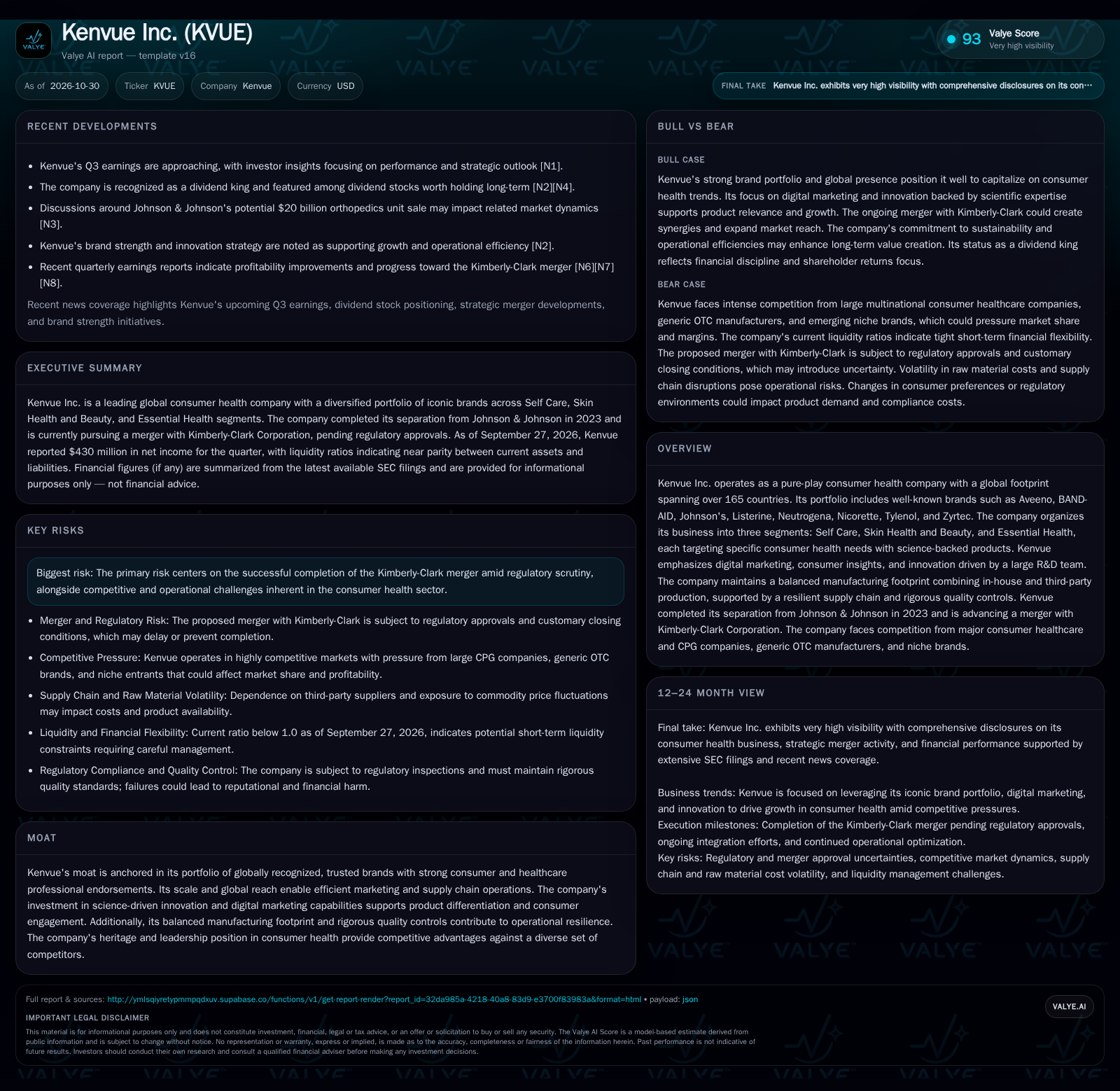
Kenvue Inc. stands at a pivotal juncture as the world’s largest pure-play consumer health company, with a $15.1 billion revenue base and a stable of household brands spanning over 165 countries. Its digital-first, science-backed approach has helped it remain relevant amid evolving consumer preferences, while robust R&D and a balanced supply chain provide operational backbone. Yet, the company’s near-parity between current assets and liabilities, intensifying competition from both global giants and agile upstarts, and persistent supply chain risks mean that the next phase of value creation will hinge on execution, cost control, and the company’s ability to maintain its brand-led moat in a rapidly shifting landscape. [S2]
Kenvue’s Current Position: Brand Scale, Innovation Drive, and Liquidity Tension
Kenvue reported $15.1 billion in net sales for fiscal year 2025, confirming its status as the largest global pure-play consumer health company. Its portfolio includes iconic brands such as Tylenol, Neutrogena, BAND-AID, and Listerine, marketed in over 165 countries, and spanning three major segments: Self Care, Skin Health and Beauty, and Essential Health. [S2]
For the quarter ending September 27, 2026, Kenvue generated $430 million in net income, with EPS of $0.22. The company’s liquidity snapshot shows cash and equivalents of $1.039 billion, current assets of $5.939 billion, and current liabilities of $6.216 billion, resulting in a current ratio of 0.96 and a cash ratio of 0.17. This near-parity between current assets and liabilities signals tight short-term liquidity and heightens the importance of disciplined working capital and cash management. [S2]
Kenvue’s digital-first marketing strategy and substantial R&D investment—supported by approximately 1,600 scientists—underscore its commitment to science-driven, consumer-centric innovation. The company also maintains a balanced manufacturing footprint, producing about 60% of sales volume in-house while leveraging trusted third-party manufacturers for the remainder. [S2]
How Kenvue’s Brand Scale and Product Mix Shape Its Economic Engine
Kenvue’s business model centers on leveraging globally recognized consumer health brands to capture pricing power and shelf space across both developed and emerging markets. Its revenue is diversified across three segments, each with distinct margin profiles: Self Care (OTC and wellness), Skin Health and Beauty, and Essential Health (including oral and baby care). High brand equity may enable premium pricing, but the presence of generics and private-label competitors limits the ability to consistently pass through cost inflation without risking share loss.
Fixed costs are significant, especially in R&D, regulatory compliance, and brand marketing. However, global scale offers potential for operating leverage—incremental sales from established brands can drop meaningfully to the bottom line, provided that volume growth outpaces fixed-cost inflation. Variable costs, particularly in supply chain and raw materials, are subject to external shocks (commodity prices, logistics bottlenecks), which can compress gross margins if not offset by productivity gains or pricing actions.
Capital needs are moderate for a consumer health peer, with capex largely focused on manufacturing upgrades, digital infrastructure, and brand support rather than heavy asset expansion. The cited source reports dividend-related activity; that disclosure alone does not establish dividend-policy continuity, management confidence, or a material constraint on capital flexibility. [N4] [S2]
Brand Moat Meets Margin Squeeze: Kenvue’s Competitive Landscape
Kenvue’s competitive strength lies in its portfolio of legacy, globally trusted brands, which offer built-in consumer trust and professional endorsements. This brand moat supports premium shelf positioning and repeat purchase behavior, particularly for OTC and personal care staples. However, the company faces multi-layered competition: multinational consumer health and CPG conglomerates, regional and local players, generic OTC manufacturers, and increasingly, digitally native niche brands that can exploit social platforms and influencer marketing at lower cost.
Switching costs for most products are relatively low—consumers may shift for price, perceived efficacy, or brand affinity—making sustained innovation and marketing investment critical. Digital-first upstarts may pressure Kenvue’s brands by targeting specific consumer segments with agile, data-driven campaigns. Meanwhile, generic manufacturers can undercut established brands on price in both OTC and commoditized essential health categories, threatening margin stability.
Kenvue’s global scale and supply chain resilience, including a mix of in-house and third-party manufacturing, offer some insulation against regional shocks and cost volatility. Yet, maintaining this advantage requires rigorous quality control and regulatory compliance—any lapse could rapidly erode brand trust and open the door to competitors.
What a Brand-Led Growth Cycle Could Look Like for Kenvue
If Kenvue executes on its digital-first marketing and innovation strategy, it could reinvigorate growth across core brands and successfully launch new science-backed products tailored to emerging consumer health trends. Effective adoption of precision marketing and e-commerce, combined with global R&D scale, may allow Kenvue to capture premium pricing and expand share in categories where consumer trust and regulatory barriers are high.
A favorable scenario would see operating leverage from top-line growth, as incremental sales from established brands flow through to earnings with limited increases in fixed costs.
Evidence that would confirm this scenario includes sustained above-market revenue growth in core and new product categories, stable or expanding gross and operating margins, and positive working capital trends despite sector-wide cost pressures. Increased digital engagement metrics and successful product launches in high-growth regions would further validate the thesis.
Most Likely: Margin Stability Battles Cost Pressures and Competitive Churn
The most plausible trajectory for Kenvue is steady, modest revenue growth with intermittent margin pressures as the company navigates rising input costs, supply chain complexity, and evolving consumer preferences. Brand strength and global reach should allow Kenvue to defend core product categories, but gains may be offset by periodic market share losses to generics and niche digital brands, particularly in commoditized or fast-changing segments.
Margins are likely to fluctuate within a narrow band as pricing actions and operational efficiencies are counterbalanced by competitive discounting and input cost volatility. Dividend payments remain sustainable, but the company may need to moderate payout growth to preserve balance sheet flexibility.
Signals supporting this scenario would include revenue and EPS growth roughly in line with the broader consumer health sector, stable (but not expanding) margins, and maintenance of current liquidity ratios. Watch for incremental innovation rather than breakthrough launches, and cost discipline to offset inflationary pressures.
When Margin Compression and Liquidity Risks Collide
In an adverse scenario, persistent input cost inflation, supply chain disruptions, or regulatory setbacks could drive sustained margin compression, eroding Kenvue’s ability to fund brand support and innovation. If generic and niche competitors accelerate share gains—especially in key OTC and essential health categories—Kenvue may be forced into deeper price competition, further squeezing profitability.
A significant regulatory or quality control event could also damage brand equity, compounding competitive losses and pressuring near-term cash flow.
Confirmation of this scenario would include declining gross and operating margins, negative working capital trends, dividend reduction or suspension, and evidence of market share losses in core categories. Deterioration in consumer sentiment or regulatory actions affecting major brands would further signal downside risk.
Thesis-Testing Data Points for Kenvue’s Brand-Led Consumer Health Ambitions
Quarterly trends in gross and operating margins, especially in the face of raw material or logistics cost volatility.
Organic revenue growth rates by segment and geography, with attention to shifts in core brand performance versus new product launches.
Success of digital marketing initiatives, measured by e-commerce share, digital engagement metrics, and direct-to-consumer channel growth—if disclosed.
Market share data in key OTC, skin health, and essential health categories, especially relative to generic and digitally native competitors—would help test the thesis.
Evidence of regulatory or quality control issues, including product recalls, adverse inspection outcomes, or reputational events.
Pace and impact of R&D-driven innovation: number of new product launches and their contribution to revenue mix—if disclosed.
Disclaimer: This is research-only, informational analysis and not investment advice. It may include AI-generated interpretation and general industry context. Always verify important details using primary sources.

Comments