
SPX Technologies: HVAC Expansion, Acquisition Integration, and the Stakes of Supply Chain Volatility
SPX Technologies’ continued expansion through targeted acquisitions in HVAC and detection technologies has fueled substantial backlog and segment growth. Yet, the company faces a complex interplay of integration risk, raw material cost exposure, and geopolitical headwinds that could reshape its margin and revenue trajectory over the next cycle.
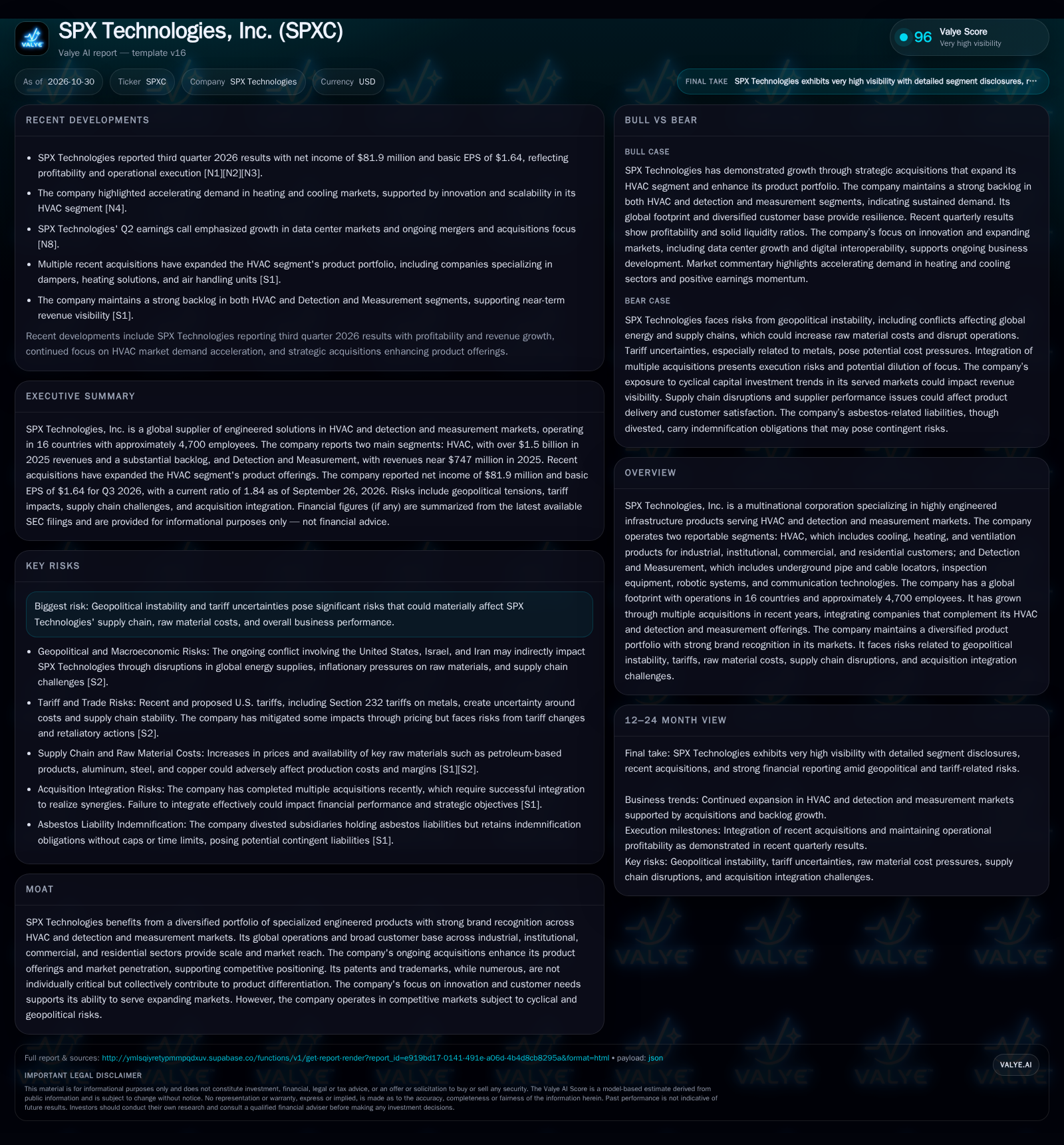
SPX Technologies has increased its scale and product breadth through multiple recent acquisitions, driving revenue growth and a sizable backlog in both HVAC and detection segments. While this strategy has expanded addressable markets and near-term visibility, the company is exposed to integration execution, raw material volatility, and geopolitical disruptions that could pressure margins and operational stability going forward. Monitoring acquisition synergies, pricing power, and supply chain resilience will be critical to the investment thesis. [S1] [S2]
SPX Technologies, Inc., a multinational supplier of engineered HVAC and detection solutions, has used strategic acquisitions to expand its footprint and deepen its portfolio, particularly in the industrial and commercial HVAC markets. With robust backlogs in both core segments, the company enters 2026 with strong near-term revenue visibility. However, as it integrates a series of recent acquisitions—while navigating volatile raw material markets and geopolitical instability—SPX faces a pivotal period where its ability to realize M&A synergies, manage cost pressures, and maintain operational continuity will shape its competitive and financial trajectory. [S1] [S2]
Recent Acquisitions and Backlog Trends Define SPX’s Near-Term Outlook
SPX Technologies’ operating context is shaped by a wave of acquisitions—TAMCO, ASPEQ, Ingénia, Kranze Technology Solutions, Sigma & Omega, Thermolec, and Crawford—completed between 2023 and early 2026. These deals have largely augmented the HVAC segment, expanding the company’s product suite and addressable markets. As of year-end 2025, the HVAC segment reported $1.52 billion in revenue and a $584.5 million backlog, with 83% of that backlog expected to be realized as revenue in 2026. The Detection and Measurement segment contributed $746.9 million in 2025 revenue and a $350.3 million backlog, with 66% slated for 2026 conversion. This backlog underpins near-term revenue visibility but also creates execution pressure as the company works to deliver on these orders amidst a volatile macro environment. [S1]
On the financial side, SPX reported Q3 2026 net income of $81.9 million and basic EPS of $1.64, with cash and equivalents of $119.2 million and a current ratio of 1.84 at quarter-end. While these metrics reflect a healthy operational baseline, the company’s balance sheet and earnings quality will be tested by ongoing integration and external risk factors. [S2]
How SPX Technologies’ Revenue Model and Margin Profile Could Evolve
SPX Technologies’ business model revolves around the sale of engineered HVAC equipment and detection/measurement solutions, with revenue driven by a mix of project-based orders, recurring service, and aftermarket components. Pricing is typically influenced by the complexity of solutions, brand strength, and the ability to pass through raw material costs. The company’s recent acquisition spree suggests a strategic tilt toward platform breadth—enabling cross-selling and upselling across industrial, commercial, and institutional customers.
Fixed costs are significant, especially in manufacturing, R&D, and sales infrastructure, but the company’s scale and product diversity offer potential operating leverage as volume grows. Variable costs are heavily exposed to fluctuations in steel, aluminum, copper, and petroleum-based inputs. If SPX can successfully integrate its acquisitions and extract synergies, incremental margins on acquired revenue could improve. However, integration costs, potential overlaps, and dilution of focus may offset some of these gains.
Capital needs for ongoing M&A and technology upgrades remain material, particularly as the company seeks to maintain competitive product offerings. Working capital management is critical given the project-driven nature of much of the backlog, and disruptions in supply chain or payment cycles could impact cash conversion.
Market Reach, Differentiation, and the Challenge from Global Rivals
SPX Technologies benefits from a diversified portfolio and established market presence, particularly in HVAC, where recent acquisitions have added product depth and customer coverage. The company competes against a mix of global conglomerates and specialized engineering firms in both HVAC and detection markets. Brand recognition, breadth of solutions, and ability to meet complex customer requirements provide some insulation from pure price competition, especially in institutional and industrial segments.
However, SPX does not operate in isolation. Large multinational competitors often have greater resources for R&D, global distribution, and pricing flexibility. In detection and measurement, technology substitution and digital integration are accelerating, raising the stakes for innovation and interoperability. The company’s ability to differentiate via proprietary features, system integration, and customer service will be tested as digital and IoT-enabled solutions proliferate. Supply chain resilience and the ability to pass through cost inflation are likely to be key competitive battlegrounds over the next cycle.
If Integration Delivers: Margin Expansion and Market Share Gains
A constructive scenario for SPX Technologies hinges on successful integration of its recent acquisitions, leading to realized revenue synergies, cost rationalization, and incremental margin expansion. As the company leverages its enhanced HVAC portfolio, cross-selling opportunities could drive above-market growth, particularly in sectors like data centers, institutional buildings, and high-spec industrial applications. If supply chain bottlenecks ease and SPX maintains pricing discipline amid raw material volatility, margins could benefit from both operating leverage and improved procurement terms.
Confirmation of this scenario would come from sequential gross and operating margin improvement, outperformance of backlog conversion rates, and evidence of revenue synergies in segment disclosures. Additionally, sustained growth in high-margin detection and measurement niches, as well as visibility into recurring service and aftermarket revenues, would support the case for a more robust earnings profile.
Execution Balances Tailwinds and Headwinds in a Volatile Environment
The most plausible trajectory for SPX Technologies is one of steady top-line growth driven by backlog conversion and incremental contributions from recent acquisitions, offset by ongoing margin pressure from raw material costs and integration expenses. The company is likely to realize some, but not all, potential synergies from its expanded portfolio, with execution risk and supply chain volatility tempering the pace of margin improvement.
Continued exposure to tariff shifts, geopolitical instability, and inflationary input costs may constrain gross margin expansion, even as volume grows. The company’s ability to maintain backlog discipline, manage working capital, and avoid significant integration missteps will be central to sustaining earnings momentum. Evidence supporting this scenario would include modest but consistent EPS growth, stable or gradually improving margins, and manageable net working capital swings.
Cost Shocks and Integration Missteps Could Disrupt Profitability
A negative scenario could materialize if raw material costs spike further or if supply chain disruptions intensify, eroding gross margins and delaying project delivery. Failure to integrate acquisitions effectively—resulting in operational redundancies, cultural friction, or customer attrition—could dilute the expected benefits of recent deals. Additionally, if tariff regimes become more punitive or geopolitical instability escalates, SPX could face elevated input costs, shipment delays, or even lost orders.
This scenario would be confirmed by declining gross and operating margins, missed revenue or EPS guidance, increased inventory or receivable days, and disclosures of integration-related charges or customer losses. An unexpected call on legacy indemnification obligations could also create unanticipated cash outflows, further pressuring potential financial flexibility.
Milestones and Metrics That Will Clarify SPX Technologies’ Acquisition-Led Growth Thesis
Backlog conversion rate by segment—actual revenue recognized versus guided expectations, especially in HVAC and Detection and Measurement. [S1]
Gross and operating margin trends, with a focus on sequential improvement and acquisition-related synergies, if disclosed.
Integration progress updates for each major acquisition, ideally including cost savings, cross-selling wins, and retention of key customers or personnel.
Breakdown of raw material cost pass-through and pricing actions in response to tariff or commodity shocks, if disclosed.
Working capital efficiency, including inventory and receivable days, to assess cash conversion and supply chain health.
Incremental revenue or margin contribution from new products or geographies added via recent acquisitions, if disclosed.
Any disclosures or charges related to asbestos indemnification obligations or other legacy liabilities.
Updates on recurring service, aftermarket, or digital solution adoption to gauge progress toward more resilient, higher-margin revenue streams.
Disclaimer: This is research-only, informational analysis and not investment advice. It may include AI-generated interpretation and general industry context. Always verify important details using primary sources.

Comments