
BNY Mellon’s Platform Model: Scale, Regulation, and the Stakes of Global Custody Leadership
With $59.3 trillion in assets under custody and a global platform spanning securities services, wealth management, and investment management, BNY Mellon stands at the intersection of financial infrastructure and regulatory complexity. The firm’s scale, diversified revenue streams, and technology focus offer resilience—but margin pressures and competitive dynamics raise questions about future returns on capital and the durability of its franchise.
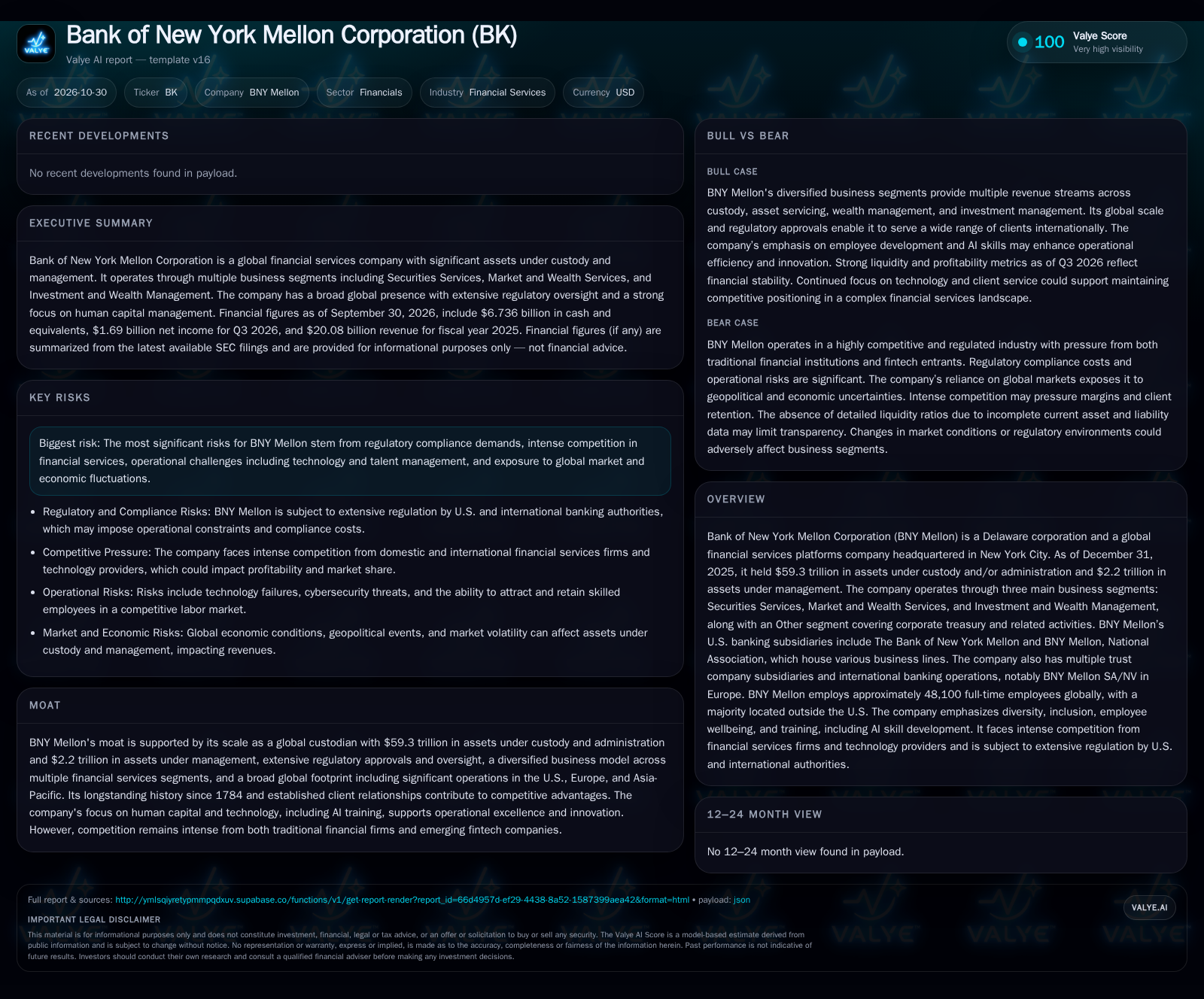
BNY Mellon commands vast scale in global custody and asset servicing, leveraging a diversified platform across three main business segments. While financial performance remains robust as of Q3 2026, the firm faces intense competition from both traditional peers and fintech disruptors, as well as rising regulatory and operational risks. Its future hinges on technology-driven efficiency, client retention, and its ability to sustain pricing power amid global market volatility. [S1] [S2]
BNY Mellon, one of the world’s largest custodians, underpins the infrastructure of global finance. With $59.3 trillion in assets under custody and administration and $2.2 trillion in assets under management, it is a critical service provider to institutional investors, asset managers, and corporates worldwide. The company’s multi-segment model spans securities servicing, wealth management, and investment management, and its global workforce and regulatory footprint reflect a complex, highly competitive landscape. Yet, BNY Mellon’s future will depend on its ability to harness technology, manage costs, and sustain client trust in the face of shifting competitive and regulatory forces. [S1] [S2]
BNY Mellon’s Current Snapshot: Scale, Segments, and Financial Position
As of December 31, 2025, BNY Mellon reported $59.3 trillion in assets under custody and/or administration and $2.2 trillion in assets under management, reinforcing its status as a foundational player in global financial infrastructure [S1]. The company’s three principal business segments—Securities Services, Market and Wealth Services, and Investment and Wealth Management—anchor a diversified revenue base. For Q3 2026, BNY Mellon posted net income of $1.69 billion and held $6.736 billion in cash and equivalents as of September 30, 2026 [S2]. Its global workforce of approximately 48,100, with 60% based outside the U.S., highlights the firm’s international reach and operational complexity [S2]. These metrics matter because they reflect both BNY Mellon’s scale-driven advantages and the operational, regulatory, and margin pressures that come with leading such a vast, global platform.
How BNY Mellon’s Platform Model Drives Revenue and Cost Dynamics
BNY Mellon’s economics rest on high-volume, relatively low-margin services—particularly in custody, settlement, and administration—where scale is crucial. The Securities Services segment typically generates revenue through asset-based fees, transaction fees, and ancillary services, with pricing often pressured by large clients’ bargaining power and industry-wide fee compression. Market and Wealth Services add fee-based income, but also drive float-related interest income, which can increase when interest rates rise. Investment and Wealth Management brings active and passive management fees, with revenue sensitive to both market levels and net flows.
Operating leverage is a key feature: while much of the cost base is fixed (technology, regulatory compliance, global operations), incremental volume can drive margin expansion if new business outpaces expense growth. However, technology investments and regulatory obligations create ongoing capital needs, limiting upside from pure scale. Variable costs include personnel (especially in high-regulation jurisdictions) and client service functions, but automation and digitalization offer potential for margin improvement if executed effectively.
Capital allocation is further shaped by regulatory capital requirements, which can constrain balance-sheet flexibility and return of capital to shareholders. The mix of recurring fees versus more volatile transaction-driven revenue also affects earnings predictability.
Competitive Forces and the Battle for Custody and Asset Servicing Dominance
BNY Mellon competes with other global custodians, major banks, and a fast-evolving set of technology-driven financial service providers. Traditional peers include State Street, JPMorgan Chase, and Citigroup in the custody and fund administration space. Competitive advantages for BNY Mellon include sheer scale, deep client relationships, regulatory approvals across jurisdictions, and a broad product suite. These factors make switching providers costly and risky for large institutional clients, given the operational and regulatory complexity involved.
However, the competitive landscape is shifting. Fee compression is ongoing as clients demand lower costs and as new entrants—particularly fintech and technology service providers—target discrete parts of the value chain with digital-first offerings. Technology innovation is now a core differentiator: firms that can automate, provide real-time data, and integrate seamlessly with clients’ systems may capture share. Reputation and reliability remain critical, as operational errors or security lapses can lead to swift client loss.
If Technology-Led Efficiency and Client Stickiness Prevail
The most favorable scenario for BNY Mellon is one in which technology investments yield substantial operational efficiencies and new value-added services, enabling the firm to lower unit costs while enhancing the client experience. If automation, AI-driven insights, and digital interfaces reduce manual processes and error rates, BNY Mellon could expand margins even in the face of fee compression. Further, if the company successfully deepens wallet share with existing clients—cross-selling wealth and investment management solutions—revenue per client could rise, offsetting industry price pressures.
Confirmation of this scenario would require evidence of sustained cost-to-income ratio improvement, new technology-enabled service launches with strong client uptake, and stable or increasing client retention rates despite competitive bids. Growth in assets under custody/administration above market averages, and rising net flows into wealth and investment management, would also support the upside case.
Sustaining Scale Advantages Amid Margin Pressures and Regulatory Demands
The most plausible medium-term outcome is that BNY Mellon maintains its leadership in global custody and asset servicing, but faces continued margin pressure from fee competition and rising regulatory/compliance costs. Incremental technology-driven efficiencies may help, but are likely offset by the need for ongoing investment to keep pace with client expectations and regulatory mandates. The diversified business model provides resilience, with market and wealth management earnings cushioning volatility in custody revenues.
This scenario would be confirmed by stable or modestly growing assets under custody and management, relatively flat fee margins, and a steady cost base as technology and compliance investments are matched by productivity gains. If disclosed, consistent client retention rates and stable credit ratings would also support this view.
When Disintermediation and Compliance Costs Overwhelm Scale
The adverse scenario involves accelerated fee compression, client attrition to technology disruptors, or a major operational or regulatory failure. If fintech entrants or major asset managers successfully build in-house custody or servicing platforms, BNY Mellon could lose high-value clients, undermining scale advantages and pressuring revenue. Simultaneously, if regulatory costs or capital requirements rise sharply—perhaps in response to a market event or compliance breach—profitability could erode more quickly than technology savings can offset.
Confirmation would come from declining assets under custody/administration, falling client retention rates (if disclosed), negative operating leverage (where expenses rise faster than revenues), or material regulatory penalties. A deterioration in credit ratings, or the need to restructure business lines, would also signal downside realization.
What Will Shape BNY Mellon’s Competitive Durability Over the Next Cycle?
Trends in assets under custody and administration: Sustained growth or market share gains would support the scale thesis, while declines could signal competitive or reputational challenges.
Cost-to-income ratio: Improvement would indicate successful efficiency initiatives; deterioration may reflect rising compliance or technology costs.
Client retention rates (if disclosed): High retention would confirm switching frictions and client stickiness; notable losses would suggest competitive inroads.
Fee margin trends: Monitoring for further compression, especially in the core custody and servicing segments.
Technology-driven service launches and adoption: Evidence of new digital offerings gaining traction would validate innovation-led differentiation.
Net flows in wealth and investment management: Positive flows would indicate cross-selling success and client trust; outflows may flag service or reputational issues.
Regulatory capital ratios and credit ratings: Stability would reflect balance-sheet resilience amid regulatory changes; declines could indicate emerging risk.
Disclaimer: This is research-only, informational analysis and not investment advice. It may include AI-generated interpretation and general industry context. Always verify important details using primary sources.

Comments