
OFS Capital: Navigating Credit Headwinds and Income Imperatives in the Middle Market BDC Landscape
OFS Capital faces a challenging environment as investment losses, rising borrowing costs, and elevated non-accrual loans pressure net asset value and distributable income. Its ability to actively manage debt maturities and maintain quarterly distributions underscores operational discipline, but persistent credit risk and refinancing hurdles test the resilience of its middle-market lending model.
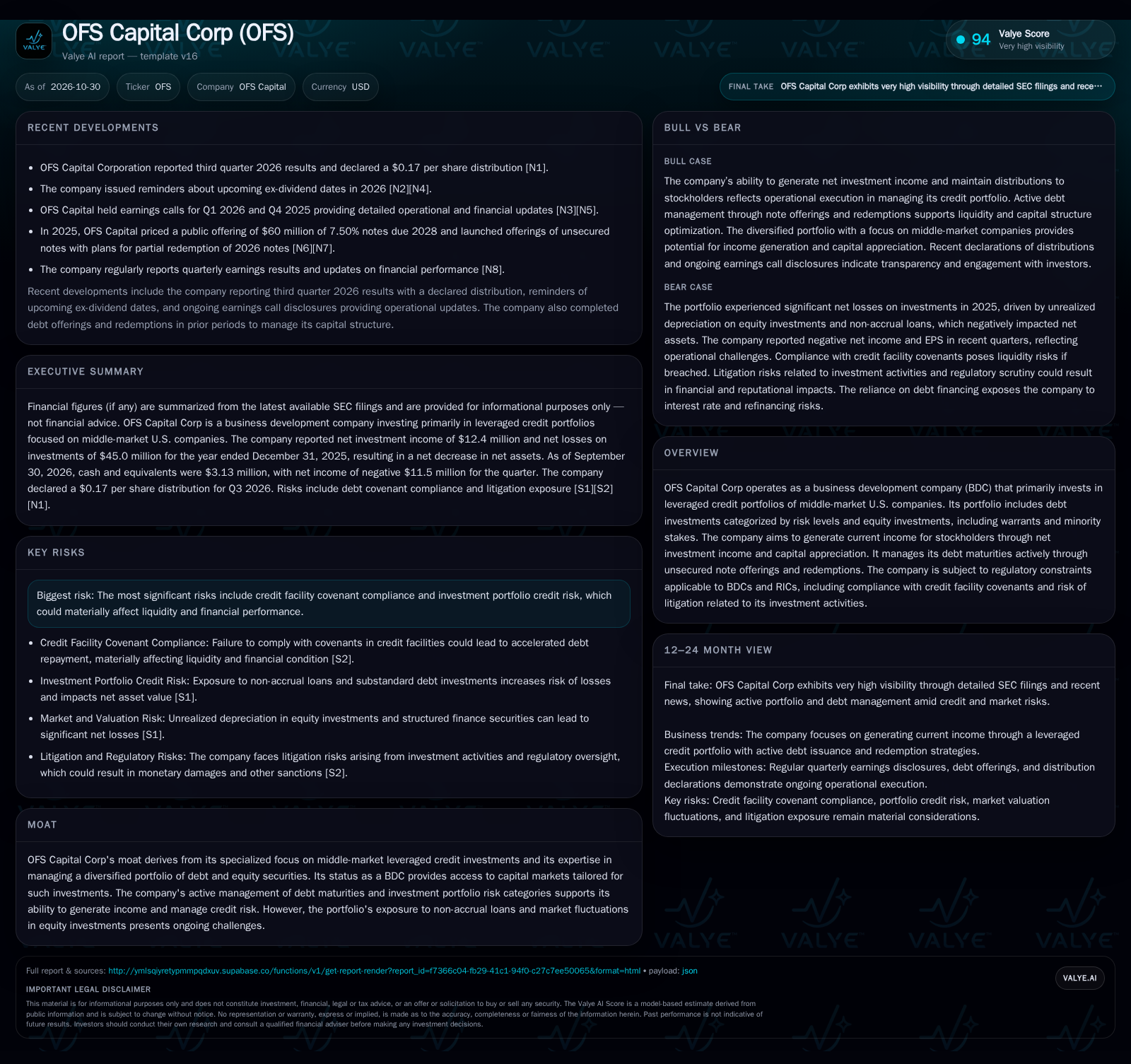
OFS Capital, a business development company focused on middle-market U.S. credit, reported significant net investment losses in 2025 and negative net income in Q3 2026, driven by unrealized depreciation and non-accruals. The company continues to declare quarterly distributions and actively refinances its debt, but rising interest expense and covenant compliance risks highlight ongoing challenges. The future hinges on credit quality stabilization, effective capital structure management, and the ability to generate sufficient net investment income to cover distributions and offset asset volatility. [S1] [S2] [N1]
OFS Capital Corp, a business development company specializing in leveraged credit to U.S. middle-market firms, is contending with a challenging credit environment. Recent results highlight a stark divergence between its ability to generate net investment income and the drag from portfolio losses, unrealized depreciation, and rising funding costs. As the company continues to pay distributions and actively manage its capital structure, investors face a critical question: can OFS stabilize credit quality and sustain distributable earnings amid persistent headwinds?
Recent Results Reveal the Strain Between Income Generation and Asset Quality
OFS Capital reported $40.7 million in total investment income for 2025, with net investment income (NII) of $12.4 million—a foundational metric for BDCs as it underpins distributions to shareholders. However, net losses on investments were a steep $45.0 million, driven by unrealized depreciation on equity holdings and non-accrual loans, resulting in a net decrease in net assets of $33.1 million for the year [S1].
Non-accrual loans remain a material concern: at year-end 2025, $36.6 million in amortized cost (fair value $14.4 million) was classified as non-accrual, highlighting ongoing credit stress in parts of the portfolio [S1].
The company’s September 30, 2026 snapshot showed cash and equivalents of $3.13 million and a quarterly net loss of $11.5 million, with negative EPS and continued portfolio headwinds [S2].
Despite these pressures, OFS Capital declared a $0.17 per share distribution for Q3 2026, maintaining its pattern of shareholder payouts [N1].
How OFS Capital’s Lending Model Amplifies Credit and Funding Sensitivities
OFS Capital’s core business model centers on originating and holding leveraged loans and select equity stakes in middle-market companies. Revenue is generated primarily from interest and fee income on these debt investments, with a smaller but potentially volatile contribution from equity and warrant positions.
The economics of the model rest on the spread between portfolio yields and funding costs, but both sides of the equation are under pressure. Portfolio yields can rise with risk, but so do credit losses—particularly when a sizable portion of assets are on non-accrual or in higher-risk categories. At the same time, the company’s refinancing activity in 2025—redeeming $109 million in notes due 2026 and issuing new unsecured notes due 2028 and 2029 at higher rates—has increased interest expense, which reached $16.5 million in 2025 [S1] [N6] [N7].
Operating leverage in BDCs is typically modest, as asset and management fee growth can be offset by variable interest and credit costs. Capital needs are persistent: BDCs like OFS depend on access to debt and equity markets to fund new investments and refinance maturing obligations, making the cost and availability of capital a recurring strategic concern.
If portfolio credit quality stabilizes, the model can generate attractive NII and support distributions. But sustained high non-accruals and rising funding costs can erode distributable income and net asset value, especially when equity stakes experience unrealized losses.
Middle-Market BDCs: Navigating Crowded Credit Waters and Rising Competition
OFS Capital operates in a crowded BDC landscape, where dozens of public and private vehicles chase yield in the U.S. middle market. The company’s competitive edge may lie in its origination relationships, underwriting discipline, and active portfolio management, but these are difficult to sustain as credit cycles turn and capital becomes more expensive.
Competing BDCs often target similar borrowers and assets, and many have access to lower-cost capital or broader origination networks. Larger BDCs may also benefit from economies of scale, deeper sponsor relationships, or the ability to weather credit cycles with more diversified portfolios.
Substitution risk is real: banks, private credit funds, and direct lenders all compete for middle-market deal flow. In periods of benign credit, these competitors may drive yields lower and terms looser. When defaults rise, BDCs with weaker underwriting or less flexible funding structures are exposed.
OFS’s regular note issuance and active liability management suggest an operational focus on capital structure optimization, but its ability to compete on pricing, structure, and risk appetite will be tested if credit conditions remain challenging or larger peers become more aggressive.
If Credit Quality Stabilizes, Distributable Income Could Rebound
The most favorable pathway for OFS Capital involves a stabilization—or improvement—in portfolio credit quality. If non-accruals decline and the company is able to resolve or restructure troubled loans without significant further write-downs, net investment income could recover and support continued distributions.
A benign or improving macro environment, with resilient middle-market borrower performance and lower-than-expected defaults, would reduce the drag from unrealized depreciation and allow the company’s core lending spread to reassert itself as the primary driver of NII.
Confirmation of this scenario would come from a declining trend in the dollar value and proportion of non-accrual loans, positive changes in fair value marks, and a return to positive net income and net asset value growth in quarterly results. Sustained or increased distributions, alongside stable or falling interest expense as debt matures or is refinanced on favorable terms, would further validate the recovery thesis.
Sustained Credit Stress Keeps OFS in a Defensive Posture
The most plausible scenario is that OFS Capital continues to grapple with elevated credit risk and modest portfolio losses, offset in part by active capital structure management and a commitment to distributions. Net investment income may remain positive, but net losses on investments—driven by ongoing non-accruals and fair value markdowns—could persist, suppressing net income and limiting net asset value growth.
Operationally, OFS will likely continue to refinance maturing debt at higher rates, resulting in elevated interest expense. The portfolio’s risk composition, with a significant share in special mention and substandard categories, suggests that credit headwinds are unlikely to abate quickly.
Evidence for this scenario would include continued quarterly net losses, stable or slightly declining non-accruals, and ongoing distribution declarations even as net asset value drifts lower. Watch for management commentary signaling a cautious approach to new originations and a focus on portfolio remediation rather than aggressive growth.
Portfolio Deterioration and Funding Constraints Could Force a Strategic Reset
The adverse scenario involves further deterioration in portfolio credit quality, with an increasing share of assets moving to non-accrual or being written down. This could trigger accelerated covenant pressures, limit the company’s ability to access new funding on acceptable terms, or force asset sales at depressed prices.
In such an environment, NII may fall below the level needed to cover distributions, prompting a payout cut and further erosion of investor confidence. If credit losses mount and refinancing options tighten, OFS could face liquidity stress, challenges in meeting debt maturities, or even regulatory intervention.
Confirmation of this scenario would come from a rising trend in non-accruals, negative fair value changes across both debt and equity holdings, distribution cuts, or management disclosures about covenant breaches or going concern risks. Inability to refinance debt or forced asset sales at significant losses would be strong negative signals.
Testing the Resilience of OFS Capital’s Credit and Income Model: What Will Matter Most
Quarterly changes in non-accrual loan balances, both in dollar terms and as a percentage of the overall portfolio, if disclosed.
Net investment income versus declared distributions—does NII consistently cover payouts, or are distributions being funded by asset sales or leverage?
Trends in net asset value per share: stabilization or recovery would suggest credit headwinds are moderating.
Interest expense as a share of total operating costs, especially after recent refinancing activity.
Portfolio risk ratings migration—movement of assets between average, special mention, and substandard categories.
Status of credit facility covenants and any management disclosures regarding covenant compliance or waivers.
Results and commentary from quarterly earnings calls, particularly around portfolio performance, new originations, and credit remediation strategies.
Announcements or guidance regarding future distribution policy, especially if accompanied by changes to payout levels or explicit caution about sustainability.
Disclaimer: This is research-only, informational analysis and not investment advice. It may include AI-generated interpretation and general industry context. Always verify important details using primary sources.

Comments