
Upbound Group’s Multi-Segment Model: Digital Growth, Margin Levers, and Portfolio Discipline in Consumer Finance
Upbound Group is leveraging digital segment momentum and margin initiatives to drive earnings, while executing a $50 million share buyback and emphasizing portfolio discipline. The mix of Brigit’s digital expansion and Acima’s margin focus could reshape earnings resilience—but execution and regulatory risk loom large.
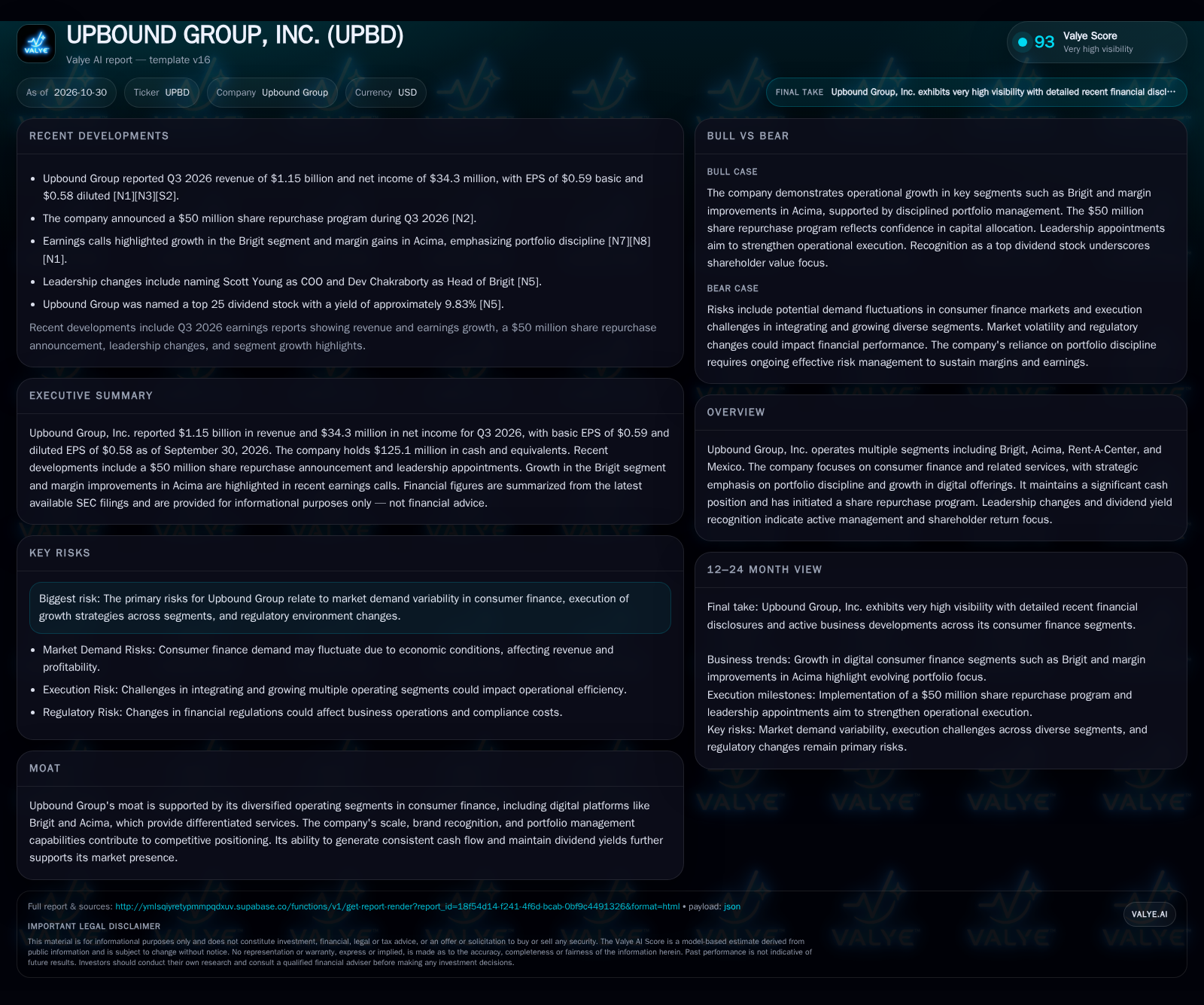
Upbound Group reported $1.15 billion in Q3 2026 revenue and $34.3 million in net income, supported by growth in its Brigit segment and margin gains in Acima. The company launched a $50 million share repurchase program and maintains a $125.1 million cash position. Execution in digital growth and portfolio discipline will determine the sustainability of recent margin and earnings improvements. Regulatory and demand volatility remain core risks. [S2] [N1] [N2] [N3] [N7] [N8]
Upbound Group, Inc. is at a strategic crossroads, balancing traditional consumer finance operations with accelerated digital growth and ongoing margin initiatives. In Q3 2026, it delivered $1.15 billion in revenue and $34.3 million in net income, topping analyst expectations and underpinning a new $50 million share repurchase program. The company’s Brigit segment is driving digital expansion, while Acima’s margin improvements highlight operational focus. Yet, with multiple business segments, execution risk and regulatory exposure are persistent themes. The next phase will test whether Upbound can convert recent digital gains and portfolio discipline into durable advantage.
Recent Financial Results and Strategic Moves Define the Landscape
Upbound Group reported $1,146,161,000 in revenue and $34,271,000 in net income for Q3 2026, with basic and diluted EPS of $0.59 and $0.58, respectively [S2] [N1] [N3]. These results exceeded analyst expectations, signaling operational momentum. The company announced a $50 million share repurchase program, a capital allocation move that may suggest management’s confidence in future cash flows or a desire to return capital to shareholders [N2]. The company reported cash and liquidity metrics for the period; these figures do not by themselves establish operating runway, investment capacity, financial flexibility, or financing capacity. [S2] Brigit’s digital growth and Acima’s margin gains were central themes in recent earnings commentary, with management emphasizing ongoing portfolio discipline and strategic prioritization of growth areas [N7] [N8] [N1].
How Upbound Makes Money: Segment Dynamics, Margins, and Capital Flows
Upbound Group’s business model spans several consumer finance and retail-adjacent segments: Brigit (digital consumer finance), Acima (point-of-sale leasing/financing), Rent-A-Center (rent-to-own retail), and a Mexico segment. Each segment has distinct economics: Brigit’s digital model likely offers higher incremental margins and lower physical overhead, but requires ongoing investment in technology and customer acquisition. Acima’s margin gains suggest improved underwriting, pricing, or cost controls in its leasing model, where gross margins are sensitive to credit losses and operational efficiency. Rent-A-Center’s traditional rent-to-own business is capital-intensive, with physical inventory and store costs, but can generate strong cash flows if managed for scale and asset turnover.
Revenue and earnings mix across these segments will drive Upbound’s blended margin profile and capital needs. Digital growth in Brigit could improve overall operating leverage, as fixed platform costs are spread across a larger user base. In contrast, physical retail and leasing operations (Rent-A-Center, Acima) have higher variable and capital costs, but may offer more stable recurring revenue streams if customer retention is strong. The $50 million share repurchase program reflects available free cash flow, but also reduces potential financial flexibility unless underlying segment cash generation is durable. Ongoing portfolio discipline—prioritizing higher-margin, lower-risk business lines—will be key to sustaining margin expansion and funding both growth and shareholder returns.
Competitive Forces: Digital Disruption, Scale, and Regulatory Headwinds
Upbound’s competitive environment is shaped by the convergence of traditional consumer finance, digital lending, and point-of-sale financing. Brigit faces competition from fintech lenders and neobanks offering automated savings, overdraft protection, and short-term credit. Acima’s leasing and financing model must compete with both legacy rent-to-own providers and newer, vertically integrated fintechs offering integrated checkout financing. Rent-A-Center’s brick-and-mortar footprint provides scale and brand recognition, but is exposed to digital substitution and shifting consumer preferences.
Potential advantages for Upbound include its diversified segment model, which could smooth volatility across cycles, and its ability to cross-leverage customer data and technology investments. However, regulatory scrutiny of consumer finance products, especially in digital lending, is a persistent risk. The company’s scale may confer some cost advantages in procurement and marketing, but execution discipline is crucial to prevent margin erosion from credit losses or operational missteps. Sustained margin gains in Acima and digital growth in Brigit would signal competitive differentiation, but these trends must outpace both traditional and digital-first rivals.
Digital Acceleration and Margin Expansion Drive Earnings Outperformance
A favorable scenario for Upbound hinges on Brigit scaling its digital consumer finance platform efficiently, driving incremental revenue with relatively modest increases in fixed costs. If Acima continues to deliver margin improvements—through better risk analytics, operational efficiency, or product mix—Upbound’s consolidated margins could rise, supporting stronger earnings growth. The $50 million share repurchase would then be both a signal and a byproduct of robust free cash flow generation.
Confirmation would come through sustained sequential revenue and margin expansion in Brigit and Acima, stable or improving credit metrics, and evidence that platform investments are yielding higher customer lifetime value. If Upbound can demonstrate customer acquisition costs declining over time or stable retention in digital channels, it would suggest durable competitive advantage. Falsification would occur if digital growth stalls, margin gains reverse, or credit losses spike—indicating that recent outperformance was not structurally repeatable.
Portfolio Balancing and Incremental Gains Amid Execution Risk
The most plausible scenario is that Upbound continues to post incremental growth in its digital and margin-focused segments, but faces periodic volatility from consumer demand and operational challenges inherent in managing a multi-segment portfolio. Brigit’s digital growth may slow as customer acquisition costs rise or as competition intensifies, while Acima’s margin improvements could plateau absent further innovation or cost reduction. Rent-A-Center and Mexico segments likely provide cash flow stability but limited growth.
Base case evidence would include modest sequential revenue growth, stable blended margins, and continued but measured capital returns (e.g., ongoing buybacks or dividends without significant expansion). Evidence against this scenario would be sharp swings in segment performance, regulatory disruptions, or inability to sustain margin improvements—forcing management to revisit capital allocation or segment strategy.
Demand Shocks or Regulatory Change Erode Earnings Power
A negative scenario could unfold if macroeconomic pressures reduce consumer demand for non-prime lending and rent-to-own products, leading to revenue contraction and higher credit losses—particularly in Acima and Brigit. Regulatory tightening in consumer finance, such as new caps on fees or stricter underwriting standards, could also compress margins or restrict growth in the digital segment.
Downside confirmation would include declining revenue, rising credit loss rates, negative operating leverage, or management pausing or reversing share repurchases to preserve cash. A sharp contraction in Brigit’s user base or a spike in Acima’s delinquencies would signal that Upbound’s recent gains were cyclical, not structural. Regulatory actions or adverse legal developments could also materially increase compliance costs or restrict business lines.
What Will Determine If Upbound’s Digital and Margin Story Holds Up
Quarterly revenue and margin trends in Brigit and Acima—if disclosed—will be critical to assessing whether digital growth and margin expansion are sustainable.
Segment-level credit loss rates or delinquency trends would help test the resilience of Acima’s margin gains and Brigit’s lending model.
Customer acquisition cost (CAC) and retention rates in Brigit—if available—would clarify the durability of digital momentum and platform economics.
Progress on the $50 million share repurchase program, and whether it continues or expands, will signal management’s confidence in cash generation.
Any regulatory or legal disclosures affecting digital lending or point-of-sale financing could materially impact future earnings and capital allocation.
Evidence of cross-segment synergies—such as customer migration between Brigit, Acima, and Rent-A-Center—if disclosed, would indicate portfolio leverage.
Ongoing commentary or disclosures around portfolio discipline and capital allocation priorities will illuminate strategic focus and execution risk.
Disclaimer: This is research-only, informational analysis and not investment advice. It may include AI-generated interpretation and general industry context. Always verify important details using primary sources.

Comments