
CarParts.com in 2026: E-Commerce Scale, Persistent Losses, and Strategic Crossroads
CarParts.com continues to grow its aftermarket auto parts e-commerce platform, reporting $129.3 million in Q3 2026 net sales amid ongoing net losses. Partnerships and a diverse trademark portfolio enhance its customer proposition, but persistent unprofitability and competitive pressures underscore the urgent need for operational improvements or strategic realignment.
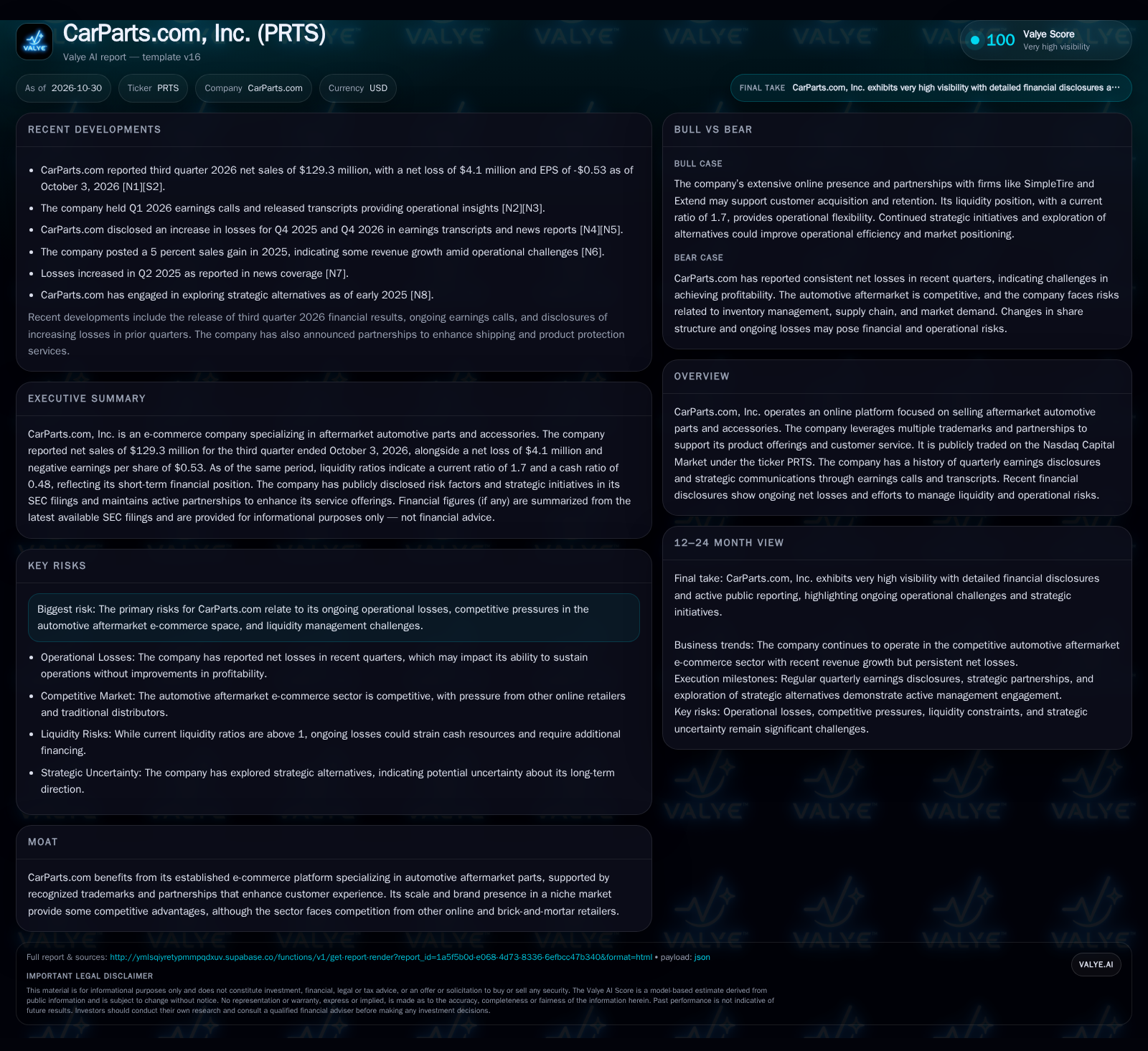
CarParts.com, Inc. remains a leading online retailer of aftermarket automotive parts, posting $129.3 million in Q3 2026 net sales but continuing to record net losses. Strategic partnerships and exploration of corporate alternatives signal management’s efforts to adapt, but the business model’s long-term viability remains under pressure. [N1] [S2]
CarParts.com, Inc. stands at a critical juncture as it seeks to translate scale in the online aftermarket auto parts sector into sustainable profitability. Despite Q3 2026 net sales of $129.3 million, the company reported a net loss of $4.1 million, continuing a trend of negative earnings. Strategic partnerships and management’s willingness to explore alternatives highlight both the company’s adaptability and the ongoing search for a path to value creation in a fiercely competitive landscape. [N1] [S2] [N8]
Recent Performance Underscores Urgency for Strategic Change
CarParts.com reported net sales of $129.3 million for the third quarter ended October 3, 2026, but continued to post net losses, with a Q3 2026 net loss of $4.1 million and EPS of -$0.53. The company’s current assets totaled approximately $128.2 million against $75.5 million in current liabilities, yielding a current ratio of 1.7 and a cash ratio of 0.48. These figures indicate a short-term liquidity buffer, but ongoing losses threaten to erode this cushion if unprofitability persists. Notably, CarParts.com has publicly disclosed its exploration of strategic alternatives since early 2025, emphasizing management’s recognition that the current trajectory may not be sustainable without significant change. [N1] [S2] [N8]
E-Commerce Model: Scale, Margin Pressures, and the Pursuit of Profitability
CarParts.com’s core business is selling aftermarket auto parts and accessories online, leveraging a direct-to-consumer model that circumvents traditional brick-and-mortar retail. Revenue is primarily driven by product sales volume, with pricing influenced by intense competition, consumer price sensitivity, and the commoditized nature of many auto parts. Gross margins in the auto parts e-commerce space are typically pressured by logistics costs, returns, and the need for competitive pricing to acquire and retain customers. The company’s partnerships with firms like SimpleTire (for tire distribution) and Extend (for product protection) aim to enhance customer experience and potentially drive higher conversion or retention, but the impact on margin structure is unclear without explicit disclosure.
Operating leverage in this business is possible at scale, particularly through warehouse automation, improved supply chain management, and digital marketing efficiency. However, persistent net losses suggest that current fixed and variable costs—especially fulfillment, customer acquisition, and technology investment—are not yet being offset by gross profit. The need to maintain inventory breadth and rapid shipping capabilities means working capital and capital expenditures must be carefully managed. If the company cannot achieve sufficient order volume or extract pricing power through branding and service, ongoing funding needs or margin compression could be structural features of the business.
Navigating a Crowded Aftermarket: Brand Presence vs. Online and Offline Rivals
CarParts.com’s competitive landscape is defined by both pure-play online auto parts sellers and traditional brick-and-mortar retailers with e-commerce channels. The company’s suite of proprietary brands (including Kool-Vue®, JC Whitney®, Evan Fischer®, SureStop®, TrueDrive®, DriveWire™, and DriveMotive™) provides some differentiation and may enable better control over product quality and margin compared to reselling third-party brands. Partnerships that streamline shipping and offer product protection can improve the customer journey, potentially reducing churn and boosting repeat purchase rates.
However, switching costs for consumers remain low in this sector, as price, availability, and shipping speed are often paramount. Larger competitors, including national chains and major online marketplaces, benefit from greater scale, wider product assortments, and deeper marketing budgets. Without clear evidence of superior retention, lower customer acquisition costs, or a unique technology platform, CarParts.com’s advantages appear limited to brand familiarity and niche specialization. The risk is that these are insufficient to stave off margin erosion and customer attrition in a highly competitive market.
Operational Leverage and Strategic Actions Could Unlock Profitable Growth
A favorable outcome for CarParts.com would see the company leverage its brand portfolio and partnerships to drive higher order volumes, improved average order values, and better customer retention, thereby achieving operating scale and positive net income. This could be accomplished through enhanced digital marketing efficiency, further integration of value-added services (such as extended warranties and expedited shipping), and more effective inventory management to reduce working capital needs and fulfillment costs.
Evidence that would confirm this scenario includes sustained revenue growth accompanied by improving gross and operating margins, a transition to positive net income, and disclosures of enhanced customer retention or repeat purchase rates. Successful execution of strategic alternatives—such as a sale, merger, or significant business model pivot—could also catalyze value realization if it leads to greater scale or operational efficiencies. Conversely, the absence of margin improvement or further dilution from capital raises would call this scenario into question.
Incremental Improvements Amid Ongoing Competitive and Margin Pressures
The most plausible outcome is that CarParts.com continues to generate solid top-line sales through its online platform but struggles to achieve consistent profitability due to ongoing competitive pressures and high operating costs. Incremental gains from partnerships and brand investments may help, but are unlikely to fully offset the structural challenges of customer acquisition expense and margin compression in a commoditized market.
Confirmation of this scenario would come from continued revenue growth without a corresponding improvement in net income or margins, as well as further management commentary on strategic reviews or cost containment. The scenario would be falsified if the company either achieves clear profitability or, conversely, faces a liquidity crisis requiring urgent external financing or a distressed sale.
Continued Losses Lead to Strategic Contraction or Forced Restructuring
In a negative scenario, CarParts.com’s net losses persist or worsen, outpacing any incremental revenue growth and rapidly depleting its liquidity buffer. This could force the company to seek additional capital on unfavorable terms, cut back on essential investments (such as technology or inventory), or pursue an urgent sale or restructuring. Intensifying competition could further erode pricing power and customer share, accelerating the downward spiral.
Evidence supporting this scenario would include sequential declines in liquidity ratios, shrinking cash balances, disclosures of covenant breaches or going-concern risks, and abrupt changes in strategic direction. Announcements of asset sales, workforce reductions, or a formal restructuring process would confirm that the downside risks have materialized.
Milestones That Will Determine CarParts.com’s Strategic Viability
Gross margin trends: Sustained improvement would indicate progress toward profitable scale, while further compression would signal intensified competition or cost pressures.
Net income trajectory: A shift from recurring losses to profitability, or at least a narrowing of net losses, would be a critical indicator of improved business economics.
Customer retention and repeat purchase rates (if disclosed): These metrics would demonstrate whether partnerships and branding are translating into a loyal customer base.
Average order value and order frequency (if disclosed): Increases here would suggest successful cross-selling or upselling initiatives.
Cash and liquidity position: Monitoring changes in the current and cash ratios will highlight the company’s ability to weather ongoing losses or invest in growth.
Strategic transaction announcements: Any update on mergers, acquisitions, or divestitures would directly impact the company’s future direction.
Competitive pricing dynamics: Evidence of stable or increasing pricing power, or conversely, price wars and discounting, will shape margin outlook.
Disclaimer: This is research-only, informational analysis and not investment advice. It may include AI-generated interpretation and general industry context. Always verify important details using primary sources.

Comments