
CNA Financial Faces Earnings Pressure from Underwriting and Reserve Challenges Despite Strong Investment Income
Q1 2026 results highlight underwriting headwinds and reserve uncertainties impacting core income, balanced by robust investment returns and steady capital management.
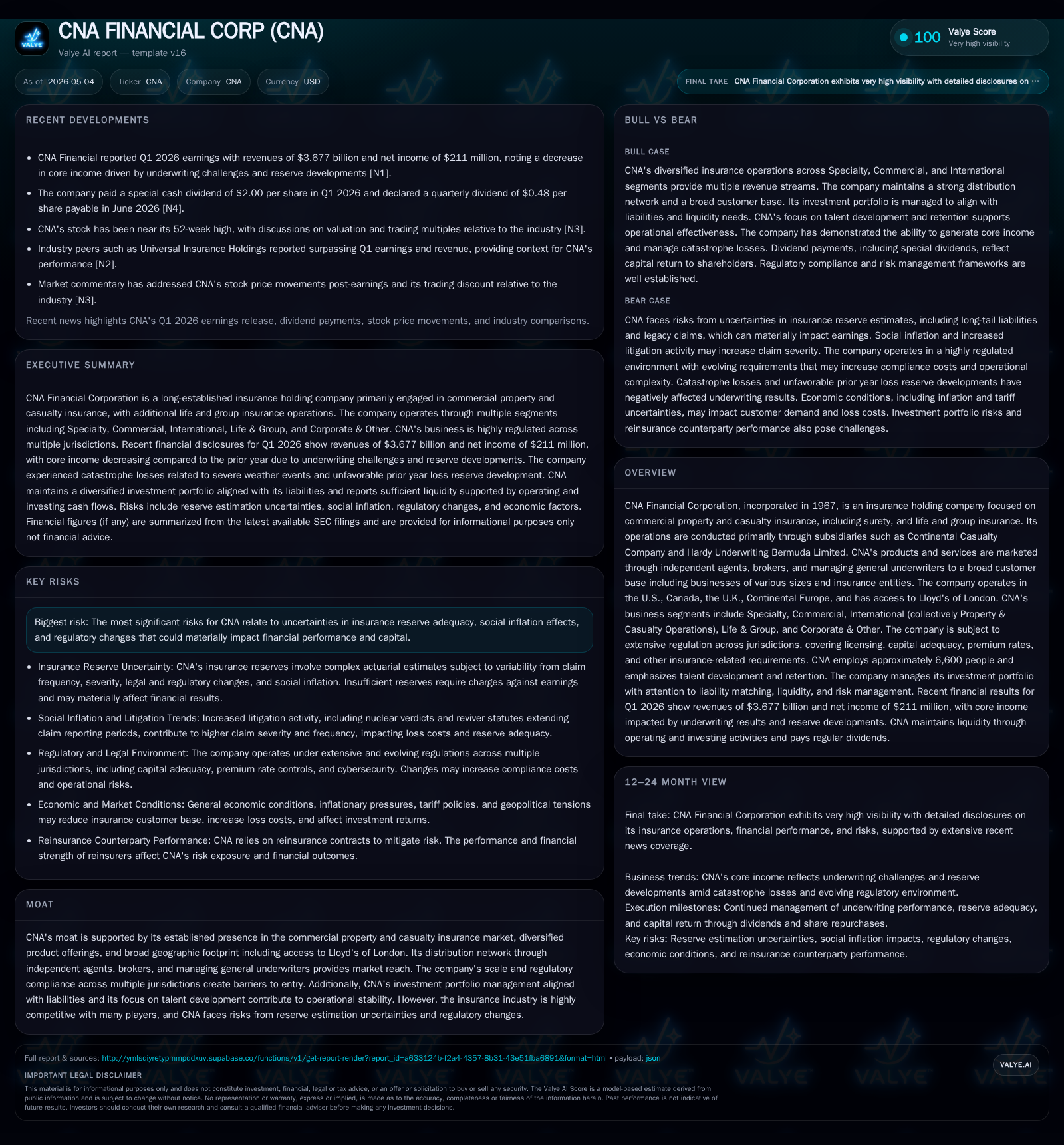
CNA Financial Corp reported a decline in core income for Q1 2026 compared to last year, driven primarily by weaker underwriting outcomes and unfavorable prior year reserve developments within its Property & Casualty segment. Catastrophe losses remained significant but stable, while net investment income saw modest gains. The company declared a substantial special dividend alongside regular dividends, reflecting strong capital generation and confidence in liquidity. CNA continues to operate across Specialty, Commercial, International, Life & Group segments with a diversified global footprint supported by established distribution channels. Key risks remain around reserve estimate accuracy and regulatory constraints, but the company’s disciplined expense management and targeted reinsurance strategies partially mitigate these pressures.
Recent Operating Update
In the first quarter of 2026, CNA Financial Corporation reported core income of $225 million, down 20% compared to $281 million in the same period last year [S8]. This decline was chiefly due to deteriorating underwriting results within Property & Casualty operations as well as unfavorable net prior year loss reserve development totaling approximately $100 million [S8], [S20]. Despite these challenges, net earned premiums grew modestly to $2.7 billion from $2.6 billion YoY [S8], while net investment income improved slightly to $610 million [S2], evidencing solid portfolio performance even as equity-related investment returns softened.
Catastrophe losses remained a notable factor at $88 million for Q1 2026, nearly flat relative to the prior year quarter's $97 million that included significant impact from California wildfires [S8]. The current quarter included an additional $9 million of catastrophe-related reinsurance reinstatement premiums reflecting costs incurred to restore coverage limits after prior storms [S20]. The overall combined ratio worsened to 103.5%, from 101.1% last year driven mainly by a rise in the loss ratio from higher severity claims in excess casualty and workers' compensation lines [S20]. Expense ratios benefited slightly from disciplined cost control efforts.
On liquidity and capital allocation front, CNA paid out cash dividends totaling $682 million during Q1 including a substantial special dividend of $2.00 per share on top of regular dividends [S2], underscoring strong capital generation capacity and shareholder return focus. Additionally, the Board recently declared a quarterly dividend of $0.48 per share payable in June 2026 [S2]. Net cash provided by operating activities declined to $393 million versus $638 million in Q1 2025 due primarily to timing differences related to reinsurance treaty settlements and elevated claim payments [S11]. Investing activities generated more robust cash flow compared with last year largely supporting financing uses.
Business Model
CNA Financial operates as an insurance holding company offering primarily commercial property and casualty (P&C) insurance products alongside life and group benefits through several subsidiaries including Continental Casualty Company (CCC) and Hardy Underwriting Bermuda Limited [S1]. The company serves a diverse customer base ranging from small businesses to large corporations across various industry verticals. Its distribution mix spans independent agents, wholesale brokers, retail brokers, and managing general underwriters providing broad market access both domestically and internationally.
The P&C business is segmented into Specialty (including surety), Commercial (traditional property/casualty), and International lines (covering Canada, U.K., continental Europe and Lloyd's syndicate participation). Non-P&C activities include Life & Group insurance offerings plus Corporate & Other internal services. Revenue mechanics revolve around earning premiums based on risk underwriting assessed per policy terms; premiums are influenced by pricing power over renewal cycles, new business inflows, exposure changes, loss experience trends, and regulatory rate approvals [S20].
Underwriting gains or losses stem from effective risk selection against incurred claims plus operating expenses. CNA measures performance using combined ratios—percentages of incurred losses plus expenses divided by earned premiums—with an aim below 100% representing underwriting profitability excluding investment returns [S2], [S21]. Investments provide steady supplemental earnings predominantly from high-quality fixed income securities aligned with liability profiles though subject to market fluctuations.
Industry Structure and Competitive Position
The commercial P&C insurance industry is highly fragmented with numerous competitors including regional insurers, specialty finance companies, mutual insurers and global players like CNA competing on price competitiveness, underwriting discipline, service quality and product innovation [S1]. CNA distinguishes itself through diversification across geographies—including Lloyd’s access via Hardy Bermuda—and across product lines targeting specialized risk segments such as surety bonds which carry higher margins but require expertise.
Its established relationships with independent agents and brokers provide distribution scale but also invite competition for agent loyalty emphasizing superior service metrics as critical differentiation factors [S1]. Regulatory compliance across multiple jurisdictions imposes capital adequacy demands that favor larger firms with balance-sheet strength such as CNA’s estimated $3 billion debt load managed prudently against statutory surplus requirements [F1], [S10].
Growth Drivers
Key growth drivers include:
- Rate adequacy improvements: CNA has demonstrated ability to push moderate rate increases mostly in specialty/commercial lines which can offset inflationary pressure on claims severity seen across long-tail coverages such as excess casualty and workers’ compensation [S20]. Rate was up ~2% in Q1 vs higher single digits previously reflecting deliberate pricing discipline amid competitive pressures.
- Inorganic portfolio optimization: Selective repositioning by shedding non-core lower-margin accounts while expanding specialty lines harnesses improved profitability mix.
- International expansion: Gains in global markets leveraging Lloyd’s platform plus targeted growth initiatives in Canada/EU support diversification.
- Investment income stability: Maintaining high-quality fixed income allocations alongside limited equity exposure helps sustain steady yield streams aiding earnings resilience despite underwriting volatility.
- Distribution partnerships: Reinforcing broker/agent alliances coupled with enhanced data analytics capabilities bolster customer retention and targeted new business prospecting.
Risks / Watchpoints / Growth Constraints
Notable risks include:
- Insurance reserves uncertainty: Inherent complexity estimating ultimate claim liabilities—particularly long-tail exposures like asbestos/excess workers’ comp—can lead to adverse reserve adjustments negatively impacting earnings unpredictably over time [S16], [S19]. Social inflation trends such as nuclear verdicts exacerbate this risk.
- Underwriting margin pressure: Competitive markets constrain rate increases limiting ability to fully recoup cost inflation notably for casualty exposures adversely affected by increasing litigation frequency/severity.
- Catastrophe event volatility: Severe weather events remain unpredictable drivers of loss spikes necessitating prudent reinsurance programs balancing cost versus coverage gaps.
- Regulatory environment: Increasing regulatory complexity around policy forms, pricing approvals, capital requirements or emerging issues like AI usage introduce possible compliance costs or operational disruptions.[S23]
- Economic conditions: Macroeconomic slowdown or tariff escalations could depress market demand affecting premium growth potential or elevate certain claim-related costs.
What To Watch Next
Investors should monitor:
- Quarterly updates on underlying combined loss ratios excluding catastrophes for signs of underwriting stabilization or deterioration.
- Prior year reserve development trends signaling if recent unfavorable adjustments persist implying reserve strengthening or further erosion needed;
- Rate renewal cadence shifts indicating pricing power retention amidst market competition;
- Progress on expense ratio improvement programs reflecting operational leverage;
- Investment portfolio yield trends against rising interest rates impacting net investment income consistency;
- Regulatory filings or guidance commentary addressing impacts of new laws/regulations or tariff policies influencing cost bases/margins;
- Capital deployment strategies signaled through dividend patterns or share repurchases demonstrating confidence in balance sheet sufficiency.
Brief Financial Context
As of December 31, 2025 CNA reported total revenue of approximately $15 billion with net income near $1.28 billion for the full year [F1], evidencing scale among mid-tier commercial insurers. Total debt approximated $3 billion reflecting moderate leverage manageable given operating cash flow generation capacity per recent quarters' ~$393 million operating cash inflow albeit down from prior-year levels impacted by reinsurance payment timing [S11]. The company's practices around capital allocation maintain healthy liquidity including zero draws on revolving credit facilities maintaining financial flexibility going forward [S10].
Conclusion
CNA Financial stands as a diversified commercial insurer with sizable geographic reach leveraging established distribution channels that underpin its premium flows. Its business model balances premium-driven underwriting revenues with complementary investment income supported by disciplined balance sheet management. Nonetheless recent quarterly results underscore ongoing challenges posed by elevated loss severity trends related to social inflation alongside reserving complexities inherent in long-tail liabilities introducing continued earnings volatility risks. Margins face cyclical pressures mitigated partially by controlled expenses and incremental rate adequacy efforts within targeted product segments. Investor attention should remain focused on how effectively CNA navigates this evolving insurance cycle through prudent underwriting execution coupled with vigilant reserve management amidst an increasingly complex regulatory landscape.
This analysis is based solely on publicly available information as of May 4, 2026. It does not constitute investment advice or recommendations.
Disclaimer: This is research-only, informational analysis and not investment advice. It may include AI-generated interpretation and general industry context. Always verify important details using primary sources.

Comments