
CNBX Pharmaceuticals Struggles to Stabilize Amid Shifting Biotech Aspirations
CNBX’s pivot from resource extraction to cannabinoid-based biotechnology has yet to translate into financial stability, as it grapples with persistent losses and liquidity risks.
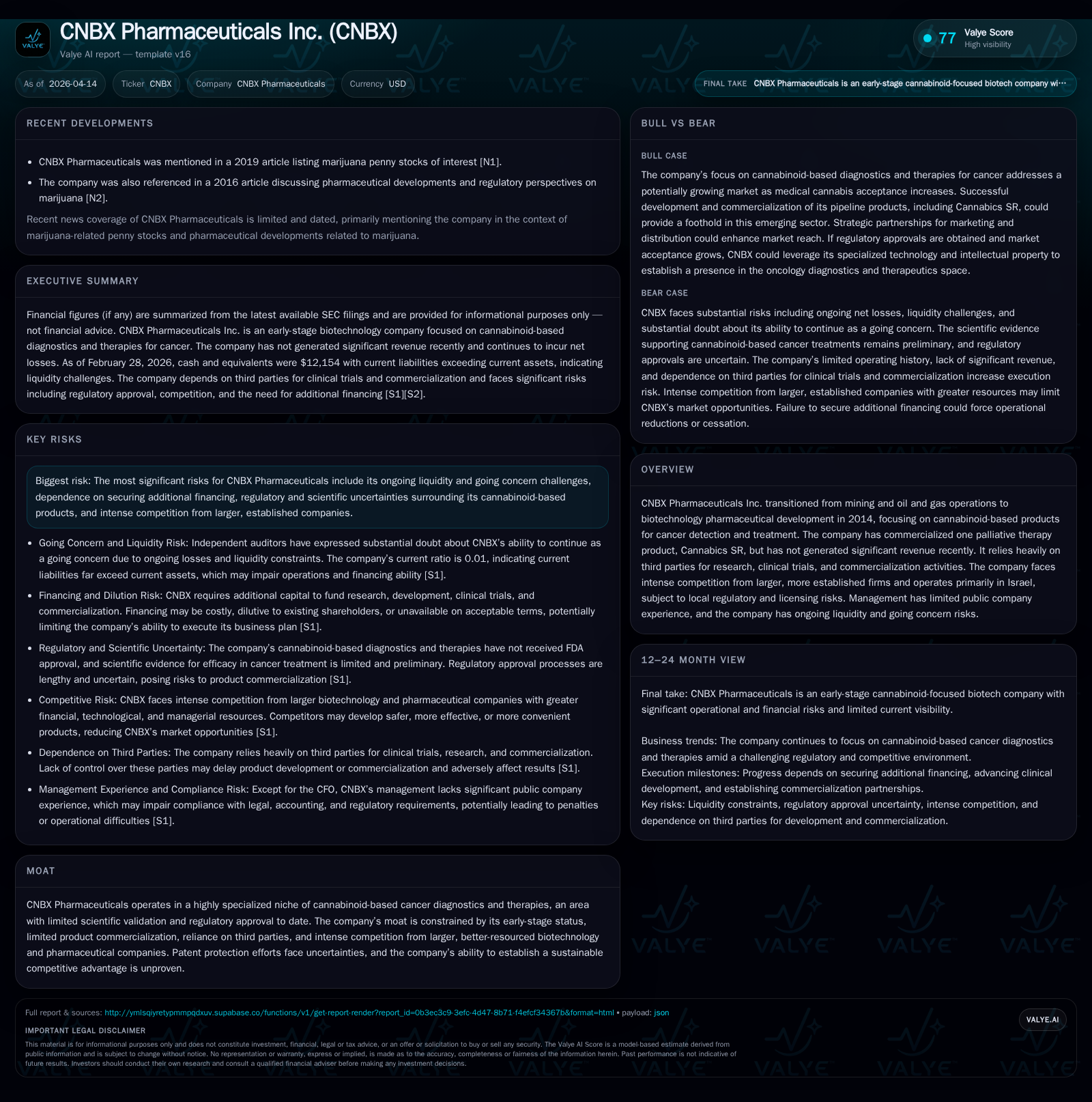
Originally a mining and oil company, CNBX Pharmaceuticals shifted focus in 2014 toward cannabinoid-based cancer diagnostics and therapies but has struggled to generate meaningful revenue or profitability. Operating primarily in Israel, the company depends heavily on third parties for research and commercialization amid a complex regulatory landscape and strong competition. Its financials reflect declining revenues, narrowing losses, and acute liquidity challenges with severe current liabilities far exceeding assets. Without clear forward guidance, CNBX remains reliant on additional financing and milestones in clinical development to alter its precarious position.
Evolution from Natural Resources to Biotech: Past Growth and Revenue Dynamics
CNBX Pharmaceuticals Inc. embodies a striking corporate transformation: originally incorporated as Thrust Energy Corp. in 2004 with operations in oil and gas exploration, the company pivoted through mining activities under the name American Mining Company before realigning radically into biotechnology pharmaceutical development in April 2014. This strategic shift redirected CNBX’s core focus toward pioneering cannabinoid-based products targeting cancer detection and treatment, divesting legacy natural resource assets accordingly [S1].
Financially, this transition has yet to yield sustainable revenues. After modest income tied mostly to laboratory services ($410K in FY2023) the firm's top line eroded rapidly, dropping to approximately $130K by FY2024 before falling to zero reported revenue for FY2025 [F1][S1]. This steep revenue decline underscores operational retrenchment or limited commercial traction beyond its sole marketed product, Cannabics SR (a palliative therapy). The vanishing top line reflects both the early-stage nature of its biotechnology efforts and ongoing capacity constraints.
Operating expenses have seen marked contraction—from over $700K in FY2024 down to roughly $272K in FY2025—as management scaled back general administrative costs and research and development spending during tightening available resources [F1][S1]. Reduced cost outlays signal attempts at financial discipline but have not reversed negative income trends fully.
Historical performance (annual)
| FY | Rev ($) | Net ($mm) | CFO ($) | OpInc ($mm) | Rev YoY | Net YoY |
|---|---|---|---|---|---|---|
| 2025 | 0 | 0 | -171305 | 0 | -100.0% | +54.8% |
| 2024 | 130074 | -1 | -244269 | -1 | -68.3% | +81.3% |
| 2023 | 410165 | -4 | -112521 | -1 | +0.3% | |
| 2022 | -4 | -1679192 | -3 |
Source: SEC companyfacts cache [F1].
Capital returns and efficiency (annual)
| FY | ROE% |
|---|---|
| 2025 | 12.6 |
| 2024 | 28.0 |
| 2023 | 183.9 |
| 2022 | 228.1 |
Source: SEC companyfacts cache [F1].
Note: All figures based on full fiscal years ending August 31; operating income improvements reflect cost cutting rather than revenue growth [F1][S1].
Operational Costs and Profitability Trends: Parsing Financial Strides and Strains
CNBX’s financial trajectory reveals an ongoing struggle with unprofitability albeit with some margin easing driven by decreasing operational scales. While operating losses halved between FY2024 (-$583K) and FY2025 (-$272K), persistent negative net income (-$314K FY2025) illustrates that fixed costs or other expense items still outstrip revenues or capital inflows [F1].
Both general & administrative expenses and R&D expenditures were significantly trimmed year-over-year [S1], though such contractions may limit future innovation pipelines given CNBX’s core mission of developing cannabinoid-based therapeutics that require sustained scientific investment .
An essential red flag emerges from cash flow metrics: operating cash flow (CFO) remains negative (-$171K for FY2025), signifying continual cash burn despite leaner expenditures. This pattern indicates that even post-cost reductions CNBX does not currently generate operational cash surplus necessary for debt servicing or capital reinvestment. If this persists without new financing or revenue inflows the going concern risk flagged by external auditors looms large [F1][S1].
Strategic Dependencies Impacting Growth: Third-Party Reliance and Market Position
One of CNBX’s defining operational constraints is its heavy dependence on external entities for core activities—research collaborations, clinical trials conduction, manufacturing supply chains, regulatory submissions, and commercialization efforts all involve third-party stakeholders [S17]. Such reliance is common within small biotechs that lack internal infrastructure; however it carries strategic drawbacks.
Contract Research Organizations (CROs), academic centers, or licensing partners may impose inflexible timelines or cost structures that strain CNBX’s constrained financial base. Furthermore, lack of day-to-day managerial control can lead to execution delays or misaligned priorities diminishing scalability potential. This dependency further accentuates risks around intellectual property management where patent filings remain uncertain amidst an intense competitive landscape dominated by better-funded multinational pharma firms who aggressively protect proprietary cannabis-related platforms [S5].
Navigating Regulatory and Competitive Headwinds in the Cannabinoid Space
The regulatory environment surrounding cannabinoids remains a labyrinth fraught with obstacles impacting market access prospects. Cannabis is classified as a Schedule I controlled substance under the U.S Controlled Substances Act since 1970, categorizing it alongside drugs with high abuse potential and no accepted medical use federally—a major barrier for companies like CNBX aiming at therapeutic innovation involving cannabis-derived compounds [S6].
While numerous U.S states allow medical or recreational cannabis use—with thirty-seven states plus D.C. permitting medical applications—federal prohibitions introduce legal contradictions that complicate product approvals, reimbursement policies by insurers or government health programs, and interstate commerce regulations [S4][S24]. The ambiguity heightens commercial risk since doctors cannot prescribe Schedule I substances despite state-level permissions.
Internationally too regulatory regimes vary widely; CNBX primarily conducts research in Israel where medical cannabis use entails licensing requirements subject to ad hoc Ministry approvals introducing further operational uncertainty [S18]. Added complexity arises from evolving laws governing product labeling standards and insurance coverage eligibility for diagnostic assays or pharmaceuticals based on cannabinoids—all factors that could delay clinical validation timelines critical for market penetration.
Moreover intellectual property protections around cannabinoid innovations remain tenuous given overlapping patents held by larger players with substantial legal budgets prepared to contest novel claims [S5][S11]. Together these conditions create a challenging commercial corridor requiring robust compliance infrastructures often beyond nascent firms’ means.
Capital Structure Analysis: Liquidity, Financing Tactics, and Equity Dilution Risks
CNBX’s balance sheet reveals acute liquidity stress signaling imminent solvency concerns if remedial action is not taken swiftly. As of February 28th 2026 balance sheet highlights show current assets totaling roughly $14.9K against ballooning current liabilities exceeding $2.54 million—a current ratio approximation of just 0.01 indicates severe short-term liquidity insufficiency jeopardizing day-to-day obligations settlement [F1][S3].
This imbalance manifests the company's ongoing reliance on external financing sources exacerbated by lack of substantial revenue streams or positive cash flow generation capacity.
Recently timed March 2026 disclosures reveal a $45K non-convertible promissory note executed with a private Delaware-based lender bearing modest interest intended exclusively for immediate working capital needs underscoring short-term survival mode [S3]. The absence of share repurchases following earlier buybacks ($30K each recorded in fiscal quarters of early 2020) underscores discontinued investor returns amid financial prioritization shifts ([F1]).
Future capital raising efforts are expected but likely dilutive given already negative equity approaching -$2.5 million indicating accumulated deficit status compromising shareholder value integrity. The company flags potential issuance of derivative securities like warrants or convertible notes which historically introduce non-cash accounting charges diluting net asset positions further if employed again [S1].
Investor vigilance around equity structure changes is warranted given the thin cushion between liabilities and tangible assets escalating governance scrutiny over capital allocation prudence.
Investor Outlook: Milestones, Potential Catalysts, and Value Drivers Ahead
The corporate filings lack explicit forward guidance or milestone schedules leaving prospective stakeholders dependent on interpretative analysis anchored in documented operational risks versus achievements.
Key performance indicators to monitor include progression through preclinical validations required for FDA consideration of cannabinoid-based diagnostics or therapeutic candidates; successful acquisition of Israeli medical cannabis licenses renewal; securing patent grants enhancing IP defensibility; and uptake or retention of third-party licenses augmenting commercialization reach [S1].
Additionally absent clear signals regarding upcoming clinical trial initiations or regulatory submission endpoints restricts near-term catalyst visibility.
Capital raise initiatives remain imperative given negative cash flows—failure to secure adequate financing poses existential threats compelling close attention on debt/equity transaction announcements.
Potential shifts in political-regulatory climates impacting cannabis acceptance could modulate market opportunity size hence profitability trajectories over medium term.
In summary CNBX's early-stage biotech position combined with intense external dependencies amidst harsh financial constraints sets a challenging context requiring prudent execution aligned with focused research milestones attainment.
Disclaimer: This report presents an independent analysis based solely on publicly available filings as of April 2026 without interpreting or projecting future stock performance nor providing investment recommendations.
Disclaimer: This is research-only, informational analysis and not investment advice. It may include AI-generated interpretation and general industry context. Always verify important details using primary sources.

Comments