
Destiny Media Technologies: Revenue Growth Tempered by Profitability Challenges and Customer Concentration
Destiny Media leverages its Play MPE® platform for steady revenue expansion but grapples with declining profitability and significant revenue concentration risks.
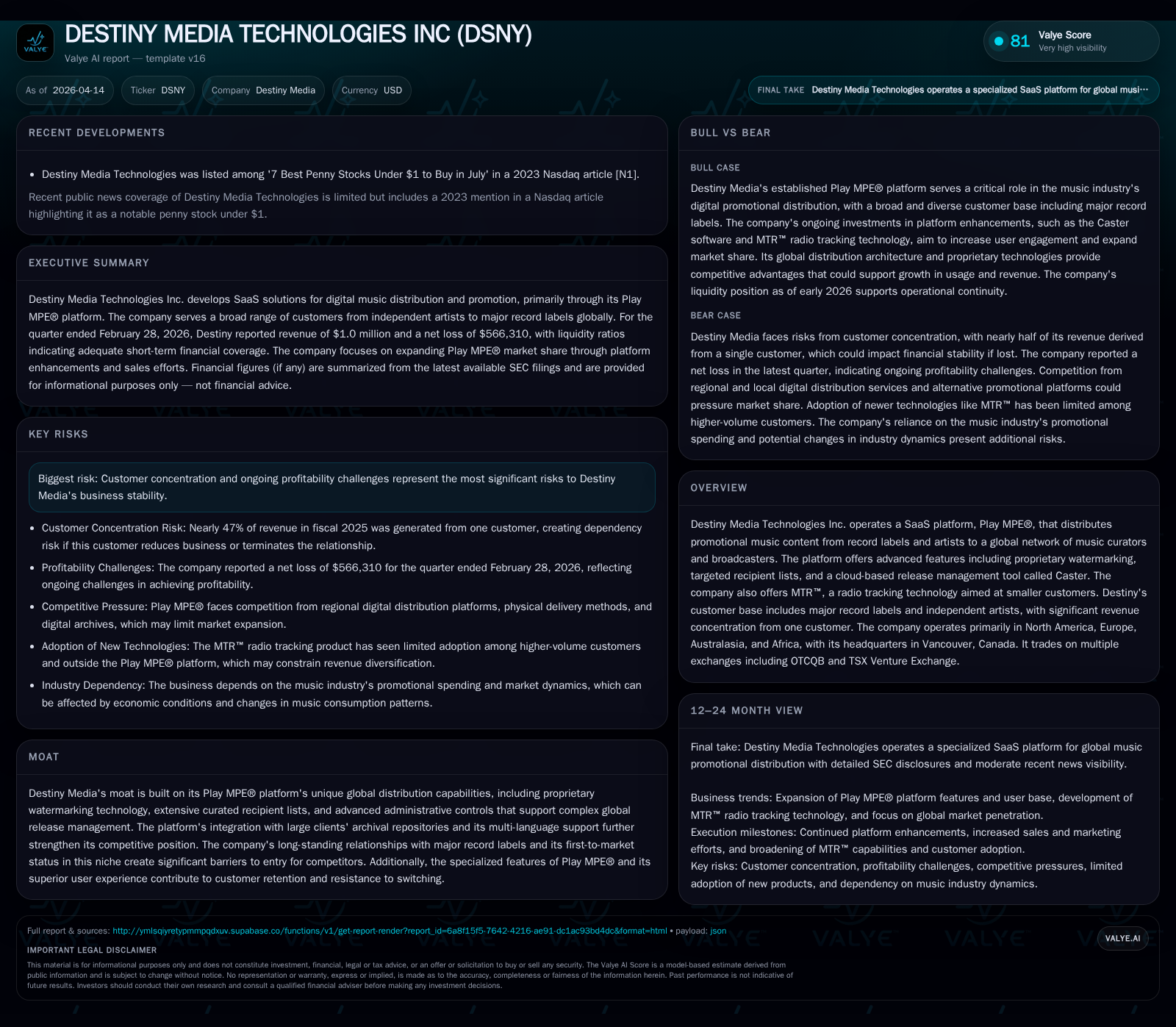
Destiny Media Technologies has demonstrated consistent revenue growth driven by its flagship SaaS product, Play MPE®, supported by proprietary watermarking and efficient global distribution capabilities. Despite this growth, the company faces mounting pressure on profitability due to rising operating costs and a heavy reliance on a single major customer that accounts for nearly half its revenue. Capital allocation remains conservative with no share buybacks recently, while cash flow metrics have deteriorated. Moving forward, business resilience hinges on operational efficiencies, further diversifying the customer base, and scaling new offerings like MTR™.
Sustained Revenue Growth Anchored by Play MPE® Platform’s Unique Value
Destiny Media Technologies Inc.'s financial narrative over the past four years reveals a pattern of consistent top-line expansion primarily attributable to its proprietary Play MPE® platform. Revenue increased from approximately $4.02 million in FY2022 to $4.52 million in FY2025 representing a compound annual growth rate of just over 3% and a year-over-year uplift of around 2.3% from FY2024 to FY2025 [F1].
This growth stems from Play MPE®'s differentiated offering as an industry-first SaaS solution designed specifically for promotional music content distribution. The platform serves an extensive global network encompassing major record labels—including Universal, Warner, and Sony—and independent artists targeting broadcasters, music curators, and reviewers worldwide [S1][S23]. Its advanced capabilities span proprietary watermarking technology which embeds unique identifiers per recipient for content security; granular administrative controls that scale across complex global release schedules; multi-language support facilitating penetration into markets such as Europe, Australasia, and Africa; and a cloud-based contact management tool named Caster that enables precise targeting of recipients [S10][S12][S18].
Moreover, the Play MPE® platform’s breadth provides substantial value to record labels by increasing on-air royalty opportunities alongside indirect popularity-driven revenue gains. This dual-sided client engagement drives marketplace stickiness evident in the growing network activity both on the distributor side (record labels/artists) and at the recipient end (broadcasters/curators) [S16]. These factors collectively underpin Destiny's continued but measured revenue progress.
Under the Hood: Profitability Slide Amid Rising Operating Costs
While top-line metrics demonstrate resilience, Destiny Media’s profit trajectory exhibits alarming deterioration. Operating income dropped precipitously from positive territory of $60K in FY2024 to a loss exceeding $663K in FY2025—a decline approximating 1195% year-over-year—and net income mirrored this reversal moving down to -$638K from prior ~$112K positive earnings [F1].
The swing reflects intensifying operating expenses linked primarily to increased investments in platform enhancements, customer support under ASC 606 stand-ready obligations, sales efforts, and R&D activities focused on platform scalability and new products such as MTR™ [S4][S26]. While software capitalization continues under ASC 350-40 guidelines for internal-use software development, these efforts have yet to translate into sufficient topline leverage or margin improvement.
Operating cash flow corroborates this pressure—despite a positive figure ($65K), it marks an approximately 85% reduction relative to FY2024's $429K performance—highlighting cash generation challenges amid rising expenditures [F1]. However, capital investment stabilized at around $29K (up from $8K prior year), suggesting moderation following elevated spend in prior years tied to infrastructure buildout [F1].
This cost structure rigidity raises concerns about Destiny's ability to scale profitably given customers' expectation for high service quality and continuous feature innovation within the SaaS distribution model.
Concentration Risks: Customer Dependency in the Spotlight
Reinforcing risk profiles is substantial revenue concentration: one single customer accounted for nearly half (46.9%) of total revenues in FY2025, up from 42.7% the previous year [F1][S5]. This dependency exposes Destiny Media to material volatility if contract renegotiations falter or if competitors encroach on entrenched relationships.
Although these marquee clients—comprised primarily of major label groups—bring credibility and stable demand supporting Destiny's first-mover advantage, they also impose bargaining power that could limit pricing flexibility and complicate renewal dynamics [S6]. The company's SEC filings explicitly underscore this as a significant risk factor accentuating potential revenue downside scenarios stemming from loss or curtailment of business with this key entity.
Therefore, while strong major label partnerships form the backbone of Destiny's moat through deep integration and feature customization (e.g., archival repository synchronization), they simultaneously require vigilant management due diligence to mitigate outsized counterparty exposure.
Global Reach and Market Position: Navigating Competition with Proprietary Watermarking Technology
At the heart of Destiny's competitive moat lies its Play MPE® platform’s sophisticated integration of patented watermarking technology enabling secure digital content delivery uniquely traceable per recipient—a critical functionality absent or underdeveloped in regional competitors [S1][S16]. This security capability strengthens client confidence against unauthorized leaks or misuse during pre-release promotional campaigns.
Complementary facets enhancing Destiny's market positioning include multilingual Caster functionality facilitating global release coordination with granular staff role assignments and label-specific administration—enabling efficient management across complex multi-territory promotions which are increasingly prevalent in today’s streaming-dominated landscape [S12][S23].
Globally, while competing services tend to be fragmented or localized, Destiny maintains an edge through an integrated tech stack that supports robust metadata enrichment, reporting tools catering both promotional senders and recipients, and continual platform updates designed in close collaboration with marquee clients ensuring relevance [S5][S16].
This multi-jurisdictional footprint concentrated chiefly in North America (largely U.S.), Europe (notably Nordic regions), Australasia (Australia/New Zealand), and Africa reinforces competitive barriers through cumulative network effects where both content senders and listeners engage consistently across software versions tailored for diverse linguistic audiences [S18].
Capital Allocation: Sparse Buybacks Amid Focus on Cash Preservation
From a capital management perspective, Destiny Media took a notably conservative stance post-FY2024 buyback activity which amounted to $470K repurchased shares but recorded zero share repurchases during FY2025 [F1][S21]. Concurrently, no dividends were paid reflecting prudent prioritization of financial resources towards operational funding amidst profitability pressures.
Liquidity balances remain solid with cash and equivalents reaching approximately $1.15 million as of February 2026 quarter-end complemented by current assets outpacing liabilities producing a robust current ratio near 3 (2.98) implying sufficient short-term cash cushions despite net losses [F1][S7]. However, returns have dwindled into negative territory—FY2025 ROE is estimated at -26%, signaling poor capital efficiency resultant from sustained net losses challenging shareholder value accretion under current business conditions [F1].
The restrained capital deployment combined with improved liquidity signals management’s focus on preserving operational runway while balancing investment needs amid uncertain near-term margin recovery prospects.
What Investors Should Monitor: Pipeline Developments, Scaling Efficiency, and Customer Diversification
Absent explicit forward guidance beyond broad framework statements within quarterly filings [S2], attention should center on metrics indicating Destiny’s transition towards scalable profitability. Key operational indicators include ramping adoption rates of features embedded within Play MPE®’s Caster system aimed at streamlining administrative overheads; broader commercial traction for the nascent MTR™ radio tracking product originally geared towards smaller clients but targeting incremental uptake among larger customers; and expansion into emerging archival marketing segments introduced seasonally as tactical leverages during soft sales windows like holiday periods [S5][S9]
Critically important will also be signs of customer base diversification efforts diminishing single-client concentration risk either through onboarding additional major label sub-labels or growing independent artist volumes—which can alleviate dependency-related vulnerabilities highlighted previously. Further monitoring should consider management's effectiveness in cost control amidst technological reinvestments necessary for sustaining long-term competitive advantage.
Domain-specific competitive factors such as adaptation pace relative to shifting consumption via streaming platforms or regulatory changes affecting digital content licensing may also materially influence Destiny's trajectory given evolving industry dynamics.
Historical performance (annual)
| FY | Rev ($mm) | Net ($) | CFO ($) | OpInc ($) | Rev YoY | Net YoY |
|---|---|---|---|---|---|---|
| 2025 | 5 | -637877 | 65156 | -663066 | +2.3% | -670.8% |
| 2024 | 4 | 111758 | 429188 | 60557 | +9.6% | -66.6% |
| 2023 | 4 | 335098 | 705634 | 301176 | +0.3% | +124.8% |
| 2022 | 4 | 149074 | 307198 | 133251 |
Source: SEC companyfacts cache [F1].
Capital returns and efficiency (annual)
| FY | Buybacks ($) | FCF ($) | ROE% |
|---|---|---|---|
| 2025 | 0 | 36024 | -26.3 |
| 2024 | 470271 | 421027 | 3.5 |
| 2023 | 21135 | 120126 | 9.6 |
| 2022 | 179401 | -19140 | 4.8 |
Source: SEC companyfacts cache [F1].
This table illustrates steady yet modest revenue growth juxtaposed against sharply declining operating profits starting FY2024 onwards coincident with surging expense levels compressing margins significantly despite nascent improvements in capital expenditures intensity.
Disclaimer: This analysis is provided solely for informational purposes without any recommendation regarding securities or investments related to Destiny Media Technologies Inc. It integrates publicly available filings up to April 14th, 2026 but does not reflect any subsequent developments thereafter or non-public information.
Disclaimer: This is research-only, informational analysis and not investment advice. It may include AI-generated interpretation and general industry context. Always verify important details using primary sources.

Comments