
Data Storage Corp's Strategic Pivot Focuses on Nexxis and Shareholder Returns
Following the divestiture of its CloudFirst business, Data Storage Corp reallocates capital to its Nexxis subsidiary and targets acquisitions in high-growth tech sectors.
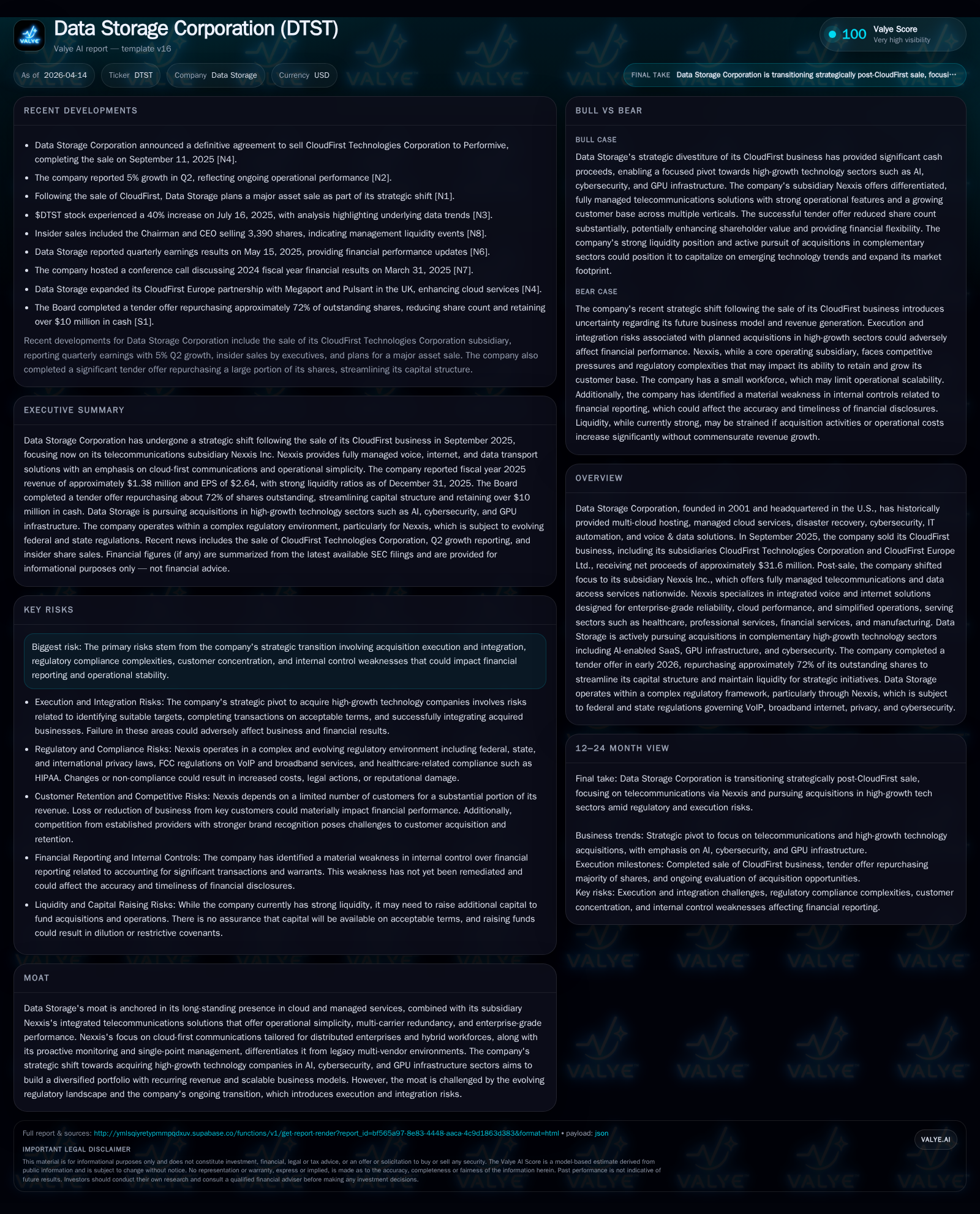
In September 2025, Data Storage Corp sold its CloudFirst cloud solutions business for net proceeds of approximately $31.6 million, marking a strategic shift toward telecommunications and targeted technology acquisitions. The company now focuses on Nexxis Inc., which offers integrated voice, internet, and SD-WAN services emphasizing reliability and simplified management. Revenue declined sharply post-sale, reflecting the divestiture impact. Data Storage repurchased about 72% of outstanding shares at $5.20 per share using sale proceeds while retaining cash for future acquisitions in AI, cybersecurity, and GPU-related fields. Execution risks remain as the company navigates integration challenges amid regulatory complexities and operational leverage constraints.
Strategic Shift Following CloudFirst Divestiture
Data Storage Corporation completed the sale of its CloudFirst business segment—including CloudFirst Technologies Corporation and CloudFirst Europe Ltd.—on September 11, 2025, realizing net cash proceeds of approximately $31.6 million after transaction costs [S1][S5]. This marked a significant strategic pivot away from multi-cloud hosting and managed services toward focusing on telecommunications through its subsidiary Nexxis Inc.
The sale price was based on an initial contractual amount of $40 million adjusted for escrow deposits and closing-date working capital adjustments [S5]. Post-divestiture, the company streamlined operations around Nexxis, which delivers fully managed voice, internet, data transport, and SD-WAN services engineered for enterprise-grade reliability nationwide.
Nexxis: Enterprise-Grade Integrated Communications
Nexxis offers a unified service agreement combining advanced voice communications with high-performance Internet and WAN infrastructure under a single managed service umbrella [S1][S5][S7]. Key value drivers include multi-carrier redundancy ensuring network resilience; proactive real-time monitoring; simplified unified billing; reduced downtime; and lower total cost of ownership compared to legacy multi-vendor environments.
Serving multiple verticals such as healthcare, professional services, finance, manufacturing, and distributed enterprises, Nexxis targets cloud-first organizations requiring continuous uptime and enterprise-grade performance [S5].
Historical Financial Overview
Financially, the impact of the CloudFirst sale is evident with FY2025 revenue falling approximately 94.5% year-over-year from $25.37 million in FY2024 to $1.38 million [F1]. Operating income swung to a loss of $3.57 million compared to a small positive operating income in FY2024 [F1]. Net income data beyond FY2024 is not confirmed but prior year showed modest profitability [F1].
Operating cash flow declined sharply by over 280%, turning negative $3.16 million in FY2025 versus positive cash flow the prior year despite a drastic reduction in capital expenditures—from $1.80 million down to just $16 thousand—reflecting curtailed investment post-sale [F1].
Historical performance (annual)
| FY | Rev ($mm) | Net ($mm) | CFO ($mm) | OpInc ($mm) | Rev YoY | Net YoY |
|---|---|---|---|---|---|---|
| 2025 | 1 | -3 | -4 | -94.5% | ||
| 2024 | 25 | 1 | 2 | 0 | +1.6% | +37.1% |
| 2023 | 25 | 0 | 4 | 0 | +4.6% | +108.8% |
| 2022 | 24 | -4 | 1 | -4 | -1726.6% |
Source: SEC companyfacts cache [F1].
Capital returns and efficiency (annual)
| FY | FCF ($mm) | ROE% |
|---|---|---|
| 2025 | -3 | |
| 2024 | 0 | 2.4 |
| 2023 | 2 | 1.9 |
| 2022 | 1 | -22.8 |
Source: SEC companyfacts cache [F1].
*Latest full year net income beyond FY2024 not available from current data [F1]
Capital Allocation: Tender Offer and Cash Position
Following the CloudFirst business sale proceeds receipt in late 2025 [S4], Data Storage launched a tender offer beginning December 8th to repurchase up to approximately 83% of outstanding common stock at a maximum aggregate price of $32.2 million [S4][S5]. By January 15th, approximately 72% of shares were repurchased at $5.20 per share totaling around $29.25 million spent from available cash resources including sale proceeds.
This transaction reduced shares outstanding from over seven million to about two million shares post-tender while retaining over $10 million in cash for operational needs and strategic initiatives [S4]. Despite this capital return program reducing share count significantly and strengthening balance sheet liquidity (equity rose to over $40 million by end-2025), free cash flow remained negative given operational losses with an approximate return on equity near 1.3%, indicating ongoing profitability challenges during transition [F1].
Growth Outlook: Acquisition-Focused Strategy in High-Growth Tech Sectors
Management’s stated strategy prioritizes acquisitions within complementary high-growth technology sectors such as artificial intelligence-enabled vertical SaaS platforms; cybersecurity solutions including Security Operations Centers; and GPU infrastructure-as-a-service providers critical for AI workloads [N1][S4][S21]. These sectors offer recurring revenue potential with higher margins but entail risks including rapid technological change; competitive intensity; integration complexity; regulatory uncertainty; and capital raising challenges [S6][S21].
The focus on these areas represents a move away from commoditized connectivity services toward scalable software-enabled offerings aligned with industry digital transformation trends.
Operational Leverage Constraints Amid Revenue Decline
Despite significant revenue contraction post-divestiture [F1], fixed overhead costs continue to pressure margins [S15][S18]. Capital expenditures dropped sharply reflecting austerity measures following asset sales ($16k versus prior millions), but research & development investments remain material signaling commitment to innovation supporting future product development [S15][S18].
This dynamic constrains operating leverage: revenues no longer sufficiently cover fixed costs leading to amplified losses until scale or acquisition synergies are realized.
Regulatory Environment and Governance Considerations
The company faces complex regulatory frameworks governing telecommunications operations through Nexxis including federal-state privacy laws relevant for healthcare clients such as HIPAA compliance alongside evolving telecommunications regulations impacting interconnected VoIP services [S6][S11]. Material internal control weaknesses disclosed pose additional risks concerning financial reporting reliability during this transformation phase [S28].
No active litigation or class actions related to recent transactions have been reported but remain potential risks [S11][S14]. Cybersecurity breaches or compliance failures could materially damage reputation affecting customer retention critical for Nexxis’ recurring revenue streams [S6][S24]. Robust governance measures will be essential to support long-term credibility amid growth ambitions.
Investor Focus: Monitoring Acquisition Execution and Capital Strategy
Investors should track key milestones including:
- Progress on identifying and closing acquisitions aligned with recurring revenue models in AI/cybersecurity,
- Integration success measured by synergy realization without employee attrition or culture disruption,
- Financing strategies balancing equity or debt issuance with dilution considerations,
- Early revenue contributions offsetting declines from legacy operations.
Disclosure updates on acquisition timing alongside quarterly financial trends will provide insight into execution effectiveness during this pivotal phase.
This analysis is based entirely on publicly available information from SEC filings and credible news sources without investment advice or recommendation.
Disclaimer: This is research-only, informational analysis and not investment advice. It may include AI-generated interpretation and general industry context. Always verify important details using primary sources.

Comments