
Rent the Runway’s Recapitalization and Subscription Model Shape Growth Amid Operational Constraints
Rent the Runway reported improved financial performance in FY2025 but faces operational flexibility limits from restrictive credit covenants.
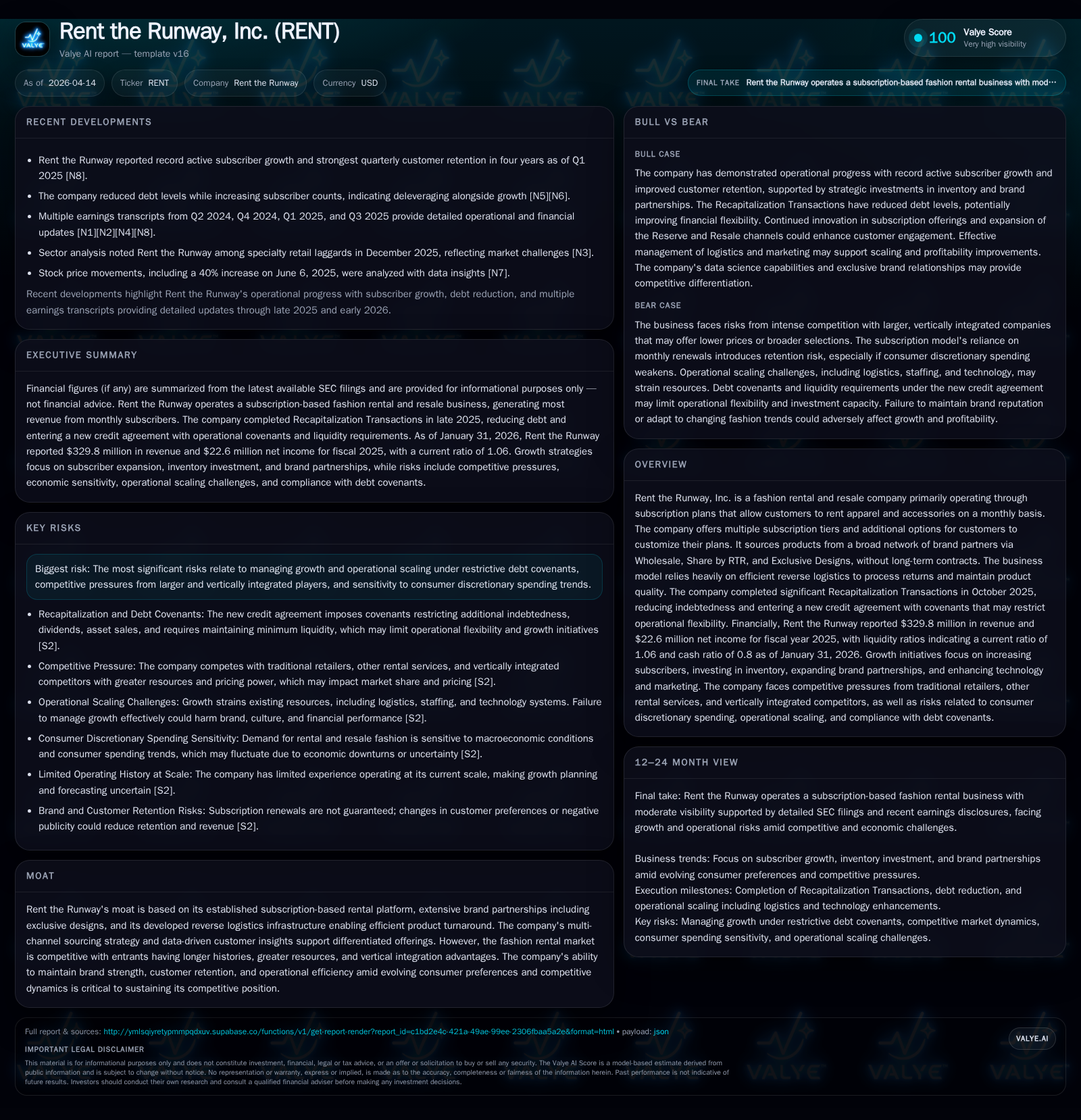
Rent the Runway, Inc., the fashion rental pioneer, posted $329.8 million revenue in fiscal 2025, reflecting a 7.7% increase over the prior year, driven primarily by subscriber growth and an expanding brand partnership network. The company achieved a profitable net income for the first time in recent years, recording $22.6 million, despite ongoing operating losses exacerbated by higher costs. However, Rent the Runway’s recent October 2025 recapitalization reduced indebtedness but introduced a stringent credit agreement with covenants that may limit investment and operational initiatives. Key growth drivers include scaling subscription tiers and deepening brand collaborations, while risks stem from competitive pressure and constraints imposed by new debt agreements.
Historical Financial Performance
Rent the Runway has shown a notable evolution over the past four fiscal years ending January each year. Its top-line revenue grew from $296.4 million in FY2022 to $329.8 million in FY2025, representing a compounded yet moderate annual growth trajectory with a 7.7% year-over-year revenue increase from FY2024 to FY2025 [F1]. This growth reflects expanding customer adoption of its subscription-based fashion rental model.
Despite top-line progress, operating income figures reveal persistent challenges in managing costs at scale. Operating losses narrowed from -$103.6 million in FY2022 to -$57.5 million in FY2025 but remain substantial [F1]. Interestingly, the net income picture reversed significantly; after multi-year net losses peaking at -$138.7 million in FY2022, Rent the Runway reported a net profit of $22.6 million for FY2025 [F1]. This swing was aided by non-operating gains or one-time financial impacts related to recapitalization efforts as discussed later.
Operating cash flow (CFO) fluctuated dramatically: from negative -$47.7 million in FY2022 to positive $12.9 million in FY2024 before retreating again to a slight $3.5 million positive generation in FY2025; free cash flow (CFO minus capital expenditures) correspondingly stayed minimal but positive at about $3.3 million last fiscal year [F1]. Capital expenditures remained conservatively low across these years.
Historical performance (annual)
| FY | Rev ($mm) | Net ($mm) | CFO ($mm) | OpInc ($mm) | Rev YoY | Net YoY |
|---|---|---|---|---|---|---|
| 2025 | 330 | 23 | 4 | -57 | +7.7% | +132.3% |
| 2024 | 306 | -70 | 13 | -47 | +2.7% | +38.3% |
| 2023 | 298 | -113 | -16 | -80 | +0.6% | +18.4% |
| 2022 | 296 | -139 | -48 | -104 |
Source: SEC companyfacts cache [F1].
Capital returns and efficiency (annual)
| FY | FCF ($mm) | ROE% |
|---|---|---|
| 2025 | 3 | -62.6 |
| 2024 | 13 | 38.3 |
| 2023 | -16 | 92.6 |
| 2022 | -48 | 392.9 |
Source: SEC companyfacts cache [F1].
Note: Dividends and Buyback data not reported.
Business Model and Strategic Positioning
Founded in November 2009, Rent the Runway established itself as a pioneer of shared designer wardrobes through its subscription offerings known as "Subscription," complemented by an a-la-carte rental service "Reserve" and resale options [S1]. The company boasts an "Unlimited Closet" concept—subscribers gain access to thousands of styles across multiple categories such as evening wear, casuals, maternity clothes, and accessories—without long-term contracts [S1]. As of January 31, 2026, Rent the Runway had approximately 144 thousand active subscribers within a total subscriber base (including paused accounts) near 184 thousand [S1].
A core competitive advantage lies in its two-sided discovery platform that simultaneously connects consumers seeking variety with brand partners looking for new customer acquisition channels [S1]. These partnerships cover well-known designer brands collectively supplying virtually all inventory via Wholesale deals and exclusive design collaborations [S1]. This multi-channel product sourcing diversifies risk inherent to inventory ownership faced by many pure rental or resale companies.
Operationally, efficient reverse logistics are fundamental; quick turnaround involving cleaning, quality checks and restocking is essential for keeping the assortment fresh and customers satisfied [S1], supported by data-driven insights into style preferences [S18]. Yet this complexity introduces cost pressures reflected in still negative operating margins.
Recent Recapitalization: Catalysts and Covenants
In October 2025, Rent the Runway executed Recapitalization Transactions aimed at deleveraging its balance sheet and injecting new capital [S1][S2][S11]. This involved amending its prior credit agreement dating back to July 2018 with a new credit facility structured with CHS US Management LLC acting as administrative agent alongside other equity investors including Gateway Runway LLC [S1][S11]. The transaction significantly reduced existing indebtedness while enhancing liquidity.
However, this came with increased operational constraints embedded within stringent negative covenants limiting recurrence of high leverage scenarios or aggressive investment strategies [S1][S11]. Restrictions include curtailments on incurring additional debt beyond agreed thresholds; limitations on dividend payments or stock repurchases; controls on asset dispositions; prohibitions on certain corporate transactions like mergers without lender consent; caps on investments; and requirements to maintain minimum liquidity levels (resetting to $30 million starting February 2027) [S1][S4][S11].
Failure to adhere to these covenants risks acceleration of debt repayment obligations which could materially destabilize operations [S1][S11]. Historically, management has negotiated waivers under prior agreements when strain arose but anticipates challenges ahead during execution of growth strategies given these tighter restrictions.
Growth Drivers and Risks Ahead
Rent the Runway’s principal growth vectors hinge on expanding subscriptions through enhanced customer acquisition efficiency and retention; increasing average order value via tiered plans enabling customers more product choices per month; broadening brand partner relationships especially exclusive designs fueling unique offerings; extending product categories especially into casual wear and accessories; and optimizing logistics technology reducing turnaround times while controlling costs [N/A S1 S18]. The company leverages data analytics aggressively to refine marketing targeting and supply chain forecasts which is critical given spotty visibility into fashion trends that can impact demand unpredictably.
That said, several headwinds temper optimistic assumptions:
- Debt Covenants: Covenants restricting capital allocation may dampen ability to fund marketing expansion or inventory scale needed for growth acceleration [S1][S4][S11].
- Operating Losses: Despite notable improvement netting positive income largely due to recapitalization effects rather than core profit generation, sustained operating losses suggest ongoing expense pressure particularly from fulfillment logistics remains unresolved [F1].
- Competitive Environment: Incumbent online retailers with vertical integration (owning production through direct-to-consumer channels) can offer lower prices or faster innovation cycles undermining RTR's market position [S18]. Larger competitors may also employ aggressive pricing or bundle services restricting RTR's customer retention potential.
- Consumer Behavior: Shifts away from discretionary spending during macroeconomic downturns threaten subscriber acquisition or subscription upgrades; also cultural resistance still exists against fashion rental models relative to outright ownership especially outside primary urban centers [S17].
- Legal & Regulatory: Complex compliance landscape tied to subscription services legislation (e.g., California Automatic Renewal Law), anti-bribery statutes affecting international supplier relationships, evolving privacy regulations impacting targeted marketing effectiveness introduce operational risk layers [S6][S10][S12][S19].
- Supply Chain / Logistics Dependencies: Heavy reliance on national carriers for shipment creates vulnerability to external disruptions like weather or labor issues potentially degrading customer satisfaction if delivery commitments waver [S23].
Financial Returns & Capital Allocation
The approximate return on equity based on latest annual net income ($22.6m) against negative shareholders’ equity (-$36m) as of January 31, 2026 implies a mathematically distorted calculation yielding about -62% ROE due primarily to prior accumulated losses eroding equity value despite recent profitability improvements [F1]. Thus ROE does not currently reflect typical return analysis but signals ongoing balance sheet challenges.
Cash flow generation remains tight: operating cash flow contracted by nearly three quarters year-over-year albeit staying mildly positive at $3.5 million last fiscal year; capital expenditure remained nominal thus free cash flow was similarly modest but positive ($3.3 million) [F1]. There have been no dividend payments or share repurchases reported recently reflecting cautious capital deployment amidst covenant restrictions.
Given these constrained cash flows alongside restrictive liquidity covenants embedded within post-recapitalization credit agreements management faces prioritizing working capital management and incremental investment initiatives carefully so as not to trigger defaults that could imperil business continuity.[F1][S4][S11]
What To Watch Going Forward (Analysis)
Absent explicit forward guidance disclosed publicly or through SEC filings as of April 14, 2026—key milestones include tracking subscriber base expansion trends using quarterly metrics; operating margins improvement reflecting better cost absorption with scale; logistics turnaround times indicative of service quality maintenance; adherence status of covenant tests within quarterly filings highlighting financial health resilience; innovation pipeline progress around exclusive designs attracting new demographics; plus monitoring competitor moves for pricing or vertical integration advances impacting market share dynamics.
Liquidity developments such as refinancing opportunities or covenant relief negotiations would crucially influence runway length for strategic investments balancing growth versus discipline post-recapitalization constraints.
Conclusion
Rent the Runway stands at an inflection point where its pioneering shared apparel rental subscription platform coupled with solid subscriber traction drive revenue momentum but remain counterbalanced by operational expense loads and tightly circumscribed financial flexibility stemming from its recent recapitalization cycle. Maintaining competitive differentiation through brand partnerships alongside sustaining reverse logistics efficiencies will be pivotal amid intensifying competition and evolving consumer spending patterns.
While a positive net income marks progress toward profitability stabilization after several years of largescale losses, future financial outcomes will heavily depend on executing growth strategies within covenant boundaries imposed by debt restructuring terms—and managing risks ranging from regulatory compliance complexities to logistics dependencies—all critical for converting growth potential into sustainable returns.
This report is intended solely for informational purposes based on publicly available documents filed through April 14th, 2026 including SEC reports [F1][S#] and does not constitute investment advice or recommendations.
Disclaimer: This is research-only, informational analysis and not investment advice. It may include AI-generated interpretation and general industry context. Always verify important details using primary sources.

Comments