
Huineng Technology Corp: Growth Headwinds and Strategic Staffing Bets
The company’s early structural changes and customer concentration underscore its challenging growth environment, counterbalanced by plans to expand its workforce to enhance service differentiation.
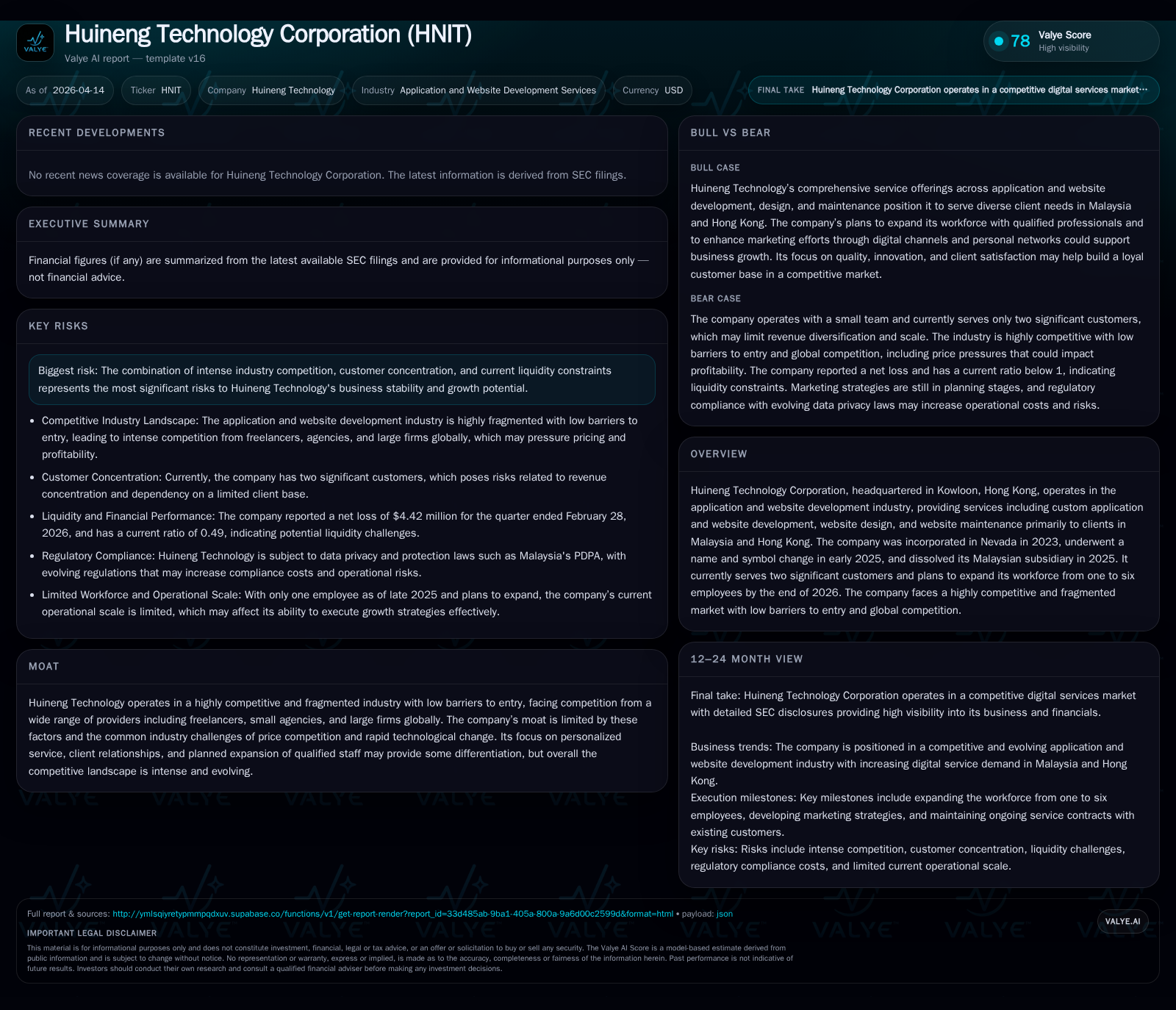
Founded in 2023 and headquartered in Hong Kong, Huineng Technology operates in a fragmented, highly competitive application and website development sector serving primarily Malaysia and Hong Kong. Significant corporate events include a subsidiary acquisition and subsequent dissolution, a leadership transition in early 2025, and a rebranding under its current name and ticker symbol. Financially, Huineng Technology faces substantial operating losses with increasing negative cash flow and liquidity pressures exacerbated by reliance on two major clients. The company's strategic response centers on expanding its small workforce from one to six employees by end-2026 to deepen client engagement and technical capability amidst an intensely competitive marketplace. Monitoring staff growth progress, client diversification efforts, and liquidity management will be critical to assess future operational stability.
Evolution of Huineng Technology: Incorporation to Current Structure
Huineng Technology Corporation, originally incorporated as Aceztech Corporation in Nevada on August 15, 2023, has undergone rapid and significant structural evolution in its formative years. In June 2024, the Company completed the acquisition of a wholly owned Malaysian subsidiary, Aceztech Sdn. Bhd., expanding its geographic footprint ostensibly to bolster regional operations. However, this subsidiary was dissolved less than a year later in April 2025 [S1]. Concurrently, the Company implemented an executive leadership transition: its founding director and sole officer resigned in February 2025 and was promptly succeeded by Guoxiang Ao across all key executive roles [S1]. Alongside this personnel shift came a corporate rebranding effort—the Company officially changed its legal name from Aceztech Corporation to Huineng Technology Corporation and adopted the stock ticker HNIT effective February 18, 2025 [S1].
These milestones collectively signal a firm navigating early-stage strategic recalibration. The subsidiary's brief tenure suggests initial ambitions for regional expansion faced challenges or misalignment with broader corporate priorities. Leadership turnover alongside a name change often reflects evolving strategic direction or repositioning within highly competitive markets.
2024-2025 Performance Review: Revenue Drivers and Profit Pressure
Financial performance for fiscal years ending November 30 reveals escalating fiscal stress. Net income deteriorated sharply from a loss of $10,784 in FY2024 to nearly triple that at -$34,968 in FY2025 [F1]. Operating cash flow more than doubled its negative burn rate over the same period—from -$27,461 to -$55,784—reflecting intensifying operational cash drain without accompanying revenue scale or margin improvement [F1]. Capital expenditure remained minimal at $729 annually during both years, illustrating limited investment in fixed assets or infrastructure expansion [F1].
Liquidity indicators further expose vulnerability: as of February 28, 2026 (Q1), current assets totaled just $11,396 compared with significantly higher current liabilities of $23,211 resulting in a distressingly low current ratio of approximately 0.49—well below typical operational thresholds [F1]. This imbalance hints at acute working capital pressures.
Historical performance (annual)
| FY | Net ($) | CFO ($) | Capex ($) | Net YoY |
|---|---|---|---|---|
| 2025 | -34968 | -55784 | 729 | -224.3% |
| 2024 | -10784 | -27461 | 729 |
Source: SEC companyfacts cache [F1].
Capital returns and efficiency (annual)
| FY | FCF ($) | ROE% |
|---|---|---|
| 2025 | -56513 | 598.6 |
| 2024 | -28190 | 112.9 |
Source: SEC companyfacts cache [F1].
This financial trajectory underscores significant profitability pressure tied likely to narrow revenue sources against fixed costs.
Market Dynamics and Competitive Challenges in Application Development
Huineng Technology's activities fall within an intensely competitive digital services landscape marked by abundant providers ranging from freelancers to well-established agencies globally. Low barriers to entry facilitate constant new entrants exerting downward price pressure—a phenomenon known as price commoditization. Rapid technological advances force continuous upgrades of tools and skillsets while clients frequently shop for cost-effective solutions with sufficient quality.
This fragmented market structure severely limits sustainable moats since service offerings tend toward comoditized IT development tasks lacking significant differentiation beyond client relationships or niche specialization. Huineng’s strategy centers on emphasizing personalized engagement given clients’ preference for trusted partners across Malaysia and Hong Kong — yet this personalization alone contends with scale disadvantages relative to larger firms with deeper resources.
Customer Concentration Risks and Operational Constraints
A critical risk factor is Huineng’s dependence on just two primary customers as revenue sources . Such concentration skews business stability metrics: loss or reduction of either client’s projects could cause disproportionate revenue volatility disrupting cash flows further.
Coupled with already visible liquidity constraints manifesting as negative working capital (current ratio <0.5), this customer concentration amplifies operational fragility. Negative operating cash flows exacerbate potential difficulties funding day-to-day operations without additional capital injections or accelerated client payments.
Working capital cycle pressures commonly face firms serving limited customers whose payment terms may extend weeks or months — delaying inflows even as outflows continue unabated.
Strategic Workforce Expansion Plans as a Differentiation Leverage
Recognizing marketplace intensity alongside capacity limits embodied by a single-employee base currently servicing demanding digital projects, management has set plans to scale headcount up to six employees by the end of calendar year 2026 .
This talent deployment strategy aims not only at distributing workload but also enriching service customization through enhanced technical expertise availability onsite. For small IT services firms confronted with fractured demand pools globally, augmenting human capital often represents the principal avenue for bolstering competitiveness amid fragmented client needs.
Expanding from one developer/consultant to a small team could accelerate project turnaround times and diversify skill coverage—potentially improving client retention rates in an otherwise commoditized environment.
Cash Flow Trends, Liquidity Constraints, and Capital Allocation Insights
The stark deterioration in operating cash flow—more than doubling its negative burn year-over-year—paired with stagnant low-level capital expenditure indicates constrained reinvestment capability during financial stress periods [F1]. This pattern is consistent with a business prioritizing survival over growth investments amid slim margins.
With equity turning further negative (-$5,842 at FY end Nov-2025 down from -$9,551 prior year), balance sheet resilience appears limited [F1]. Return on equity metrics become distorted when equity is negative; however, the growing net losses are unequivocal signs of operational strain.
The absence of dividend distributions or share repurchases aligns logically with these conditions; conserving available cash takes precedence above capital returns amidst nascent scale and liquidity shortfalls.
Together these features portray a firm trapped in early developmental losses reliant on forthcoming strategic initiatives—namely staffing expansion—to alter operational economics.
Financial Outlook: Key Milestones and What To Monitor Next Year
Forward-looking assessment hinges largely on execution milestones around hiring additional skilled employees per stated plans along with any nascent indications of customer base expansion or diversification—which remains unconfirmed due to lack of disclosures or recent news updates.
Close observation should focus on tracking changes in headcount disclosed through future SEC filings relative to projected six-person target; shifts in client composition would materially impact risk profiles given current concentration levels; liquidity metrics must also improve lest operational viability be compromised further.
Without explicit guidance from company statements or public releases past Q1 2026 data points analyzed here, forecasts remain qualitative; an ongoing operating cash flow burn rate exceeding $50k yearly without commensurate customer growth will challenge sustainability absent capital raises or transformative contract wins.
This analysis is based solely on publicly available company filings through April 14, 2026 ([F1], [S1], [S2]) combined with the Valye report excerpt detailing industry context and strategic positioning. No investment recommendations are provided herein.
Disclaimer: This is research-only, informational analysis and not investment advice. It may include AI-generated interpretation and general industry context. Always verify important details using primary sources.

Comments