
Envirotech Vehicles’ Power-Integrated Strategy Faces Financial Crossroads
Envirotech Vehicles balances its diversified hardware platform ambitions against mounting financial losses and operational recalibrations.
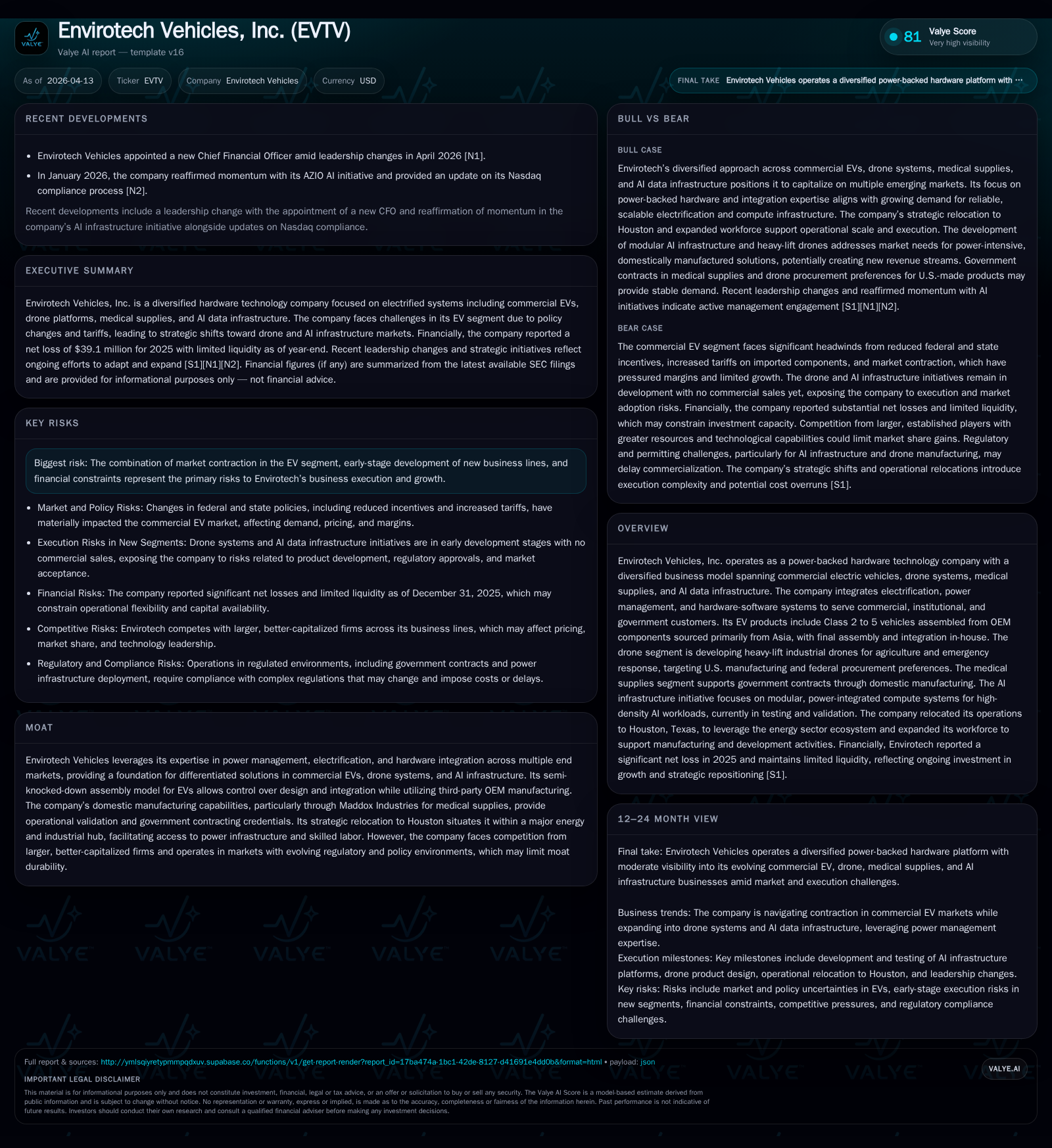
Envirotech Vehicles, Inc. operates a multi-faceted power-backed hardware portfolio encompassing commercial electric vehicles, drone platforms, medical supplies manufacturing, and emerging AI compute infrastructure. While its semi-knocked-down assembly approach for EVs sustains core market presence, tariff pressures and policy shifts have dampened growth and margins. The company is pivoting toward drone systems and modular AI data centers, leveraging domestic manufacturing hubs and power integration expertise. However, financial strains culminated in a sharp net loss increase to $39M in 2025 and deteriorating equity, prompting capital discipline enhancements including a new CFO appointment. Key near-term developments hinge on drone commercialization, AI infrastructure validation, and cash flow stabilization.
Historic Trends in Revenue and Operating Losses: A Tug of War
Envirotech Vehicles has faced an extended struggle balancing top-line generation against mounting losses over recent years. The company's last reported annual revenue remains at a modest $425k as of 2017 [F1], indicating limited sales growth amidst ongoing operational expansion.
Operating income trends highlight this challenge with losses widening sharply to approximately -$38.7 million in fiscal year 2025 from -$7.9 million the prior year [F1]. Correspondingly, net losses expanded over fourfold reaching about -$39.1 million for the same period [F1].
Operating cash flow also deteriorated significantly to around -$5.6 million in 2025 compared to -$3.5 million in 2024 [F1], reflecting persistent negative cash generation despite curtailed capital spending which fell nearly 59% to roughly $177k that year [F1]. This retrenchment underscores constrained investment capacity amid financial pressures.
The company’s liquidity position at the end of 2025 showed scant cash & equivalents under $360k contrasted against current liabilities exceeding $13 million, resulting in a low current ratio of approximately 0.26 [F1]. Shareholders’ equity swung from a positive $20.9 million at the end of 2024 to negative near -$8.9 million by the close of 2025, signaling balance sheet stress requiring close monitoring [F1].
Historical performance (annual)
| FY | Net ($mm) | CFO ($mm) | OpInc ($mm) | Capex ($) | Net YoY |
|---|---|---|---|---|---|
| 2025 | -39 | -6 | -39 | 176828 | -342.2% |
| 2024 | -9 | -4 | -8 | 430333 | +30.2% |
| 2023 | -13 | -4 | -13 | 35810 | +71.0% |
| 2022 | -44 | -7 | -44 | 168583 |
Source: SEC companyfacts cache [F1].
Capital returns and efficiency (annual)
| FY | FCF ($mm) | ROE% |
|---|---|---|
| 2025 | -6 | 438.2 |
| 2024 | -4 | -42.3 |
| 2023 | -4 | -61.5 |
| 2022 | -8 | -136.9 |
Source: SEC companyfacts cache [F1].
Operating results denote fiscal year ends; revenue flat since 2017 with accelerating losses post-2023
Commercial Electric Vehicles: Stability Within Selective Markets
Envirotech's commercial EV segment remains foundational targeting fleet operators—including delivery logistics—and public agencies such as utilities and school districts that seek electrification benefits where predictable duty cycles offer clear economic returns [S4][S17].
Manufacturing employs a semi-knocked-down (SKD) assembly model whereby vehicle chassis and major subassemblies are sourced primarily from OEM partners based in China and Malaysia. Final assembly and system integration occur domestically allowing control over technical specifications including battery systems and powertrain elements tailored per customer requirements [S4][S17].
In 2025 market headwinds intensified due to federal policy uncertainties following reviews of incentive programs under the Inflation Reduction Act (IRA), leading to lengthened sales cycles as customers exhibited heightened sensitivity to total cost of ownership economics [S13][S4][S8]. Additionally, escalating tariffs—exceeding 100% on key Chinese-origin components—further pressured input costs limiting margin stability [S13][S25].
Consequently, Envirotech adjusted strategy focusing on deployments where electrification yields measurable return on investment rather than broad expansion amid industry contraction marked by competitor exits [S4][S8]. The SKD approach provides operational flexibility essential under these conditions.
Emerging Drone Systems and AI Infrastructure: Moonshots or Pillars?
To diversify beyond the cyclical commercial EV business impacted by policy volatility and tariffs, Envirotech has advanced development of drone systems alongside AI compute infrastructure.
The drone segment targets heavy-lift industrial-grade unmanned aerial vehicles designed for agricultural spraying/fertilization as well as fire suppression and forestry management missions requiring payloads near 500 lbs [S9][S11]. Focused on U.S.-based manufacturing aligned with government procurement preferences favoring domestic sourcing creates potential competitive differentiation amidst security-driven restrictions on foreign UAVs [S9][S21]. As of late 2025 commercial production had not commenced; only limited refundable deposits have been received which do not constitute firm backlog or recognized revenue yet [S9][S14]. Regulatory approvals remain pending.
Parallelly at the start of 2026 Envirotech announced plans for modular AI compute infrastructure featuring containerized modules integrating dedicated power generation—including natural gas hybrids—thermal management systems along with CPU/GPU racks intended for third-party AI workloads [S10][S17][S26][S29]. This initiative addresses growing demand driven by surging AI computational needs projected across U.S. data centers.
Currently this segment remains pre-revenue undergoing testing and validation without proprietary software involvement; monetization could occur via equipment sales or leasing arrangements possibly through strategic partnerships or joint ventures [S10][S17]. These ventures leverage Envirotech’s core competencies in electrification and hardware-software integration but require considerable capital investment within highly competitive markets dominated by established players.
Manufacturing Shift: From Arkansas to Houston’s Energy Hub
During 2025 Envirotech ceased expansion plans in Arkansas relocating primary corporate and manufacturing operations to Houston Texas—a transition expected complete by mid-2026—to capitalize on superior operational advantages there [S6][S12].
Arkansas facilities suffered from workforce skill limitations especially for specialized technical roles required for power-integrated hardware production coupled with logistical challenges inhibiting scalable supply chain efficiency [S6]. In contrast Houston offers proximity to one of the nation’s largest energy corridors providing direct access to natural gas pipelines plus refineries alongside an extensive skilled labor pool spanning engineering disciplines critical to scaling assembly lines.
Their approximately 86k sq ft facility leased through affiliated Maddox entities supports diversified activities including ramped medical supplies production under Maddox Industries acquisition—a domain validating domestic semi-automated manufacturing capabilities aligned with government contracts enhancing supply chain resilience [S12][S18][F1].
This relocation reflects disciplined execution prioritizing operational scalability consistent with strategic diversification into drone manufacture and AI infrastructure focused on reliable local power solutions.
Capital Allocation and Returns Amid Negative Equity
Financial stewardship is challenged by mounting losses with net deficits near $39 million alongside shareholder equity shifting from a positive $20.9 million at end-2024 to negative approximately $8.9 million by end-2025 revealing acute capitalization strain exacerbated by ongoing negative operating cash flows (-$5.6 million) outpacing modest reinvestments ($177k capex) indicative of spending restraint consistent with retrenchment aims [F1].
No dividends or share repurchase programs are active reflecting liquidity conservation priorities under current pressures.
Leadership changes including appointment of a new Chief Financial Officer announced April 2026 underscore management’s intent to intensify capital discipline amidst turbulent market conditions necessitating tighter resource allocation controls while exploring alternative financing or partnership structures that may alleviate balance sheet strain without sacrificing execution momentum [N1].
These measures aim to enhance governance rigor preserving flexibility given exposure across multiple nascent ventures lacking immediate revenue streams.
Competitive Environment and Regulatory Pressures
Envirotech operates within fragmented yet intense competitive landscapes varying markedly across its segments.
In commercial EVs competition involves legacy OEMs alongside specialized electric vehicle developers targeting fleet/institutional buyers emphasizing reliability/service depth combined with cost competitiveness heavily influenced by incentive programs whose uncertainty following federal/state program pauses has driven market consolidation among weaker participants [S5][S20][S22].
Drone segment competition is shaped by increasing U.S.-centric procurement policies linked to national security statutes favoring domestically manufactured heavy-lift UAVs designed for precision industrial uses creating niche opportunities albeit against established foreign suppliers dominating lighter payload classes; thus competition emphasizes payload capacity/durability/performance metrics critical for agricultural/fire suppression applications favored by federal agencies [S21][S22].
AI data infrastructure faces elevated entry barriers due to constrained access to computing hardware supply chains combined with substantial capital demands for integrated power/cooling/data center deployments competing against incumbent data center operators backed by technology conglomerates—necessitating sophisticated power management innovation enabling differentiation though at significant cost .
Regulatory adherence spans automotive safety/testing standards; hazardous materials transport regulations relevant to lithium-ion batteries; FAA rules governing commercial drone operations; government contracting standards related to medical supply quality and cybersecurity mandates—non-compliance risks penalties impacting reputation/cost/timelines mandating rigorous procedural discipline embedded within corporate governance processes .
What to Watch: Development Timelines, Cash Flow Trajectory & Market Adoption Dynamics
While explicit forecasts or formal guidance are not publicly disclosed monitoring Envirotech’s progress involves watching:
- Advancement of drone design towards certification milestones enabling initial production readiness plus announcements signaling transition from refundable deposits toward recognized revenues;
- Outcomes from testing/validation cycles of modular AI compute platform coupled with emerging customer engagements progressing into binding contracts evidencing commercialization potential;
- Improvements in cash flow reflecting operational efficiencies or material working capital infusions possibly via strategic partnerships or financings;
- Any public indications of equity recapitalization or asset monetization appearing through SEC filings or disclosures;
- Regulatory developments influencing product deployment timelines particularly amid volatile federal incentives impacting both EVs and drones;
- Supply chain cost dynamics notably tariff changes affecting component sourcing economics thereby impacting margin outlooks.
Monitoring these vectors will illuminate Envirotech’s capability to navigate its complex strategic pivot while managing financial headwinds through mid-decade horizons.
Disclaimer: This report presents a factual analysis based strictly on publicly available SEC filings and news items without providing investment advice or recommendations. All financial figures reflect historical reporting periods as cited directly from source documents up to the date indicated.
Disclaimer: This is research-only, informational analysis and not investment advice. It may include AI-generated interpretation and general industry context. Always verify important details using primary sources.

Comments