
Marti Technologies Doubles Revenue Through Subscription Launch While Managing Persistent Losses
The company’s integrated urban mobility platform saw rapid growth in 2025, driven by a unified subscription model, but profitability remains elusive amid high costs and macro headwinds.
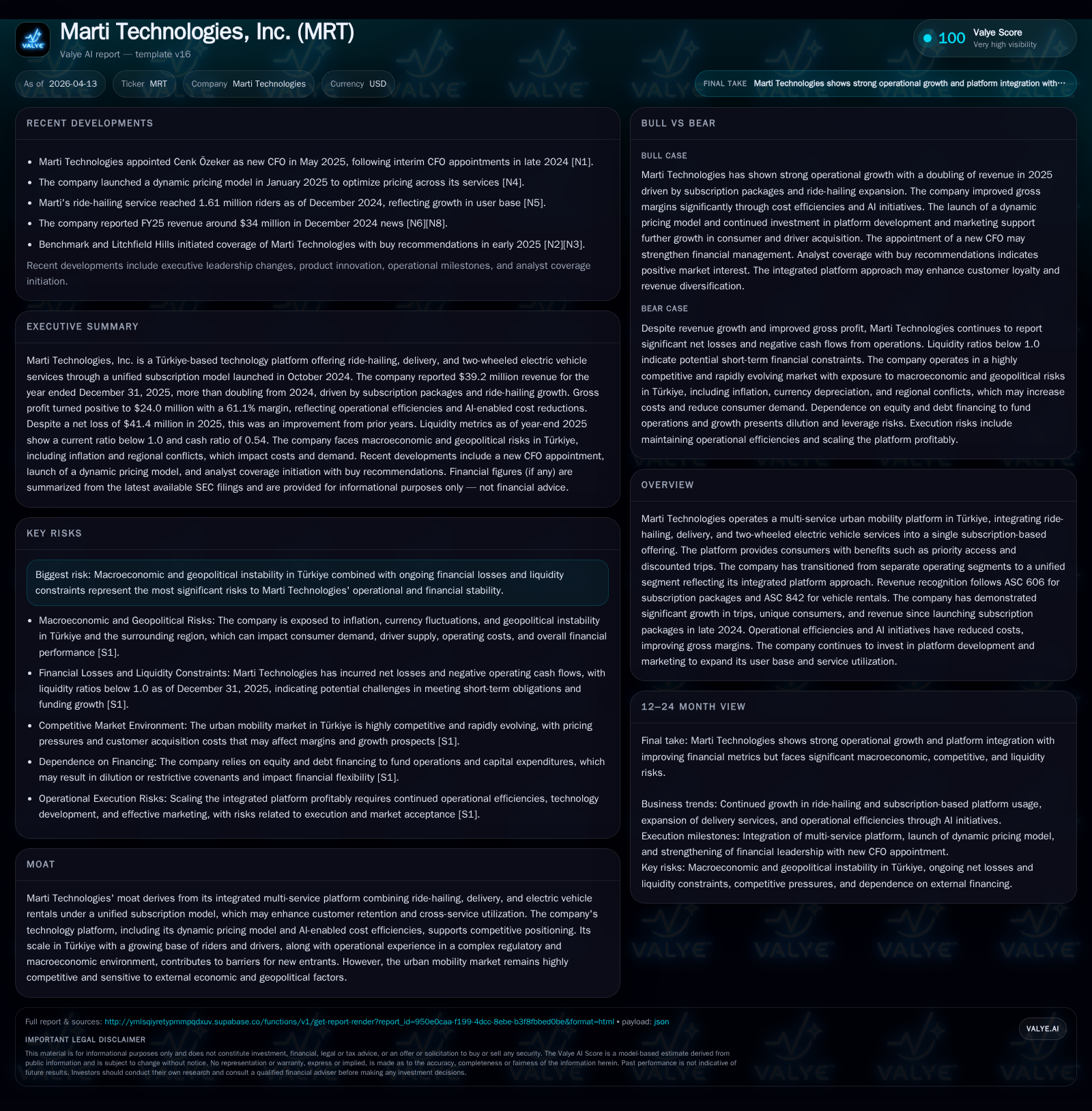
Marti Technologies, Inc. transformed its business in 2024-2025 by launching a comprehensive subscription package uniting ride-hailing, delivery, and electric vehicle rentals in Türkiye. This shift propelled revenues to $39.2 million in 2025, more than doubling year-over-year as trips surged past 50 million and consumer engagement deepened. Operational efficiencies and AI initiatives markedly improved gross margins from negative territory to above 60%. However, net losses remain substantial at over $41 million due to continued high administrative and financial expenses. Liquidity is supported by recent financing though the operating cash flow remains negative. The company faces significant external risks in a challenging geopolitical environment while seeking to scale and monetize its multi-service platform further.
Company Overview and Strategic Shift
Marti Technologies operates a multi-service urban mobility platform in Türkiye that integrates ride-hailing, package delivery, and shared two-wheeled electric vehicles (e-mopeds, e-bikes, e-scooters). The firm transitioned from reporting separate two-wheeled EV and ride-hailing segments into a single segment starting October 1, 2024, coincident with launching a unified subscription offering that bundles all services into one platform accessible via their Marti app [S1][S28]. This subscription model provides consumers enhanced benefits including priority access to services and discounted or free trips.
Historical Growth and Financial Performance
Revenues expanded aggressively following adoption of the subscription packages beginning late 2024. Total revenue increased from approximately $18.7 million in FY2024 to $39.2 million in FY2025 — a robust increase of over 110% year-over-year [F1][S14]. This growth was accompanied by a substantial increase in trips completed across all service lines — surging from nearly 31.7 million trips in 2024 to over 50.8 million in 2025 (+60%) — reflecting strong demand growth post-subscription launch [S14][S25]. Unique active users also grew by over 44%, reaching more than three million consumers by year-end [S14].
Operationally, Marti recorded an important positive inflection turning gross profit into positive territory: from a loss of approximately $2.9 million (negative margin of -15.5%) in FY2024 to a gross profit of $24.0 million (margin of +61.1%) in FY2025 [F1][S5]. This dramatic margin improvement reflects the higher-margin nature of subscription revenues combined with operational efficiencies such as AI-enabled cost reduction initiatives targeting fleet depreciation and vehicle maintenance expenses.
Despite improving top-line metrics and gross profitability, Marti continues to absorb significant operating losses largely driven by high general and administrative costs including personnel expenses that include share-based compensation [F1][S12][S24]. Operating loss narrowed from roughly $65 million in FY2024 to about $28.5 million in FY2025 — a notable improvement but still substantial [F1]. Correspondingly, net loss contracted from -$73.9 million to -$41.4 million over the same period [F1], influenced heavily by increased interest expense on outstanding convertible debt facilities totaling approximately $85.8 million as of end-2025 [S18].
Operating cash flow remains negative but improved meaningfully from -$25 million in FY2024 to just under -$14.8 million in FY2025 [F1][S16], signaling better cash management although the path to positive cash flow remains distant.
Unit Economics and Pricing Dynamics
Marti manages key metrics like gross profit per trip ($0.47 in FY2025 vs negative prior), pre-depreciation contribution per trip ($0.53 vs $0.17 prior), demonstrating operational leverage achieved through scale and cost control improvements across ride-hailing, delivery, and two-wheeled electric vehicle services [S6][S8][S11].
Fleet depreciation expense decreased significantly due to fully depreciated vehicles remaining deployed longer on the platform—supporting margin gains amidst capital expenditure discipline [F1][S14][S19].
Consumer engagement deepened with average trips per unique consumer increasing from about 15 trips annually in FY2024 to over 16 trips in FY2025, reflecting growing utilization intensity across the subscriber base and broader customer expansion [S25].
Capital Allocation and Liquidity Position
As of December 31, 2025, Marti held approximately $7.8 million in cash against current liabilities near $14.4 million resulting in a current ratio around 0.97x—indicating liquidity constraints but manageable with ongoing financing support [F1][S10]. Net cash generated from financing activities reached about $18 million primarily via convertible notes issuance; term loan repayments declined compared with prior periods [S16].
Capital expenditures were modest at approximately $0.5 million focused mainly on property/equipment purchases with reduced intangible asset investment compared to prior years reflecting strategic prioritization towards software development alongside R&D spending increases for platform enhancements [F1][S12][S16].
Share-based compensation expense dropped substantially in 2025 reducing personnel costs despite headcount growth—a sign of tighter compensation management post-IPO volatility [S24]. However, financial expenses rose sharply due to interest on new convertible debt issuances nearing amortization schedules impacting net results negatively [F1][S13][S18].
Industry Context and Regulatory Environment
Marti's competitive advantage lies in its integrated multi-service urban mobility platform tailored specifically for Türkiye's regulatory landscape combining ride-hailing, delivery logistics, and shared electric two-wheelers into one subscription ecosystem designed to enhance customer retention through cross-service incentives not readily available locally or regionally.
The company’s scale—with millions of riders and several hundred thousand registered drivers—amplifies network effects while technology investments focus on AI-driven efficiency gains that raise barriers against less tech-forward competitors or standalone service providers.
Nonetheless, regulatory challenges remain significant due to evolving licensing requirements for two-wheeled EV operations requiring continuous government engagement; macroeconomic instability including inflationary pressures and currency fluctuations add further uncertainty to operational planning [S17].
Table: Selected Annual Financial Highlights (USD thousands)
Historical performance (annual)
| FY | Rev ($mm) | Net ($mm) | CFO ($mm) | OpInc ($mm) | Rev YoY | Net YoY |
|---|---|---|---|---|---|---|
| 2025 | 39 | -41 | -15 | -29 | +110.3% | +43.9% |
| 2024 | 19 | -74 | -25 | -65 | -6.8% | -118.5% |
| 2023 | 20 | -34 | -15 | -31 | -3939.4% | |
| 2022 | -1 | 0 |
Source: SEC companyfacts cache [F1].
Capital returns and efficiency (annual)
| FY | ROE% |
|---|---|
| 2025 | 61.8 |
| 2024 | 120.2 |
| 2023 | 103.4 |
| 2022 | 16.8 |
Source: SEC companyfacts cache [F1]. Note: Capital expenditure figure is approximate; YoY calculations based on available consecutive year data.
Conclusion
Marti Technologies has successfully scaled its integrated urban mobility platform through launching an innovative subscription model that fosters cross-service synergies attracting millions of users within Türkiye’s complex market environment. This achievement is evidenced by revenue doubling year-over-year combined with a transition into positive gross profitability driven by operational efficiencies including AI initiatives. However substantial net losses persist primarily due to high financial costs related to debt instruments alongside sizeable administrative overheads. Liquidity remains adequate near-term but requires careful management given ongoing negative operating cash flows. Macroeconomic volatility coupled with stringent regulatory dynamics pose continued challenges. Future success depends on sustaining subscriber growth momentum across services while maintaining capital discipline amid competitive pressures. Investors should monitor metrics tied closely to subscriber quality growth, unit economics improvements per trip across modalities,and regulatory developments impacting fleet deployment capabilities.
Disclaimer: This analysis is based solely on publicly available sources as cited reflecting data up to April 13, 2026; it does not constitute investment advice.
Disclaimer: This is research-only, informational analysis and not investment advice. It may include AI-generated interpretation and general industry context. Always verify important details using primary sources.

Comments