
Lexaria Bioscience’s DehydraTECH: Patent-Protected Bioavailability Technology Amid Financial and Regulatory Challenges
Lexaria Bioscience develops a proprietary drug delivery platform enhancing oral bioavailability of APIs, with ongoing clinical programs and licensing efforts but faces significant commercialization and financial hurdles.
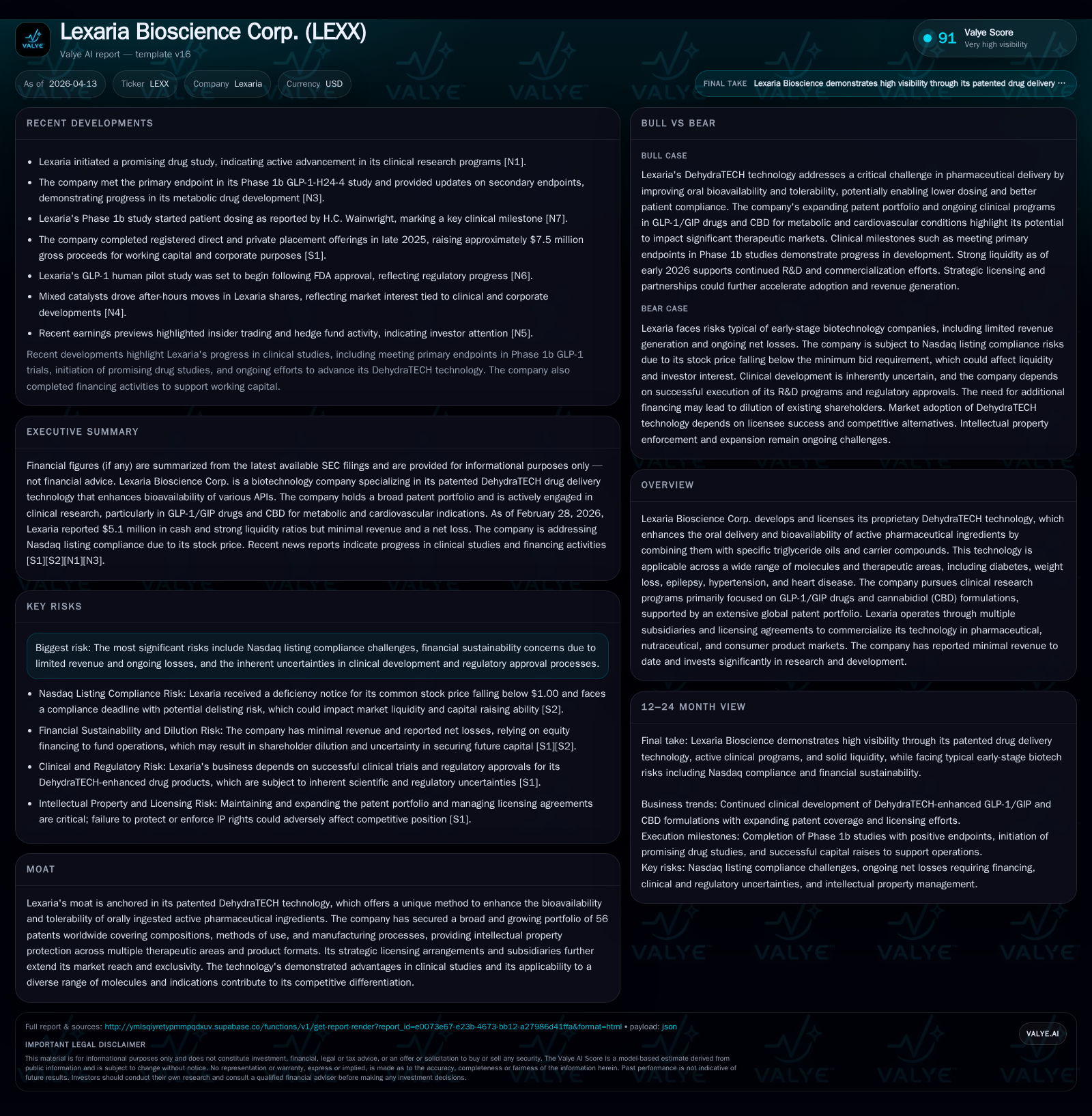
Lexaria Bioscience Corp. has developed DehydraTECH, a patented drug delivery technology designed to improve oral bioavailability of various active pharmaceutical ingredients (APIs) including GLP-1 drugs and cannabinoids. The company maintains a broad patent portfolio and licenses its technology globally across pharmaceutical and consumer sectors. Despite growing revenues, Lexaria reports substantial operating losses and negative cash flows. Key risks include regulatory uncertainties, dependence on third-party collaborators, Nasdaq listing compliance challenges due to stock price issues, and the need for additional financing. Near-term prospects depend on advancing clinical trials, activating dormant licenses, and navigating regulatory and market access hurdles amid financial constraints.
Company Overview and Technology
Lexaria Bioscience Corp., based in Canada, develops DehydraTECH™, a proprietary drug delivery platform that enhances the oral bioavailability of active pharmaceutical ingredients (APIs). The technology involves molecular association of APIs with long-chain fatty acid-rich triglyceride oils via controlled dehydration into carrier substrates. This process improves absorption into the bloodstream while enabling lower dosing and better tolerability [S1].
DehydraTECH is applicable to a wide range of molecules including glucagon-like peptide-1 (GLP-1) drugs, glucose-dependent insulinotropic polypeptide (GIP) compounds, cannabinoids (CBD), nicotine analogs, vitamins, hormones, antivirals, NSAIDs, among others. It supports various dosage forms such as tablets, capsules, suspensions, oral pouches, creams, lotions, foods, and beverages targeting pharmaceutical as well as nutraceutical and consumer packaged goods sectors [S1], [S21].
Historical Performance and Financial Summary
Lexaria has generated minimal revenue historically but showed growth with $705,923 reported for fiscal year 2025 (ending August 31), up approximately 52% from $464,278 in fiscal 2024 [F1]. Despite this increase in top-line sales driven by licensing activities, revenues remain small relative to expenses.
Operating losses nearly doubled to -$11.88 million in fiscal 2025 from -$5.75 million in fiscal 2024; net losses followed a similar trend (-$11.90 million vs. -$5.80 million) [F1]. Operating cash flow remained deeply negative at -$10.45 million in fiscal 2025 compared to -$4.96 million the prior year reflecting continued heavy investment in R&D and clinical development programs [F1]. Capital expenditures were minimal but consistent.
Equity fell significantly from about $8 million in fiscal 2024 to under $3 million in fiscal 2025 indicating reduced net asset value during ongoing losses [F1].
Historical performance (annual)
| FY | Rev ($) | Net ($mm) | CFO ($mm) | OpInc ($mm) | Rev YoY | Net YoY |
|---|---|---|---|---|---|---|
| 2025 | 705923 | -12 | -10 | -12 | +52.0% | -105.4% |
| 2024 | 464278 | -6 | -5 | -6 | +105.2% | +13.0% |
| 2023 | 226208 | -7 | -6 | -7 | -11.4% | +8.3% |
| 2022 | 255397 | -7 | -5 | -7 |
Source: SEC companyfacts cache [F1].
Capital returns and efficiency (annual)
| FY | FCF ($mm) | ROE% |
|---|---|---|
| 2025 | -10 | -398.1 |
| 2024 | -5 | -72.1 |
| 2023 | -6 | -218.9 |
| 2022 | -91.5 |
Source: SEC companyfacts cache [F1].
Note: Revenue growth reflects increased licensing activity though absolute levels remain low.
Business Model: Licensing Structure and Subsidiaries
Lexaria operates through several wholly owned subsidiaries that hold exclusive or non-exclusive licenses for DehydraTECH applications:
- Lexaria Pharmaceutical Corp: Holds exclusive rights for all molecules except nicotine requiring physician consultation for therapeutic uses.
- Lexaria Nutraceutical Corp: Exclusive licensee for non-nicotine/non-cannabis molecules for non-pharmaceutical products.
- Lexaria Nicotine LLC: Exclusive rights holder on nicotine-related DehydraTECH products; partially owned by Altria Ventures Inc.
- Lexaria Hemp Corp: Holds exclusive license for cannabis-derived products containing less than 0.3% THC for non-pharmaceutical use.
Licensing partners span Europe (including UK & Australia/New Zealand), the US via entities like Bevnology LLC and Hill Inc., among others [S17], [S21]. Some licenses remain inactive or dormant.
Competitive Positioning and Intellectual Property Protection
The company's competitive advantage centers on its patented DehydraTECH technology protected by over 56 global patents covering formulations and manufacturing methods [S1]. Clinical data indicate enhanced pharmacokinetic profiles such as increased speed and extent of bioabsorption relative to traditional formulations.
Competition arises from large pharmaceutical companies with substantially greater resources who may develop alternative drug delivery technologies potentially making DehydraTECH less competitive or obsolete [S9], [S18]. Emerging nanotechnology-based encapsulation methods offer improved water solubility but may lack broader performance benefits offered by DehydraTECH [S22].
Strategic licensing alliances aim to extend market reach while maintaining exclusivity in key product domains including GLP-1 metabolic therapies and cannabinoid derivatives.
Clinical Development Pipeline and Growth Drivers
Advancement of DehydraTECH-enabled pharmaceutical candidates through clinical trials toward regulatory approvals is critical for unlocking revenues via direct commercialization or licensing royalties.
Current pipelines focus on GLP-1/GIP analogs targeting diabetes and obesity—large unmet medical needs—and cannabidiol formulations aimed at neurological conditions like epilepsy [N1], [S1]. Early human pilot studies show promise but face typical biotech development risks including multi-phase testing complexities under FDA oversight where efficacy or safety setbacks can delay or halt progress [S1], [S26].
Growth depends on establishing proof-of-concept efficacy sufficient to command premium licensing fees or direct sales.
Additionally, adoption among nutraceuticals or consumer products offers alternative revenue streams with fewer regulatory burdens but intense competition given crowded supplement markets [S9].
Regulatory Environment and Risks
Regulatory approval risks are material given costly clinical trials with uncertain outcomes that could materially impact valuation [S10], [S25], [S27].
CBD-containing products face added complexity due to evolving FDA policies restricting marketing claims while permitting interstate commerce under US Farm Bill hemp provisions [S24], [S26]. Regulatory ambiguities add compliance costs and may limit market geography.
As a Nasdaq-listed company,[S16] Lexaria must comply with listing requirements including minimum bid price rules. It received a deficiency notice due to prolonged sub-$1 share price trading with an extended compliance period until August 3rd ,2026 before potential delisting action[S2], [S3]. Management intends corrective actions including requesting further compliance extensions or possibly executing a reverse stock split.[S2]
Capital Structure & Returns Analysis
As of February 28th ,2026 Lexaria had cash equivalents of approximately $5.1 million offering operational runway but highlighting the need for further equity financing or partnerships[F1], [S8], [S11].
The company does not pay dividends nor conduct share repurchases,[S6] allocating capital primarily toward R&D expansion.
Return on equity is deeply negative at about -398% for fiscal year ended August 31st ,2025 reflecting persistent net losses typical of pre-revenue biotech firms investing ahead of commercial revenues[F1].
Free cash flow remains severely negative at approximately minus $10.47 million driven by operating expenses far exceeding revenues[F1].
Outlook: Milestones & What to Watch
While no formal guidance is provided,[N1] key milestones include:
- Progression through late-stage clinical trials especially for GLP-1/GIP candidates;
- Activation or expansion of dormant licensees increasing royalty income;
- Outcomes from regulatory interactions affecting approval timelines;
- Resolution of Nasdaq listing deficiencies impacting liquidity;
- Announcements regarding capital raises ensuring operational continuity beyond current cash reserves.
Analysis: Lexaria stands at a critical juncture balancing proprietary technology validated in early studies against substantial financing needs coupled with regulatory hurdles typical of developmental biotech firms. Success depends on converting R&D into commercial partnerships generating sustainable revenues.
Risks Summary
Key risk factors include:[S13], [S29]:
- Potential delays or failures in clinical trial outcomes leading to program abandonment;
- Competition from well-funded biotech firms developing alternative delivery platforms;
- Patent challenges that could erode exclusivity;
- Difficulty retaining qualified personnel essential for R&D execution;
- Risk of Nasdaq delisting reducing share liquidity;
- Regulatory uncertainty particularly around CBD product marketing;
- Dependence on third parties for trials/manufacturing risking delays if protocols unmet;
- Need for continued capital raises potentially dilutive to shareholders;
- Uncertainty whether licensees will activate agreements effectively limiting royalty growth.
Conclusion
Lexaria Bioscience’s DehydraTECH represents an innovative approach targeting improved oral delivery across multiple therapeutic areas including metabolic disorders and cannabinoid treatments supported by extensive intellectual property protection.
However, the path forward entails typical developmental biotech challenges: scaling clinical validation under complex regulation amid financial constraints marked by steep operating losses and limited current revenues. Risks related to Nasdaq compliance add near-term uncertainty around investor confidence. Investors should monitor pivotal trial progressions alongside commercial partner activations which will shape transition toward sustainable commercialization.
This report is based solely on publicly available information as cited above. Valye News does not provide investment advice or recommendations.
Disclaimer: This is research-only, informational analysis and not investment advice. It may include AI-generated interpretation and general industry context. Always verify important details using primary sources.

Comments