
DiDi Global’s 2025 Growth Moderates with Narrow Profit Margins and Strategic Capital Allocation
DiDi Global reported revenue growth driven primarily by its core China mobility segment but faces margin pressure and elevated operational costs amid regulatory and market challenges.
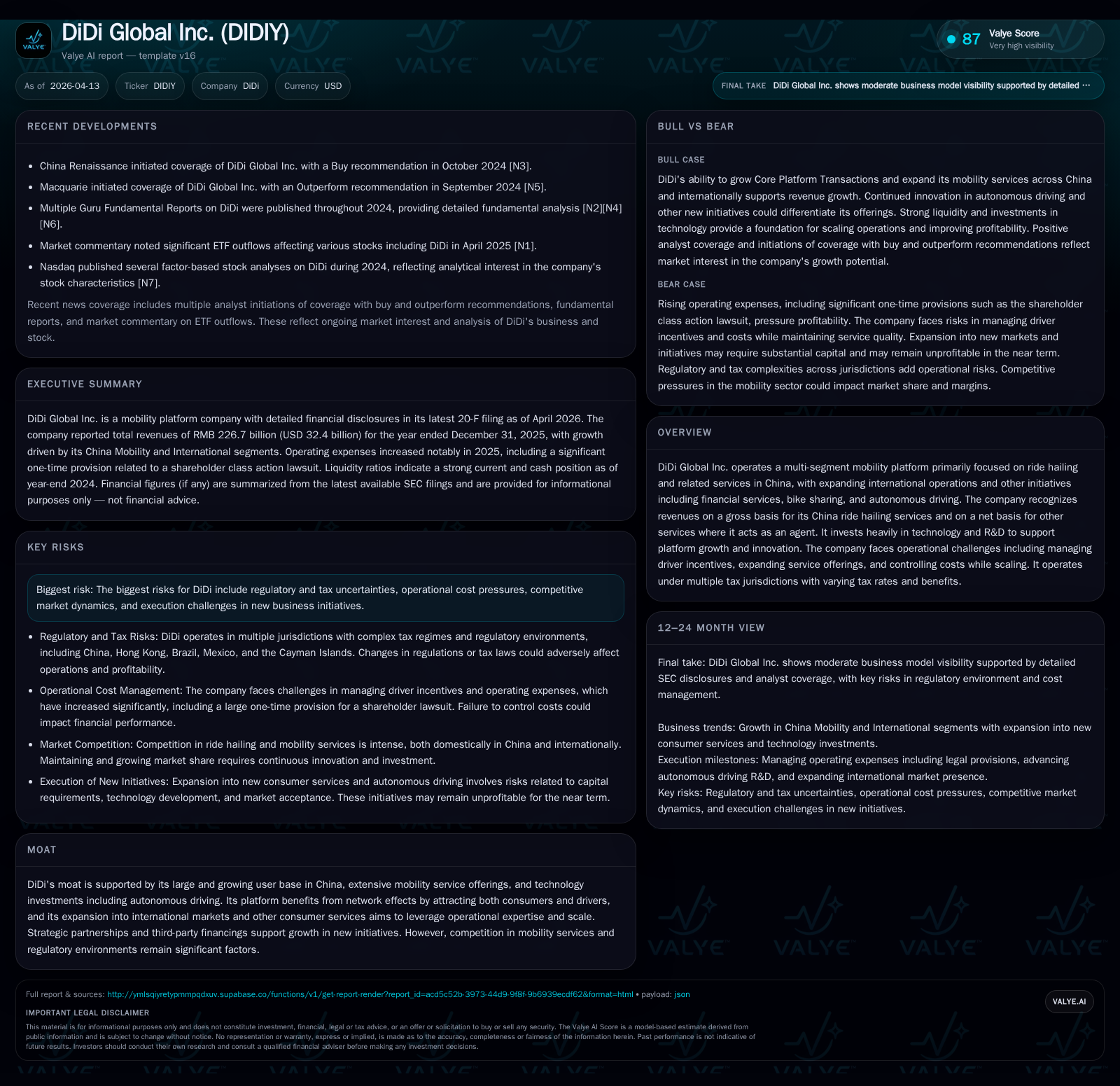
DiDi Global Inc. continues to expand its ride-hailing platform, with revenues rising from RMB206.8 billion in 2024 to RMB226.7 billion (US$32.4 billion) in 2025, driven by scalable growth in both China and international markets. The company returned to profitability after multi-year losses, reporting a net profit of US$143.7 million in 2025 but operating income remains negative. Heavy investment in technology, autonomous driving, and new initiatives constrains earnings despite positive operating cash flow and free cash flow generation. DiDi’s capital allocation includes disciplined share repurchases and manageable leverage, while risks from regulatory pressures, competition, and litigation persist.
Company Overview and Industry Positioning
Founded in 2012, DiDi Global Inc. has grown into a leading technology platform focused primarily on shared mobility services in China complemented by expanding operations internationally across 14 countries plus diversified initiatives including financial services, bike sharing, electric mobility, intra-city freight logistics, energy services, and autonomous driving development [S1]. Its platform benefits significantly from network effects where more drivers attract more consumers creating scale advantages particularly in China's dense urban centers.
DiDi operates under a multi-segment business model consisting mainly of:
- China Mobility (ride hailing, chauffeur services, online taxi)
- International operations (ride hailing and food delivery outside China)
- Other Initiatives (new ventures such as bike sharing and autonomous driving) [S1][S24]
While competition is fierce both domestically from emerging local players and internationally from entrenched rivals like Uber, coupled with ever-shifting regulatory frameworks focused on user safety, data privacy, driver rights, taxation sets a complex operating backdrop [S14].
Historical Financial Performance and Growth Drivers
DiDi’s revenue trajectory over recent years captures the rebound effect post-regulatory scrutiny peak circa 2021–22 when it suffered steep losses [F1][S1]. Revenue grew steadily from RMB192.4 billion in 2023 to RMB206.8 billion in 2024 (+7.5%) and then accelerated modestly to RMB226.7 billion (US$32.4 billion) in 2025 (+9.6%) [F1][S1].
Core Platform GTV—a proxy for transactional scale aggregating rides domestically and abroad—expanded robustly from RMB341.4 billion in 2023 to RMB392.7 billion in 2024 (+15%) reaching RMB450.8 billion (US$64.5 billion) in 2025 (+14.7%), signifying increased ride completion volumes as urban mobility normalized post-COVID restrictions [S1].
The improved revenue base reflects scaling ride volumes alongside strategic pricing adjustments amid competitive dynamics balanced against heightened incentives for drivers essential for supply-side liquidity [S22].
Despite top-line expansion, operating income remains negative; the latest figure for FY2023 was an operating loss of approximately US$809 million albeit an improvement versus prior years’ larger losses [F1]. Net income swung positive with reported profits of RMB1.3 billion in 2024 followed by RMB1.0 billion (US$143.7 million) in 2025 demonstrating narrowing losses on the path towards sustainable profitability [F1][S1]. Operating cash flows turned positive over the same recent periods signaling underlying operational efficiency improvements alongside cost controls [F1].
Historical performance (annual)
| FY | Net ($bn) | CFO ($bn) | OpInc ($bn) | Capex ($mm) | Net YoY |
|---|---|---|---|---|---|
| 2024 | |||||
| 2023 | 0.1 | 1.1 | -0.8 | 330 | +102.0% |
| 2022 | -3.4 | -1.4 | -2.6 | 370 | +55.5% |
| 2021 | -7.7 | -2.1 | -7.6 | 1039 |
Source: SEC companyfacts cache [F1].
Capital returns and efficiency (annual)
| FY | Buybacks ($mm) | FCF ($bn) | ROE% |
|---|---|---|---|
| 2024 | |||
| 2023 | 16 | 0.7 | 0.5 |
| 2022 | -1.8 | -25.0 | |
| 2021 | 32 | -3.1 | -44.0 |
Source: SEC companyfacts cache [F1].
Table note: Operating income data available only through FY23; buyback amounts for FY25 reflect authorization levels with partial execution reported [F1][S6][S8]
Future Growth Prospects
DiDi’s expansion engine rests on increasing penetration within China by diversifying offerings beyond classic ride hailing into chauffeur services, hitch rideshares, online taxi platforms plus leveraging customer traffic towards adjacent opportunities like financial services embedded within the platform [S1]. International growth leverages localized partnerships enabling scalability without full market ownership—mitigating direct investment risk while broadening ecosystem reach.
Other Initiatives face an intensive R&D cycle with significant outflows given nascent technologies like autonomous driving systems plus capital-heavy asset acquisitions such as e-bikes and logistics fleets [S16]. These verticals are funded partly through third-party financings reducing balance-sheet strain [S16], yet the path to profitability is longer term.
Potential constraints include intensifying competition forcing sustained incentive spending to maintain driver supply; ongoing regulatory uncertainty especially regarding data compliance or localized laws; plus macroeconomic factors influencing discretionary mobility demand particularly during economic slowdowns or policy shifts impacting ride usage patterns.
Monitoring indicators include sequential improvements or expansion in Core Platform GTV outside China, margins at segment levels particularly Other Initiatives narrowing losses gradually, regulatory developments affecting operational compliance costs and tax treatment under multiple jurisdictions [S14][S22][S24].
Financial Forecasts / Milestones / Expectations
Explicit management guidance or forecasts were not disclosed in the filings but milestones to watch encompass continued revenue growth trending above GDP or urban mobility sector averages; adjusted EBITDA inflections positive; sustained or growing net profits; operating cash flow consistency; measured capex aligned with scaling initiatives; alongside successful integration or commercial launches of autonomous driving features contributing incremental revenue streams . The upcoming court approval of the $740 million litigation settlement scheduled mid-2026 may reduce overhang risk for investors but requires monitoring for impacts on capital structure or optionality [S14].
Returns and Capital Allocation
Return on equity sits on a thin positive foundation around a half percent (0.5%), reflecting recent swings into net profitability though subdued relative to mature tech peers [F1]. Operational cash flows animate a healthier profile topping US$1 billion as of latest reporting periods enabling funding for capex averaging just under US$350 million annually focused on bikes/e-bikes acquisitions plus IT infrastructure supporting platform scalability [F1][S10]. Free cash flow remains positive driven by stronger cash generation versus investment outlays (US$746 million FCF estimated latest year).
Capital returns saw active share repurchase programs initiated:
- November 2023 program allowed $1B repurchase over two years; completed partial buybacks totaling roughly $60 million by end-2023 [S8]
- March 2025 authorization increased buying capacity to $2B over following two years with incremental open market repurchases underway through late-2025 totaling hundreds of millions USD worth according to disclosures [S15]
No dividends were reported indicating management preference towards buybacks or reinvestment given growth-stage status [S6][S18]. Financial leverage remains moderate with about $1.8B short-term borrowings supplemented by minimal long-term debt (~$33M), balanced against a strong liquidity pool exceeding $7.9B including cash equivalents plus short/long term treasury investments providing a comfortable cushion to meet obligations [S3][S25].
Operational Highlights & Technology Investment
Driver incentives remain a key cost component under "Cost of Revenues" including insurance and payment processing fees while operational support expenses incorporate personnel costs along with outsourcing fees for customer service tailored for scale coverage across segments [S16]. With ride-hailing recognized gross on revenue when acting as principal under Chinese regulations contrasts net basis accounting used internationally where DiDi is agent highlighting complexity in financial models requiring calibrated analysis per geography/service type [S22].
Research & development spend includes significant allocations toward autonomous vehicle development innovating proprietary technologies aiming eventually at cost reduction through automation lowering human driver dependency—a critical industry frontier competing with other global players targeting similar tech frontiers like Waymo or Uber's AV units [S16].
Risks Summary
Significant risks outlined include:
- Regulatory uncertainty involving cross-border jurisdictional issues impacting tax treatment potentially creating unexpected liabilities or compliance costs,
- Competitive pressures pressuring margins requiring sustained driver/consumer incentives,
- Litigation risk culminating recently in a substantial $740 million settlement payable pending judicial approval illustrating material legal exposures,
- Execution risks linked to scaling ambitious initiatives including autonomous driving that require heavy upfront investments absent guaranteed commercial returns,
- Currency fluctuations affecting overseas operations earnings translation due to deployment across multiple currencies.
These all imply that while DiDi benefits from scale moats bolstered by network effects reinforcing consumer & driver lock-in particularly domestically, its future financial outcomes remain sensitive to exogenous economic & political variables plus operational execution precision within evolving mobility innovation landscape.
Conclusion
DiDi Global demonstrates solid top-line growth momentum powered by dominant foothold within China's shared mobility market complemented by growing international activities plus related service vertical expansions albeit shadowed by persistent margin pressures largely attributable to high fixed costs of technology investment plus competitive incentive structures needed to maintain market share. Positive net income achievement marks important stabilization though tempered operating losses illustrate continuing scaling costs inherent at this stage. Capital discipline manifested through sizeable share buyback programs alongside robust liquidity provides runway flexibility while moderate leverage preserves financial resilience amidst evolving regulation. Market watchers should track detailed segment profitability evolution alongside legal developments concerning material settlements that could impact future cash flows or capital allocation priorities. Ultimately DiDi's capacity to innovate technologically fast enough—particularly around EV electrification plus autonomous mobility—and navigate regulatory complexity will dictate medium-term performance viability as one of the world's largest ride-hailing platforms.
This report is prepared solely for informational purposes without any recommendation regarding investments.
Disclaimer: This is research-only, informational analysis and not investment advice. It may include AI-generated interpretation and general industry context. Always verify important details using primary sources.

Comments