
SOBR Safe’s Financials and Expansion Strategies Amid Technology Adoption Hurdles
SOBR Safe advances its patented alcohol monitoring technology while managing operating losses and seeking broader market acceptance.
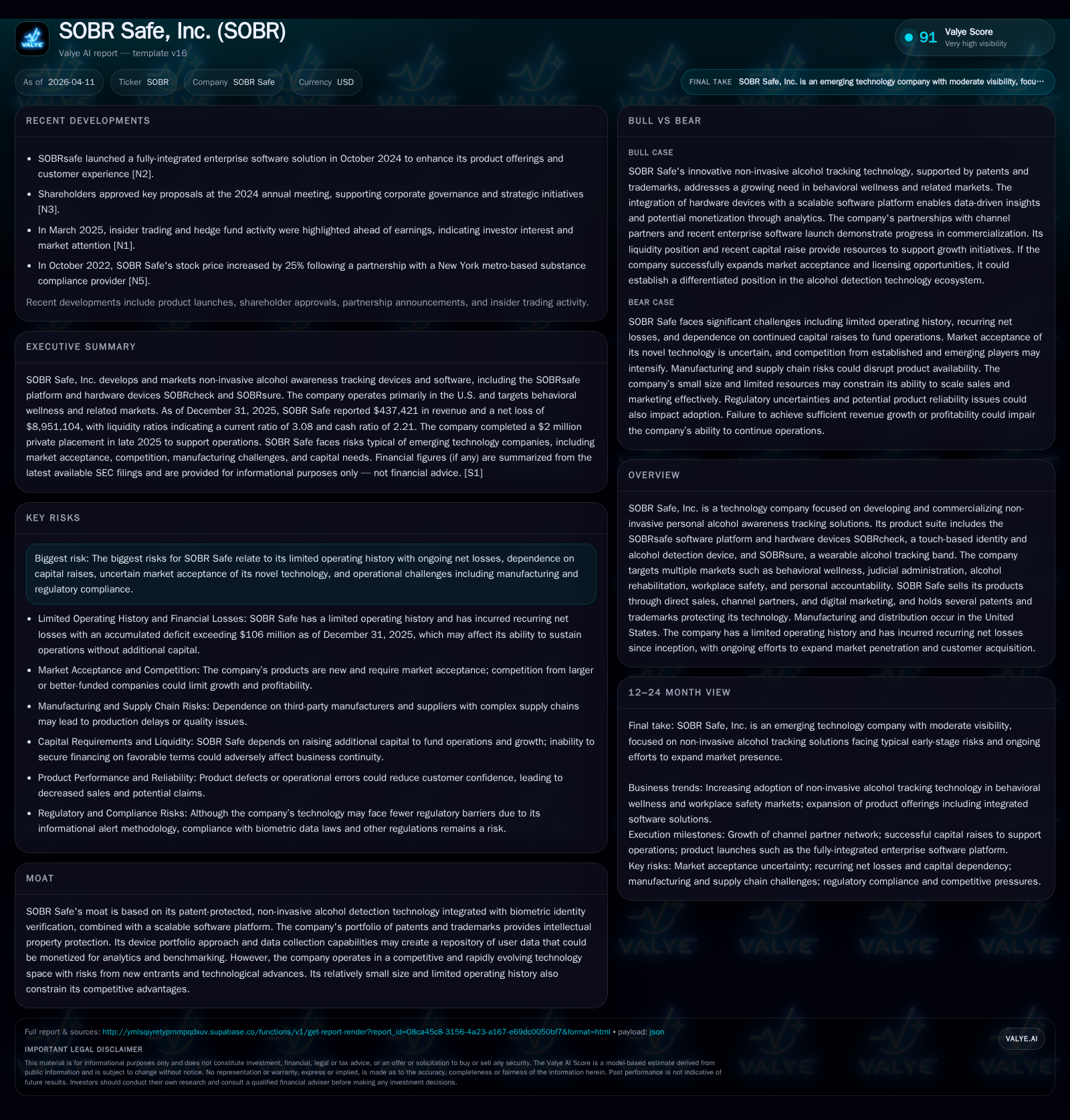
SOBR Safe, Inc. has steadily grown revenue from a modest base, reaching approximately $437K in 2025 with over 100% year-over-year growth that year. Despite this growth, the company continues to operate at significant net losses exceeding $8M annually, reflecting heavy investments in R&D and sales. The core value proposition centers on its non-invasive alcohol detection integrated with biometric identity verification, targeting diverse end markets such as behavioral wellness and workplace safety. Market penetration hinges on overcoming adoption hurdles including cost justification and reliability perceptions. Capital allocation remains focused on technology development funded through equity raises, as the company expects continued negative cash flows in near term. Key risks include regulatory compliance, supply chain complexity, and market acceptance of novel technology solutions.
Innovative Roots: Technology and Product Portfolio Shaping Early Growth
SOBR Safe’s core innovation lies in its patented non-invasive alcohol tracking technology fused with biometric identity verification—a valuable combination forming the basis of its competitive moat [S1]. Unlike traditional breathalyzers or ankle monitors commonly used in punitive settings, SOBRcheck operates via a simple touch interface where users place fingers on sensors that simultaneously confirm biometric identity and detect alcohol content through perspiration analysis. Complementing this is SOBRsure, a wearable fitness-style wristband enabling discreet passive monitoring of transdermal alcohol levels connected via Bluetooth to mobile devices for real-time data capture [S25].
These hardware devices feed into the SOBRsafe software platform that aggregates behavioral data for use across markets including behavioral wellness programs, judicial administration alternatives, workplace safety enforcement, rehabilitation settings, and individual personal accountability applications. SOBR Safe’s IP portfolio covers issued patents—such as U.S. Patent No. 9,296,298 covering alcohol detection systems—and pending applications extending into wearables and vehicle integration devices [S16][S19]. This portfolio offers defense against competitors leveraging similar sensing technologies.
Sales are pursued through a tripartite channel strategy: direct enterprise and consumer sales executed by an experienced but small sales team; channel partners who distribute products among business customers; and nascent licensing efforts exploring integration of SOBRsafe tech into third-party platforms [S16]. This multi-channel approach aims to maximize reach but also demands balancing technical education for customers alongside operational scalability.
Historical Financial Performance: Examining Revenue Growth during Persistent Losses
SOBR Safe has exhibited encouraging revenue growth from essentially negligible amounts in early years to over $437K by fiscal year-end 2025 [F1]. This progression translates to roughly a twelvefold increase from $35K in 2022 to $438K in 2025. Notably, revenue more than doubled between 2024 and 2025 alone (approximate +105.6% YoY), reflecting improving traction albeit off a low base.
Nevertheless, operating results continue to reflect the steep developmental curve characteristic of early-stage hardware/software innovators. Operating income remains deep in the red at roughly -$9.16M for FY 2025—an increase in absolute loss compared to $7.68M negative EBIT in 2024 but an improvement relative to prior years’ higher losses (-$10.4M in 2022) [F1]. Net income trends similarly emphasize sustained significant losses ($-8.95M in 2025), though marginal improvement from earlier periods.
Operating cash flows remain persistently negative (-$6.96M in FY25), signaling extensive cash burn driven by investment outlays likely dominated by R&D expenses and expansion of marketing/sales infrastructure [F1][S4]. The current ratio exceeds three times (3.08) reflecting strong short-term liquidity buffers yet signaling reliance on outside funding for ongoing operations.
Historical performance (annual)
| FY | Rev ($) | Net ($mm) | CFO ($mm) | OpInc ($mm) | Rev YoY | Net YoY |
|---|---|---|---|---|---|---|
| 2025 | 437421 | -9 | -7 | -9 | +105.6% | -4.0% |
| 2024 | 212736 | -9 | -7 | -8 | +35.2% | +15.7% |
| 2023 | 157292 | -10 | -6 | -10 | +345.3% | +17.3% |
| 2022 | 35322 | -12 | -6 | -10 |
Source: SEC companyfacts cache [F1].
Capital returns and efficiency (annual)
| FY | ROE% |
|---|---|
| 2025 | -179.8 |
| 2024 | -87.3 |
| 2023 | -501.7 |
| 2022 | -135.9 |
Source: SEC companyfacts cache [F1].
The financial trajectory underscores an ambitious scaling phase where operational leverage remains elusive as commercial momentum builds from a modest base.
Market Penetration Strategies and Customer Adoption Challenges
SOBR Safe’s tripartite go-to-market strategy hinges on direct sales executed by a compact four-person highly experienced team supported by channel partnerships numbering ten as of late-2025 [S16], complemented by exploratory licensing discussions designed to widen distribution footprints via established third parties [S5]. This layered approach reflects an understanding that achieving scale requires both direct engagement for complex enterprise customers alongside leveraging network effects through channel partner capabilities.
However, several barriers complicate rapid adoption. The cost of devices versus potential savings remains a pointed concern—customers must weigh upfront investment against longer-term gains from workplace safety improvements or insurance premium reductions [S7]. Reliability perceptions critically influence procurement decisions; any malfunction or perceived instability can quickly erode confidence given the sensitive nature of alcohol monitoring use cases ranging from behavioral health programs to judicial oversight [S7][S23]. Additionally, delivering sufficient training imbued with technical competency to channel partners and end clients poses challenges typical for integrated hardware-software products requiring user education.
Further complicating brand recognition efforts is the novel character of non-invasive transdermal sensing technology which contrasts with established breathalyzer methodologies familiar within legal or rehabilitative contexts [S16]. The company invests substantially in media exposure through trade shows and digital marketing aimed at awareness-building tailored toward demographic segments recently profiled as having substantive demand potential—moderate-to-severe AUD sufferers represent a primary target [S16]. These insights underscore the need for proof-based marketing emphasizing device discreetness coupled with continuous data fidelity.
Capital Allocation Philosophy: Balancing Investments, Cash Flows, and Returns
Capital discipline at SOBR Safe centers on heavy deployment toward research & development alongside market expansion initiatives accompanied by prudent financial stewardship given sustained negative net income streams [S4][F1]. There are no dividends or share repurchase programs consistent with typical growth-stage technology firm behavior where reinvestment underpins longer-term value creation pathways [S15].
Equity issuances have allowed continued operations amid cash burn exceeding $6M annually at present scale; however equity dilution concerns surface given the magnitude of capital needs relative to modest revenues [S6][F1]. The consequent approximate return on equity (ROE) stands deeply negative around -180%, typical for companies balancing asset buildout against early commercialization phases without operational profits achieved [F1].
Capital expenditure relates largely to product development activities including hardware iterations and software platform enhancements as reflected by increasing R&D expenses documented in filings [S4]. Given limited tangible fixed assets beyond inventory and leasehold improvements reported at headquarters in Greenwood Village Colorado, capex does not presently dominate outflows but accompanies aggressive investment in intellectual property advancement.
Risks From Supply Chain to Regulatory Compliance in a Nascent Industry
Operational risk analysis reveals vulnerabilities concentrated around supply chain complexity despite exclusive use of United States-based manufacturing partners [S2][S5][S28]. These suppliers' own networks include sub-suppliers potentially overseas where differing regulatory regimes create compliance intricacies difficult for SOBR Safe to oversee fully. Absence of contingency stockpiling or alternative sourcing plans exacerbates risk exposure should disruptions arise [S2][S22].
On regulatory fronts, while the company’s unique "pass/fail" alcohol presence methodology avoids traditional government regulation applied to quantitative breathalyzer tests across most targeted markets (behavioral wellness etc.), geographic variation—especially within judicial applications—poses challenges requiring careful navigation of state-specific rules governing device acceptability [S19]. Moreover, data privacy laws relating to collection of biometric identifiers mandate adherence to evolving legal frameworks adding compliance overhead that could affect scalability if mishandled [S19][S10].
Product liability insurance is carried but entails risk given novel devices deployed for safety-critical decisions; future claims or coverage issues could impact finances adversely if adversarial legal actions materialize [S17][S23]. Cybersecurity protections must also evolve amid increased collection/transmission of user data given potential threats compromising data integrity or system uptime consequential for user trust.
Future Outlook: Growth Prospects and Financing Dependencies Ahead
Looking forward, SOBR Safe's ability to advance product commercialization will remain closely tied to securing fresh capital injections necessary both for ongoing R&D cycles and scaling distribution activities—particularly expanding the direct sales force beyond current levels—and executing channel partner recruitment drives designed to deepen market penetration across verticals such as oil/gas fleet management and insurance-linked safety programs [N1][S8][S16].
Licensing platforms could offer accelerated indirect revenue streams if technical integration proves successful but remain early-stage prospects without guaranteed timelines or contract terms finalized yet [S16][S7]. Sustaining these growth initiatives absent profitability projections implies dilution risks pervasive within similar early-stage tech enterprises dependent upon capital markets receptivity.
Market acceptance remains speculative; factors including demonstrating reliable ROI for enterprise clients spanning safety-sensitive industries will be critical milestones alongside regulatory clarifications especially pertinent if judicial administration use expands toward alternatives reducing incarceration reliance [S8][S14]. Monitoring industry-wide post-pandemic labor productivity standards may also modulate corporate willingness to adopt continuous alcohol awareness solutions embedded within health/safety protocols.
Milestones to Monitor: Strategic Partnerships, Licensing, and Sales Expansion
Key upcoming catalysts involve securing major licensing agreements—particularly ones integrating SOBRsafe technology into broad ecosystem partners capable of scaling deployments rapidly—and accelerating expansion of the direct sales team whose current size limits reach despite their advanced technical acumen [S3][S7].[Explicit guidance on timing is not yet available so these remain watchpoints rather than confirmed targets]. Launches of iterative improvements or new hardware variants could further differentiate offerings enhancing competitive positioning alongside enhanced mobile app functionalities enabling granular administrative controls.
Additionally crucial will be tangible execution on vendor risk mitigation plans addressing identified supply chain vulnerabilities encompassing alternative supplier identification plus potential inventory buffering strategies aimed at reducing manufacturing disruptions' impacts [S2][S28]. Effective management here will underpin stable customer delivery commitments reassuring enterprise contracts requiring high service-level compliance.
Sector insight: Early-stage hardware/software firms face unique challenges scaling device-dependent recurring revenue models while achieving operational leverage often delayed well past initial revenue ramp phases reflecting lengthy product iteration cycles combined with required user education investment costs integrated within channel partner networks.
This report synthesizes public filings up through April 10, 2026. All financial figures are sourced directly from SEC-filed statements per XBRL datasets unless otherwise noted. Forward-looking considerations reflect company disclosures complemented by standard sector analysis without speculative numeric forecasts absent explicit guidance.
Disclosure: This document does not contain investment advice or recommendations but is intended solely as an informational overview supporting further due diligence processes.
Disclaimer: This is research-only, informational analysis and not investment advice. It may include AI-generated interpretation and general industry context. Always verify important details using primary sources.

Comments