
FGI Industries Faces Intensifying Profitability Pressures Despite Stable Sales Growth Drivers
The company’s expansion in branded products and product categories contrasts with ongoing operating losses and supply chain risks.
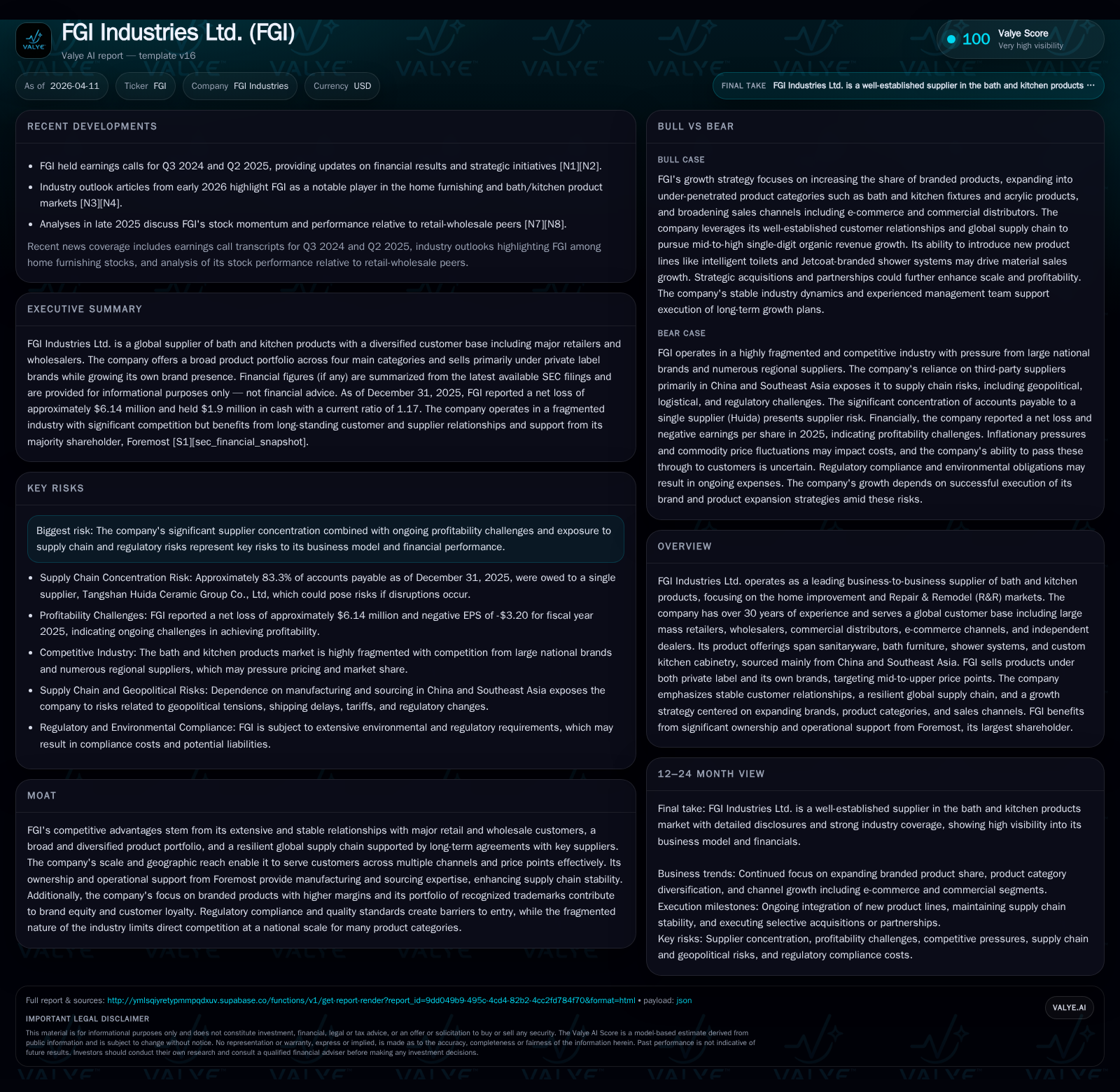
FGI Industries Ltd. has established itself as a leading B2B supplier in the bath and kitchen markets over more than 30 years, leveraging strong retailer and wholesale relationships. While the company benefits from diversified product lines and growing e-commerce presence, it has faced significant declines in operating income and net profit, resulting in losses in recent years. Growth initiatives focus on brand expansion, product diversification, and channel development, though supplier concentration and regulatory compliance remain key challenges. Cash flow improved in 2025 but free cash flow remains negative; no dividends or buybacks have been reported.
Company Overview
FGI Industries Ltd. is an experienced business-to-business supplier specializing in kitchen and bath products focused mainly on the home improvement and Repair & Remodel (R&R) markets worldwide. Supported by Foremost—a family-controlled industrial group owning approximately 71% of voting power—FGI offers a wide range of products including sanitaryware (toilets, sinks), bath furniture (vanities, cabinets), shower systems (walls, doors), and custom kitchen cabinetry sourced mainly from China and Southeast Asia [S1][S6][S13].
The company serves large mass retailers such as The Home Depot and Lowe's; wholesalers including Ferguson; commercial distributors; expanding e-commerce platforms like Wayfair.com; as well as many independent dealers [S7][S13]. Products are sold both under customer private labels (e.g., Glacier Bay by Home Depot) and proprietary brands such as Foremost®, contrac®, Jetcoat®, Rosenberg®, Avenue®, and Covered Bridge Cabinetry®, targeting mid-to-upper price tiers rather than entry-level segments [S1][S5].
Stable long-term supplier relationships, particularly with Tangshan Huida Ceramic Group accounting for over 83% of accounts payable as of year-end 2025, underpin FGI’s supply chain resilience alongside its broad product offering capabilities [S4][S13].
Historical Financial Performance
While comprehensive recent revenue figures beyond Q3 2022 ($332.8K reported) are not publicly detailed, FGI has historically achieved consistent above-industry growth driven by strategic focus on quality design, service excellence, and efficient global supply chains [F1][S1]. However, profitability deteriorated sharply starting in FY2024:
Historical performance (annual)
| FY | Net ($mm) | CFO ($mm) | OpInc ($mm) | Capex ($mm) | Net YoY |
|---|---|---|---|---|---|
| 2025 | -6 | 1 | -2 | 1 | -411.2% |
| 2024 | -1 | -7 | -2 | 2 | -263.7% |
| 2023 | 1 | 1 | 2 | 1 | -80.1% |
| 2022 | 4 | 1 | 5 | 1 |
Source: SEC companyfacts cache [F1].
Capital returns and efficiency (annual)
| FY | FCF ($mm) | ROE% |
|---|---|---|
| 2025 | 0 | -35.5 |
| 2024 | -10 | -5.4 |
| 2023 | 1 | 3.0 |
| 2022 | 0 | 16.2 |
Source: SEC companyfacts cache [F1].
All figures USD thousands except equity.
Operating income swung from positive $2.3 million in FY2023 to negative $2.4 million in FY2025 amid inflationary cost pressures and operational challenges [F1][S15]. Net income declined more steeply due to additional non-operating expenses.
Operating cash flow exhibited volatility: rising from $980K in FY2022 to $1.39 million in FY2023 before plunging to negative $7.43 million in FY2024 then recovering to positive $673K in FY2025 ([F1]). Capital expenditures peaked in FY2024 reflecting investment phases but moderated thereafter.
Equity declined by around $5 billion between FY2024 and FY2025 driven by accumulated losses ([F1]). Foremost’s majority ownership provides operational stability but also affects governance dynamics [S8].
Growth Prospects
FGI’s "BPC" growth strategy targets Brands (boosting own branded sales share), Products (expanding into categories like intelligent electronic toilets), and Channels (growing e-commerce alongside traditional retail/wholesale) [S10][S11]. New product launches such as Jetcoat shower systems exemplify efforts to capture higher-margin market segments.
Whitespace opportunities exist notably within bath/kitchen fixtures including behind-the-wall plumbing components and acrylic bathtubs where current penetration is low [S10]. Sales channel breakdown includes:
- Mass retail: ~34%
- Wholesalers: ~33%
- Commercial: ~12%, with room for further penetration via local distributors
- E-commerce: ~8%, up from <2% a decade ago
- Independent dealers: ~13%
Geographically focused largely on North America with growing presence in Canada and Germany ([S10]), FGI aims for mid-to-high single-digit organic revenue growth aligned with favorable R&R market trends driven by housing turnover and aging stock ([S11]).
Capital Allocation & Liquidity
FGI does not currently pay dividends nor conduct share repurchases per disclosures ([S29],[F1]). Capital allocation emphasizes working capital management alongside measured capital investments mainly related to manufacturing capabilities secured through Foremost affiliations.
Liquidity is moderate with a current ratio of approximately 1.17 at year-end 2025 ([F1]). The company maintains an amended revolving credit facility with East West Bank extended through April 17, 2027 supporting operational funding needs ([S21],[S22]).
The approximate return on equity for FY2025 was negative around -35%, reflecting significant net losses against equity base ([F1]). These metrics highlight ongoing profitability challenges despite stable revenue drivers.
Industry Position & Competitive Moat
FGI benefits from entrenched relationships with major retailers plus a broad product suite diversified across mid-to-upper price points competing against numerous regional/local players [S8]. Its global sourcing platform backed by Foremost’s manufacturing expertise adds resilience amid geopolitical trade uncertainties affecting China-Southeast Asia supply chains.
Strong brand recognition through trademarks such as Foremost® supports consumer trust enabling higher margins relative to commoditized private label goods. Compliance with environmental standards like EPA Water Sense for toilets and CARB Phase II for wood furniture enhances barriers to entry while aligning with sustainability goals [S12][S15].
However substantial supplier concentration risk persists—over four-fifths of accounts payable owed to Huida Ceramics—and supply chain complexity remains a material operational challenge [S4][F1]. Regulatory compliance costs require continuous attention.
Risks Summary
Key risks include:
- Supplier concentration elevating vulnerability to cost or supply disruptions,
- Persistent profitability pressure exacerbated by inflationary cost environment,
- Complex international supply chains potentially causing delays,
- Regulatory compliance across multiple jurisdictions imposing costs,
- Competition from larger integrated manufacturers with scale advantages,
- Absence of sustained profitability raises concerns about long-term financial stability without operational improvements.
Conclusion
With a long history supported by extensive channel relationships within core kitchen/bath R&R markets globally, FGI Industries Ltd. is positioned for growth centered on brand building and category expansion alongside increasing digital commerce penetration. Yet recent financial results reveal significant profitability headwinds.
Investors should monitor the company's ability to restore margins through operational efficiencies or pricing power; reduce supplier concentration risk via diversification; execute growth strategies including new product launches and acquisitions; while maintaining liquidity health given existing credit facilities.
Disclaimer: This report reflects information available as of April 2026 without investment advice or recommendations.
Disclaimer: This is research-only, informational analysis and not investment advice. It may include AI-generated interpretation and general industry context. Always verify important details using primary sources.

Comments