
Ekso Bionics Holdings: Charting Growth amid Reimbursement and Liquidity Challenges
Ekso Bionics balances pioneering exoskeleton innovation with complex reimbursement landscapes and acute liquidity constraints shaping its strategic outlook.
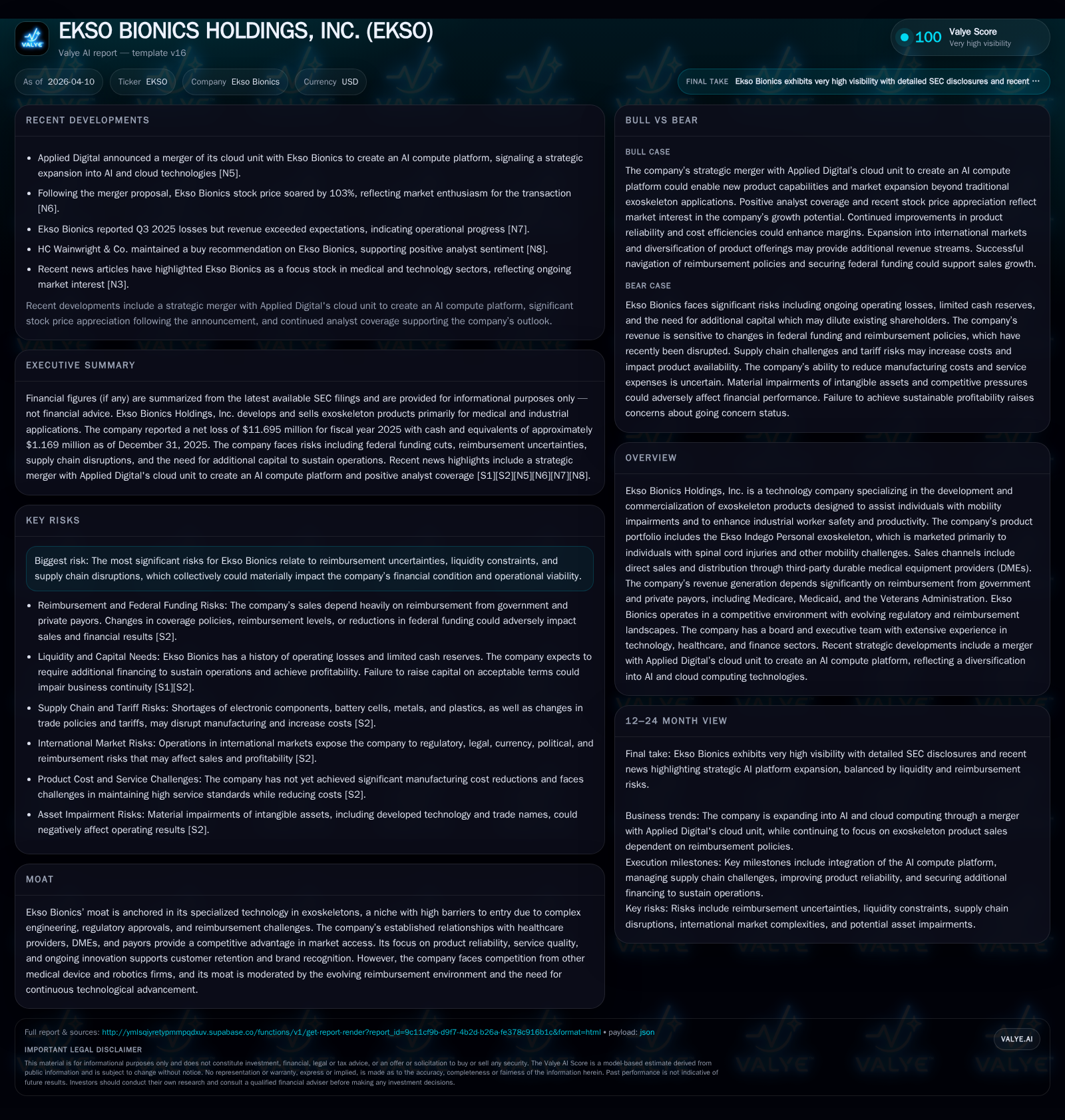
Ekso Bionics specializes in advanced exoskeleton technology aimed at mobility-impaired individuals and industrial applications, but faces stalled revenue growth alongside persistent operating losses and cash outflows. The company’s competitive edge stems from its technological moat and established healthcare partnerships, yet it grapples with evolving and fragmented reimbursement policies, primarily reliant on government payors such as Medicare, Medicaid, and the Veterans Administration. Liquidity pressures are pronounced, highlighted by approaching going concern uncertainty and limited cash reserves. Capital allocation prioritizes sustaining operations and innovation over shareholder returns amid challenging market conditions.
Evolution of Ekso’s Growth Drivers and Operating Performance
Ekso Bionics Holdings continues to operate without recording reported revenues since the first quarter of 2013 [F1]. This prolonged revenue absence underscores significant challenges in commercializing its pioneering exoskeleton products within a complex healthcare market. Financial data for FY2025 reveals an operating income loss of approximately $13.3 million—nearly a 27.4% deterioration compared to the $10.5 million loss in FY2024 [F1]. Net losses stood at $11.7 million for FY2025, a modest increase from the prior year’s $11.3 million deficit.
Operating cash flows remain negative, reflecting sustained investment in product development and servicing expenditures necessary to maintain clinical support levels. For FY2025, net cash used in operations reached -$11.8 million—a nearly 20% worsening relative to FY2024's cash burn [F1]. Capital expenditure surged over fourfold to approximately $188 thousand in FY2025 from $37 thousand the previous year [F1], indicative of intensified Capex efforts amidst constrained resource availability.
Historical performance (annual)
| FY | Net ($mm) | CFO ($mm) | OpInc ($mm) | Capex ($) | Net YoY |
|---|---|---|---|---|---|
| 2025 | -12 | -12 | -13 | 188000 | -3.2% |
| 2024 | -11 | -10 | -10 | 37000 | +25.5% |
| 2023 | -15 | -12 | -15 | 157000 | -0.8% |
| 2022 | -15 | -15 | -16 | 194000 |
Source: SEC companyfacts cache [F1].
Capital returns and efficiency (annual)
| FY | FCF ($mm) | ROE% |
|---|---|---|
| 2025 | -12 | -129.6 |
| 2024 | -10 | -89.2 |
| 2023 | -12 | -120.6 |
| 2022 | -15 | -59.3 |
Source: SEC companyfacts cache [F1].
Table summarizing key financial metrics for Ekso Bionics through FY2025 showing persistent losses and rising capital expenditures [F1].
The deteriorating operating figures reflect incremental challenges in scaling sales amid dependency on third-party reimbursement mechanisms while sustaining R&D efforts necessary to advance commercial readiness.
Innovation Anchors in Exoskeleton Technology amid Competitive and Regulatory Pressures
Ekso's proprietary position lies within its sophisticated exoskeleton systems engineered for individuals with spinal cord injuries (SCI) and industrial safety augmentation . These devices require cutting-edge robotics engineering paired with rigorous clinical validation to ensure safety and efficacy — factors which form high barriers to entry within this specialized medical technology niche.
The company's moat is reinforced through longstanding collaborations with healthcare entities and durable medical equipment (DME) providers who facilitate distribution and patient access . The complexity of regulatory approvals — involving FDA clearance for medical use cases — combined with bespoke reimbursement pathways further restricts competitor encroachment.
Nevertheless, rival firms developing medically analogous robotics systems amplify pressure to continually innovate across hardware function reliability standards as well as software-based adaptive control capabilities essential for clinical adoption durability.
Navigating Reimbursement Complexities Impacting Market Adoption
A pivotal factor constraining Ekso’s growth trajectory is the patchwork nature of reimbursement policies governed by governmental agencies including Medicare (CMS), Medicaid programs as well as the Veterans Administration (VA) [S2][S4][S5]. The company's business model heavily depends on coverage decisions by these third-party payors since many end-users require funded access facilitated through approved DME channels.
CMS decisions serve as de facto benchmarks that private insurers often emulate; however reimbursement approval timelines can be protracted due to decentralized regional Medicare Administrative Contractors who execute localized policy implementations [S4][S8]. Policy shifts such as budget cuts targeted at federal health agencies continue to reduce available funds for certain hospital systems purchasing Ekso’s products [S2], directly impeding client purchasing power.
Additionally managed care organizations exert cost containment pressures that may limit both coverage scope and price points offered—challenging revenue ramp-up despite demonstrated clinical benefits [S5]. The process of obtaining initial CMS approval followed by layered payer acceptances entails substantial time-consuming medical necessity assessments commonly involving DME intermediaries responsible for documentation compliance.
Financial Liquidity Challenges and Going Concern Implications
The company’s liquidity position remains exceptionally stressed entering FY2026. As of December 31, 2025 Ekso held approximately $1.17 million in cash equivalents versus current liabilities totaling about $8.6 million—a current ratio near 1.63 indicating tight working capital capacity [F1]. This snapshot aligns with disclosures highlighting "substantial doubt" regarding the company’s ability to continue as a going concern absent securing additional financing or generating significantly higher revenue streams [S6].
The escalating operating loss trend (-$13.3 million in FY2025) coupled with accelerating cash burn rates underline an urgent requirement for near-term capital raises or alternative liquidity solutions [F1][S6]. Management has acknowledged ongoing engagement with capital markets for financing alternatives; however terms may be less favorable given limited asset backing and recurring negative free cash flow scenarios [S6][S16].
Any failure to procure requisite funding could necessitate curtailing operations or discontinuing development initiatives—risks that could materially impair enterprise value realized by stakeholders.
Capital Allocation, Cash Flow Dynamics, and Shareholder Returns
Ekso exhibits disciplined but limited capital expenditure focused on maintaining critical R&D momentum rather than expansive infrastructure buildout [F1][S18]. Free cash flow remains deeply negative when subtracting Capex from operating cash flows (~-$12 million), reflective of persistent operational deficits without offsetting investing inflows [F1].
Return metrics are understandably adverse; approximate return on equity (ROE) stands near -130%, driven by prolonged net losses against a notably diminished equity base ($9 million at FY2025 year-end vs $25 million two years prior) [F1]. Absence of dividends or stock repurchase programs further emphasize reinvestment priority over shareholder distributions during this development phase [S18][S22][S29].
Capital allocation thus currently prioritizes sustaining operational continuity and incremental innovation advancement rather than generating immediate investor yield.
Forward-Looking Considerations: Key Milestones and Market Risks
Explicit financial guidance remains undisclosed; however notable forward-looking risks emerge around expanding product adoption through DMEs contingent upon evolving payer reimbursements [N1][S3][S28]. The company must also navigate regulatory agency operational risks heightened by potential U.S. government shutdowns which could delay FDA clearances or CMS policy updates impacting market access speed [S12].
Tariff fluctuations impose additional margin pressures on manufacturing raw materials sourcing with potential indirect costs creeping into overall product cost structures should trade policy tighten further [S7]. Monitoring changes in federal healthcare budgets is critical given their outsized influence on grant availability among institutional customers notably hospital systems reliant on public funding streams [S4].
Key milestones will include successful integration of recently acquired technology platforms; regulatory progress through FDA submissions; securing expanded CMS coverage codes; obtaining private insurer endorsements; plus definitive capital raise completions essential for viability beyond the next fiscal year.
Sector Insights: Durable Medical Equipment Channel Dynamics and Payor Relations
Within the durable medical equipment ecosystem that underpins access for mobility-assistive devices like Ekso Indego Personal exoskeletons lies a complex mesh of medical relevance testing protocols administered by payors determining eligibility criteria at individual claim levels [S4][S5]. DMEs act as crucial intermediaries facilitating product dispensing while managing extensive documentation demands particularly regarding establishing functional necessity per payer guidelines.
Managed care organizations increasingly emphasize cost containment frameworks applying rigorous utilization reviews potentially curbing negotiated pricing flexibility despite clinical innovation merits inherent in exoskeleton technologies [S5]. Integration success thus hinges not solely on technological superiority but also on adept navigation of payer networks to secure broad coverage—balancing clinical evidence packages against dynamic policy environments shaping product uptake curves.
This analysis synthesizes Ekso Bionics Holdings’ complex intersection between breakthrough exoskeleton technology innovation ambitions with pressing reimbursement policy uncertainties culminating in severe liquidity strain risks informed by consolidated financial disclosures up to FY2025 alongside regulatory filings through early 2026. Continued monitoring of funding developments within federal healthcare channels alongside successful capital initiatives will be critical determinants shaping near-term operational viability versus restructuring imperatives.
Disclaimer: This document is for informational purposes only and does not constitute investment advice or recommendations.
Disclaimer: This is research-only, informational analysis and not investment advice. It may include AI-generated interpretation and general industry context. Always verify important details using primary sources.

Comments