
Heritage Commerce’s Strategic Merger and Regional Bank Performance in 2025
A thorough examination of Heritage Commerce Corp's 2025 financial results and its merger with CVB Financial highlights critical growth drivers, capital allocation, and integration risks.
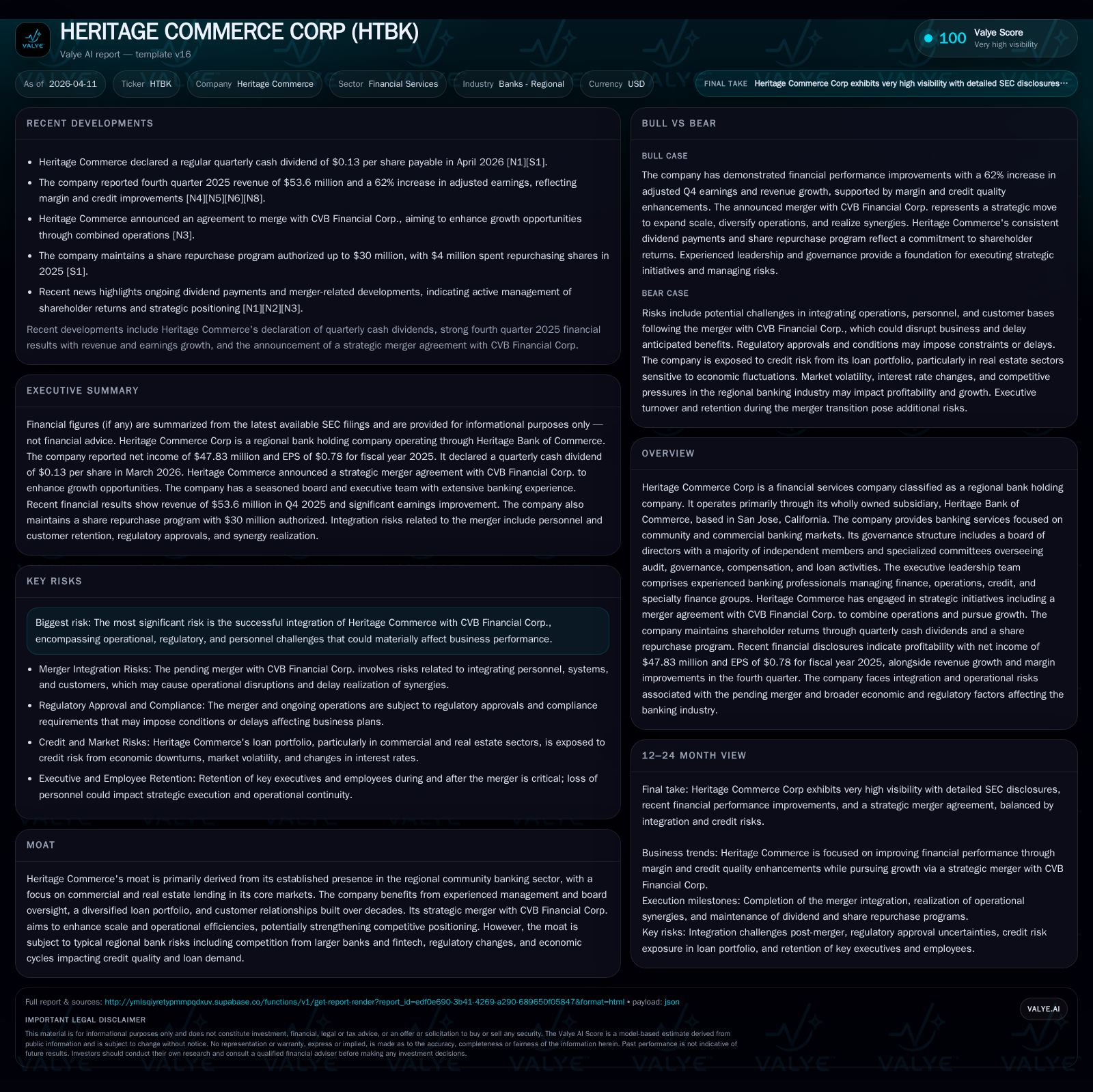
Heritage Commerce Corp (HTBK), a San Jose-based regional bank, demonstrated resilient profitability in 2025 despite sector headwinds, growing operating cash flow significantly while net income dipped from prior peaks. The company’s strategic merger with CVB Financial Corp received regulatory approvals in early 2026, marking a key transitional milestone expected to enhance scale and operational efficiencies. Capital returns remained consistent with robust free cash flow funding dividends and buybacks. Post-merger execution risks center on integration challenges, regulatory compliance, and maintaining loan portfolio quality amid regional economic cycles.
Heritage Commerce at a Glance: Business Model & Market Focus
Heritage Commerce Corp (HTBK) operates as a regional bank holding company headquartered in San Jose, California. Its primary banking operations are conducted through its wholly owned subsidiary, Heritage Bank of Commerce. The company’s focus lies predominantly in commercial and community banking markets within its core geographic area. A significant part of its lending portfolio is concentrated in commercial real estate loans—a typical profile for regional institutions that derive moat from established local relationships and sector expertise. Governance at Heritage features a majority independent board alongside specialized committees managing audit, loan review, governance policies, and compensation frameworks [S1]. This structure supports oversight essential to maintaining prudent risk management in community banking.
Financial Performance Overview: Strong Profitability Despite Sector Challenges
Heritage Commerce exhibited resilient earnings performance in fiscal year 2025 with net income coming in at $47.8 million [F1], reflecting an 18% rise over the prior year ($40.5 million). However, this level remains below the peaks reached during 2023 ($64.4 million) and 2022 ($66.6 million), illustrating some earnings volatility inherent to the sector stemming from fluctuating net interest margins and credit provisioning cycles.
Operating cash flow for FY2025 rose sharply to $61.7 million—an increase of approximately 58% from $39 million in FY2024 [F1]. This improvement evidences more efficient day-to-day operations and asset-liability management adjustments that enhanced liquidity conversion despite some pressure on net income.
Equity capital steadily expanded over the four-year period ending at $708.6 million as of December 31, 2025 [F1], supporting an approximate return on equity (ROE) of roughly 6.8%, which remains modest yet sustainable given the regional bank's conservative credit posture.
Historical performance (annual)
| FY | Net ($mm) | CFO ($mm) | Capex ($) | Net YoY |
|---|---|---|---|---|
| 2025 | 48 | 62 | 377000 | +18.0% |
| 2024 | 41 | 39 | 1624000 | -37.1% |
| 2023 | 64 | 73 | 1671000 | -3.2% |
| 2022 | 67 | 70 | 783000 |
Source: SEC companyfacts cache [F1].
Capital returns and efficiency (annual)
| FY | Div ($mm) | FCF ($mm) | ROE% |
|---|---|---|---|
| 2025 | 32 | 61 | 6.8 |
| 2024 | 32 | 37 | 5.9 |
| 2023 | 32 | 71 | 9.6 |
| 2022 | 31 | 69 | 10.5 |
Source: SEC companyfacts cache [F1].
Heritage Commerce financial trends highlight cash flow resilience despite sector cyclicality.
Drivers Behind FY2025 Growth and Operating Cash Flow Surge
The marked increase in operating cash flow during FY2025 reflects multiple factors including strategic cost control initiatives and an improved deposit base stabilizing funding costs [S2]. While net income declined compared to earlier years marked by stronger spreads or one-time benefits potentially realized during peak cycles, Heritage managed credit quality prudently with no material deterioration evident up to Q3 filings.
Changes in loan origination mix favored higher-quality commercial loans aligning with tightening underwriting standards appropriate for regional banks exposed to California markets where real estate volatility poses downside risks [S2]. The reduction in capital expenditures during the year also contributed positively by lowering discretionary outlays without impairing operational capacity.
Merger Milestone: Regulatory Approval and Integration Outlook
On April 1, 2026, Heritage Commerce reported receipt of all required regulatory approvals to complete its planned merger with CVB Financial Corp., consolidating Heritage Bank of Commerce with CVB's Citizens Business Bank subsidiary into a larger entity aiming for regional scale benefits [N3][S3].
This transaction represents a significant strategic pivot designed to leverage combined deposit bases and expand lending capacities especially within commercial real estate sectors where competitive pressure is intense from national banks and fintech entrants alike [S4][S23]. However, numerous integration risks linger including potential customer attrition stemming from system conversions or branch consolidations alongside personnel retention challenges common to large banking mergers.
Regulatory compliance will demand heightened focus particularly as combined entity capital adequacy is recalibrated while ensuring alignment across corporate governance frameworks previously distinct to each party [S3][S4]. Operational scale efficiencies targeted through back-office consolidation must offset transitional expenses for the deal to generate anticipated financial benefits.
Future Growth Catalysts and Market Constraints
With the merger finalized post-FY2025 reporting periods, growth prospects hinge on realizing synergies such as expanded geographic reach within California’s commercial corridor and leveraging shared technology platforms to reduce costs over time [N2][S16]. Loan demand outlook remains cautiously optimistic given gradual economic recoveries balanced against persistent inflationary pressures affecting borrowing rates.
Conversely, constraints include heightened competition not only from larger regional players armed with superior digital capabilities but also from fintech firms capturing younger demographics through innovative deposit products and streamlined lending solutions [S16][S23]. The cyclicality of real estate markets presents additional risk vectors with periodic valuation declines posing credit loss threats necessitating vigilant portfolio monitoring post-merger.
Capital Allocation: Dividends, Buybacks, and Return on Equity Analysis
Heritage Commerce maintained shareholder-friendly capital allocation policies throughout FY2025 consistent with prior years by distributing approximately $31.9 million in dividends—largely steady relative to slight variations since FY2022—sustained by strong free cash flow generation exceeding $61 million after subtracting minimal capex spend [$F1][N1][S10][S19][S21][S28].
The company also supported buyback programs authorized through SEC filings aimed at offsetting dilution from employee equity compensation plans without pressuring capital buffers critical during merger transitions.
ROE measured close to a moderate 6.8% reflecting the bank’s conservative stance but signalling room for uplift should integration synergies materialize into enhanced profitability metrics post-merger.
Risk Factors Centered on Merger Execution and Regional Banking Headwinds
Principal risks revolve around successful merger integration encompassing operational harmonization challenges that might trigger temporary service disruption or customer attrition impacting fee income sources [S4][S23]. Retention of key talent essential for maintaining client relationships also represents an ongoing priority potentially complicated by organizational restructuring.
Credit risk remains salient given geographic concentration within California real estate markets susceptible to cyclical downturns or regulatory policy shifts that could impair borrower repayment capacity leading to increased nonperforming assets [S4][S16][S20]. Regulatory frameworks governing capital reserves may also tighten further under evolving federal supervisory standards post-transaction thereby constraining capital deployment flexibility.
Litigation risks were noted with several shareholder lawsuits contesting disclosure adequacy surrounding merger terms; while believed unfounded by management these legal matters introduce some degree of uncertainty until fully resolved [S8][S9].
Monitoring Key Metrics and Strategic Developments Ahead
Post-merger monitoring should prioritize quarterly earnings releases illuminating net interest margin trends reflective of broader rate environments alongside loan portfolio growth rates signaling market traction under combined branding [N2][N3][S2]. Close tracking of nonperforming assets ratios will provide early warnings regarding credit quality trajectories critical amid economic fluctuations.
Progress toward operational synergy goals can be gauged via cost-to-income ratio movements offering visibility into efficiency gains crucial for justifying strategic rationale behind consolidation efforts.
Stakeholders would do well to watch announcements relating to any amendments or updates on integration timelines as well as capital structure adjustments highlighted in upcoming quarterly proxies or SEC disclosures.
This analysis does not constitute investment advice or recommendations but aims to provide an informed perspective grounded in publicly available financial data and regulatory filings as of April 2026.
Disclaimer: This is research-only, informational analysis and not investment advice. It may include AI-generated interpretation and general industry context. Always verify important details using primary sources.

Comments