
RUCONEST and Joenja Lead Pharming’s Transition from Loss to Profitability
Pharming Group's recovery is powered by robust sales growth of proprietary rare disease therapies RUCONEST® and Joenja®, backed by strategic pipeline advances and expanding global commercialization.
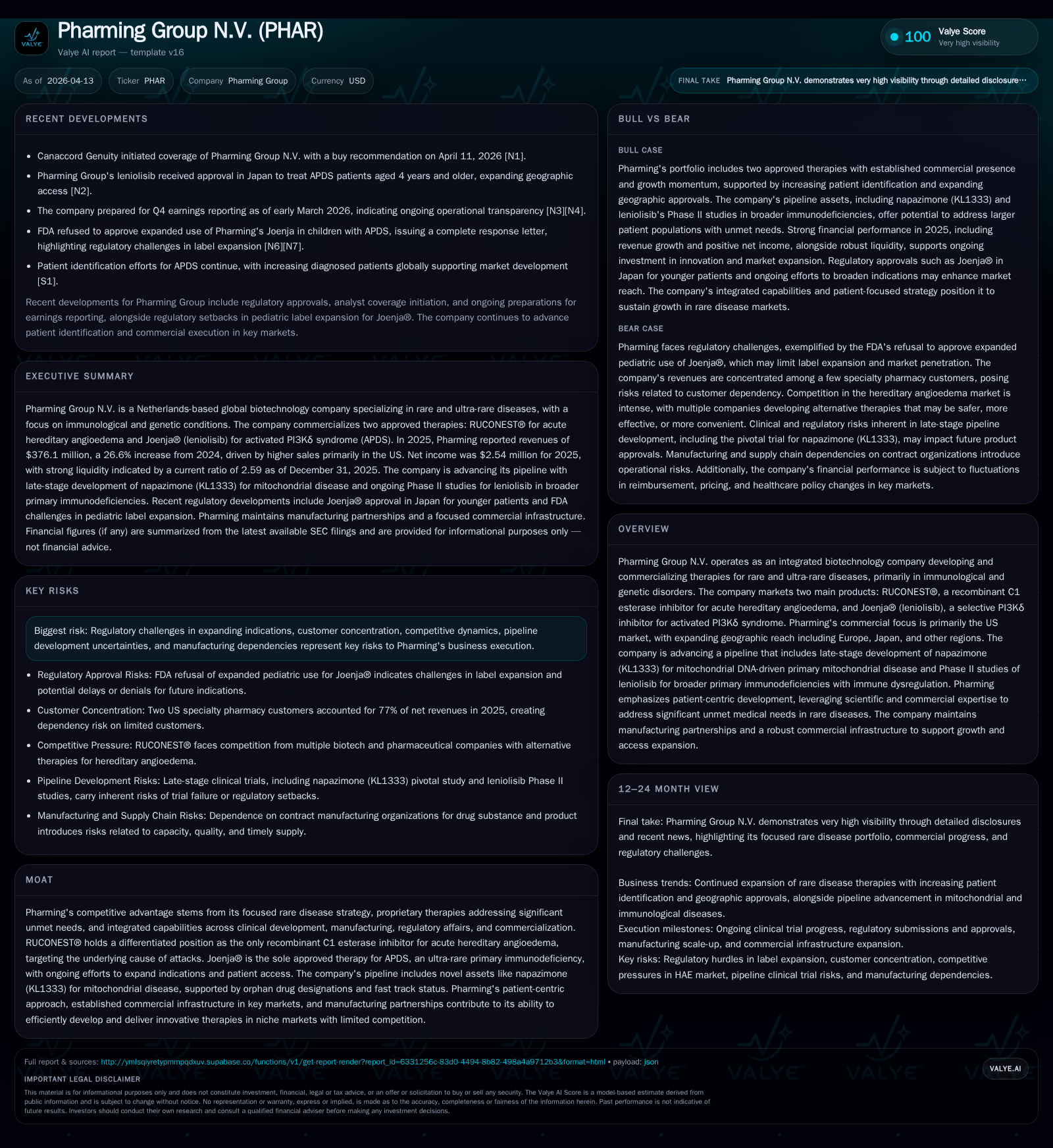
After consecutive years of net losses, Pharming Group N.V. reversed its financial trajectory in 2025, achieving a positive net income of $2.54 million driven primarily by significant revenue growth in their flagship rare disease products RUCONEST® and Joenja®. This turnaround reflects increased physician adoption, patient transitions, and expanded geographic reach, particularly in the US market. Simultaneously, Pharming augmented its late-stage pipeline with the acquisition of napazimone (KL1333) for mitochondrial diseases, while regulatory milestones pave the way for further approvals in Europe and Japan. Despite ongoing risks related to regulatory processes and market competition, the company balances investment in commercialization and R&D alongside disciplined capital management.
Anchoring Growth: RUCONEST® and Joenja® Sales Surge in 2025
Pharming Group's commercial momentum centered on two principal therapies—RUCONEST®, a recombinant C1 esterase inhibitor for hereditary angioedema (HAE), and Joenja® (leniolisib), a selective PI3Kδ inhibitor approved for activated PI3Kδ syndrome (APDS). In 2025, RUCONEST® achieved a robust 26% revenue increase year-over-year propelled predominantly by expanded sales volume within the U.S., where heightened physician prescribing activity and greater patient adoption underpinned growth [S1]. Parallelly, Joenja® revenues rose approximately 29% compared to 2024 figures since its April 2023 launch. The acceleration reflected effective transition of known patients onto commercial therapy as well as groundwork laid for upcoming market entries including the UK, Australia, Israel, Japan, the European Economic Area (EEA), and Canada [S1][N2]. Enhanced marketing investments facilitated these advances amid careful management of chargebacks and rebate dynamics customary in biotech rare disease markets.
Historical performance (annual)
| FY | Net ($mm) | Net YoY |
|---|---|---|
| 2025 | 3 | +121.4% |
| 2024 | -12 | -12.3% |
| 2023 | -11 | -177.1% |
| 2022 | 14 |
Source: SEC companyfacts cache [F1].
Capital returns and efficiency (annual)
| FY | ROE% |
|---|---|
| 2025 | 0.9 |
| 2024 | -5.4 |
| 2023 | -4.8 |
| 2022 | 6.7 |
Source: SEC companyfacts cache [F1].
Revenues from these flagship products now constitute the bulk of Pharming’s top-line performance. Notably, RUCONEST’s unique positioning as the sole recombinant C1 esterase inhibitor targeting underlying HAE attack mechanisms reinforces differentiation against competitors within an evolving therapeutic landscape that includes plasma-derived products [S19]. Joenja®, similarly grounded on pioneering mechanism-of-action therapy for an ultra-rare primary immunodeficiency lacking prior approved treatments, holds substantial expansion potential contingent on regulatory success across jurisdictions [S21].
From Red to Black: Profitability Turnaround and Underlying Financial Dynamics
Pharming successfully reversed its prior years’ pattern of losses to report net income of $2.54 million in FY2025 compared to negative results over $11 million in both 2023 and 2024 [F1]. This translates into an approximate return on equity of 0.9%, reflecting initial positive returns amid continued equity base expansion [F1]. The profitability shift was largely driven by operating leverage effects stemming from higher product volumes paired with disciplined expense controls.
Incremental expenditures accompanied Joenja’s multi-market rollout including increased research & development toward expanded clinical indications—particularly pediatric trials supporting filings in Japan—with marketing and sales costs rising due to expanded commercial infrastructure investments across the US and internationally [S1][S14]. Nevertheless, intensified spending was offset by revenue gains from existing products along with contributions from acquired assets such as napazimone’s program following the Abliva acquisition.
The company prudently maintained financial strength during this transition period by optimizing cost structures such as discontinuing lower-priority programs like OTL-105 while leveraging government R&D tax incentives recognized as other income [S1]. Capital expenditures held steady at about $0.7 million for property, plant, and equipment improvements largely related to manufacturing capacity in the Netherlands—underscoring efficient capital allocation aligned with strategic needs [F1][S1].
Pipeline Highlights: Napazimone Acquisition and Expanded Clinical Programs
A landmark strategic milestone was achieved through Pharming's March 2025 acquisition of Swedish biotech Abliva AB, integrating napazimone (KL1333), a late-stage therapeutic candidate targeting mitochondrial DNA-driven primary mitochondrial diseases—a highly underserved area characterized by significant unmet medical need [S1][N3]. Napazimone benefits from orphan drug designations alongside accelerated approval pathways such as Fast Track status enhancing potential commercial exclusivity length.
Simultaneously, Pharming advanced Phase II clinical studies evaluating leniolisib beyond APDS into broader primary immunodeficiencies manifesting immune dysregulation. This diversification targets an extended patient population thereby augmenting longer-term growth prospects beyond the current ultra-rare APDS segment [S1]. Concentrating R&D resources narrowly on these high-value assets follows Pharming’s overarching strategy of focusing exclusively on rare diseases where clinical differentiation is achievable.
Regulatory Momentum: Key Approvals Position Joenja® for Global Market Expansion
Substantial regulatory progress was realized during the first quarter of 2026 with Pharming securing a positive Committee for Medicinal Products for Human Use (CHMP) opinion recommending approval of Joenja® for treatment of APDS in patients aged 12 years and older—marking a first potential authorized therapy for this indication within the European Union [N4][S3]. The European Commission’s final decision is expected imminently during Q2 2026.
Complementing this achievement was Japanese Pharmaceuticals and Medical Devices Agency approval granted earlier expanding leniolisib use down to pediatric patients aged four years and above—a significant pediatric indication broadening [N4]. These regulatory endorsements amplify geographic diversification efforts beyond Pharming’s historically US-centric commercial presence.
These incremental marketing authorizations will facilitate more extensive patient access across critical global markets aligning with concurrent preparations including UK launch strategies as well as named-patient programs active in Israel and other territories [S1]. Regulatory pathways emphasize comprehensive safety monitoring plans integrated into product lifecycle management meeting stringent post-marketing commitments standard in orphan drug frameworks [S8].
Commercial Infrastructure and Geographic Diversification Strategy
Reflecting strategy execution geared toward maximizing rare disease franchise value creation through global reach expansion, Pharming reinforced its commercial infrastructure footprint notably across key US territories while accelerating new market entry readiness across Europe and other regions including Japan [S1][N3]. This entailed scaling field sales personnel specialized in rare immunology disorders supported by localized medical affairs ensuring tailored physician engagement.
Manufacturing partnerships remain integral to sustain supply chain reliability optimizing cost efficiencies amidst higher output demands associated with scale-up launches globally. Investment into such collaborations ensures alignment with current good manufacturing practices (cGMP) essential for sustaining regulatory compliance across jurisdictions [S14][S21].
This integrated approach—from discovery through commercialization—underpins Pharming's competitive advantage derived from operational dexterity combined with scientific specialization addressing ultra-rare populations typically neglected by larger pharma players .
Capital Allocation: Balancing R&D Investment with Shareholder Returns
Pharming maintained conservative capital expenditure levels at approximately $0.7 million during FY2025 focused primarily on upgrading property plant equipment to support manufacturing capabilities consistent with established commercial strategies [F1][S1]. Concurrently, R&D outlays increased reflecting clinical development activities essential to broaden leniolisib’s indication footprint plus advancing napazimone's late-stage program subsequent to Abliva integration.
Capital structure prudence is evidenced through issuance of €100 million senior unsecured convertible bonds due in 2029 supporting liquidity needs without immediate dilution concerns given conversion optionality governance features discussed at investor meetings last year [S5][S20]. Cash reserves stood robust at $145 million coupled with liquid marketable securities around $34 million—providing operational funding flexibility extending beyond twelve months from end-2025 reporting period [F1][S5].
While no formal dividend or share repurchase policies were highlighted during the reporting cycle consistent with typical biopharma reinvestment priorities pending sustained profitability trajectories remain monitored closely by stakeholders potentially influencing future capital return decisions contingent on sustained cash flow stability.
Risks in Focus: Regulatory, Competitive, and Operational Challenges Ahead
Pharming confronts several salient risks inherent to biotechnology enterprises engaged chiefly with pharmaceutical innovation targeting orphan diseases. Regulatory hurdles underpin uncertainties surrounding label expansions especially given complex globally diverse healthcare frameworks requiring meticulous compliance inclusive of data privacy statutes like HIPAA/HITECH in US plus evolving EU medicinal product advertising regulations imposing tailored promotional constraints [S4][S6][S7][S8][S9][S10].
Further customer concentration risk persists with two specialty pharmacy entities accounting collectively for over three-quarters of revenues underscoring dependence vulnerabilities despite robust client relationships nurtured since commercialization inception [S21]. Competition dynamics may intensify particularly if rival companies develop therapeutics offering improved efficacy or convenience potentially eroding Pharming’s nascent franchise share—though APDS space remains relatively uncontested presently [S19]. Cybersecurity threat exposure has been elevated as a corporate governance priority given sensitive health data stewardship compounded by increasing digital operational dependencies; oversight is exercised via Board audit committee complemented by experienced C-suite management roles orchestrating risk mitigation strategies effectively deployed over recent fiscal periods [S4].
Forward Look: Milestones, Market Potential, and Value Catalysts to Watch
Critical near-term milestones include anticipated European Commission approval confirmation for Joenja® which would unlock full marketing authorization within all EU Member States significantly broadening patient access relative to current named-patient program mechanisms [N3][S3]. Additionally noteworthy will be Phase II trial readouts assessing leniolisib utility beyond APDS addressing broader immune dysregulation—potentially expanding target populations substantially subject to positive efficacy/safety profiles demonstrated.
Parallel ongoing monitoring focuses on napazimone's progression encompassing pivotal clinical endpoints necessary for eventual regulatory submissions complemented by outreach efforts preparing rollouts outside core US markets completing geographic diversification schema driving long-term sustainable growth avenues.
Investor attention also directed towards operational execution regarding incremental build-out plans spanning production scale scalability aligned with demand forecasts alongside prudent capital allocations maintaining financial agility balanced against future organic innovation pursuits or selective bolt-on opportunities consistent with Pharming’s strategic focus on rare diseases requiring integrated biotech capabilities.
This analysis is based exclusively on publicly available financial disclosures filed with U.S. Securities regulators ([F1], [S#]) combined with recent news reports ([N#]). It aims to provide an independent synthesis devoid of investment recommendations while contextualizing Pharming Group N.V.’s business trajectory within specialty biotech focused on rare diseases. Readers should consider all material risks noted herein alongside prospective future developments disclosed directly by the company or through regulatory channels.
Disclaimer: This is research-only, informational analysis and not investment advice. It may include AI-generated interpretation and general industry context. Always verify important details using primary sources.

Comments