
Jianzhi Education Technology Group's Revenue Collapse Amid Operating Loss Improvement
Jianzhi Education’s FY2025 financials reveal a significant top-line decline paired with reduced operating losses in China’s regulated digital education sector.
Jianzhi Education Technology Group experienced a severe 70.6% revenue drop in FY2025 compared to FY2024 but concurrently reduced its operating losses by 13.3%. The company’s historical rapid growth gave way to sharp contraction amid regulatory pressures and competitive challenges in the Chinese vocational training market. Capital allocation has been conservative, focusing on liquidity preservation with minimal capital expenditure and no dividend payouts due to persistent net losses. Future growth depends heavily on content innovation, platform development, and navigating regulatory complexities inherent in their VIE structure.
Financial Performance Overview: Steep Revenue Decline with Operating Loss Reduction
Jianzhi Education Technology Group’s revenues have contracted sharply over the past four years, culminating in a steep 70.6% decline to roughly $10 million USD in FY2025 from $34 million USD in FY2024 [F1]. This follows decreases from prior peaks of approximately $73 million USD in FY2022 and $62 million USD in FY2023.
Operating losses have narrowed significantly after previous large deficits: from -$30 million USD in FY2022 worsening to -$53.9 million USD in FY2023 before improving substantially to -$2.79 million USD in FY2024 and further narrowing to -$2.42 million USD in FY2025 [F1]. Net income followed a similar trend, remaining negative but improving by over half year-on-year.
Historical performance (annual)
| FY | Rev ($mm) | Net ($mm) | CFO ($mm) | OpInc ($mm) | Rev YoY | Net YoY |
|---|---|---|---|---|---|---|
| 2025 | 10 | -2 | -1 | -2 | -70.6% | +51.0% |
| 2024 | 34 | -5 | 1 | -3 | -45.1% | +91.3% |
| 2023 | 62 | -53 | 2 | -54 | -15.4% | -82.2% |
| 2022 | 73 | -29 | 14 | -30 |
Source: SEC companyfacts cache [F1].
Capital returns and efficiency (annual)
| FY | FCF ($mm) | ROE% |
|---|---|---|
| 2025 | -1 | -32.6 |
| 2024 | 1 | -142.1 |
| 2023 | 2 | 1589.0 |
| 2022 | -56.9 |
Source: SEC companyfacts cache [F1].
Note: Capex figures remain minimal throughout the period reflecting stringent investment discipline.
Business Model and Market Dynamics
Jianzhi primarily provides proprietary digital educational content focused on professional development training via self-developed online platforms combined with an omni-channel sales approach targeting both institutions and individual users [S1]. The company expanded its end-user market presence through acquisitions concentrated in Shanghai and Guangzhou.
Revenue volatility is attributable to this strategic shift alongside intensifying competition affecting pricing flexibility and customer acquisition costs within China's fragmented online education sector.
The Variable Interest Entity (VIE) structure employed to operate domestically adds regulatory complexities that influence operational decisions and capital allocation strategies [S1].
Regulatory Environment and Operational Risks
China’s regulatory framework imposes licensing requirements, curriculum standards, pricing controls, data security mandates, and customer protection measures on online education providers like Jianzhi [S1]. These regulations contribute to thin margins due to compliance costs and reliance on a limited number of promotion companies for customer outreach introduces credit risk related to trade receivables collection.
Offshore-to-PRC capital injections are subject to approval processes that can delay funding flows given the Cayman Islands holding company structure using VIE arrangements.
Capital Allocation Strategy
Facing market headwinds, Jianzhi has prioritized liquidity preservation over expansionary investments or dividends.
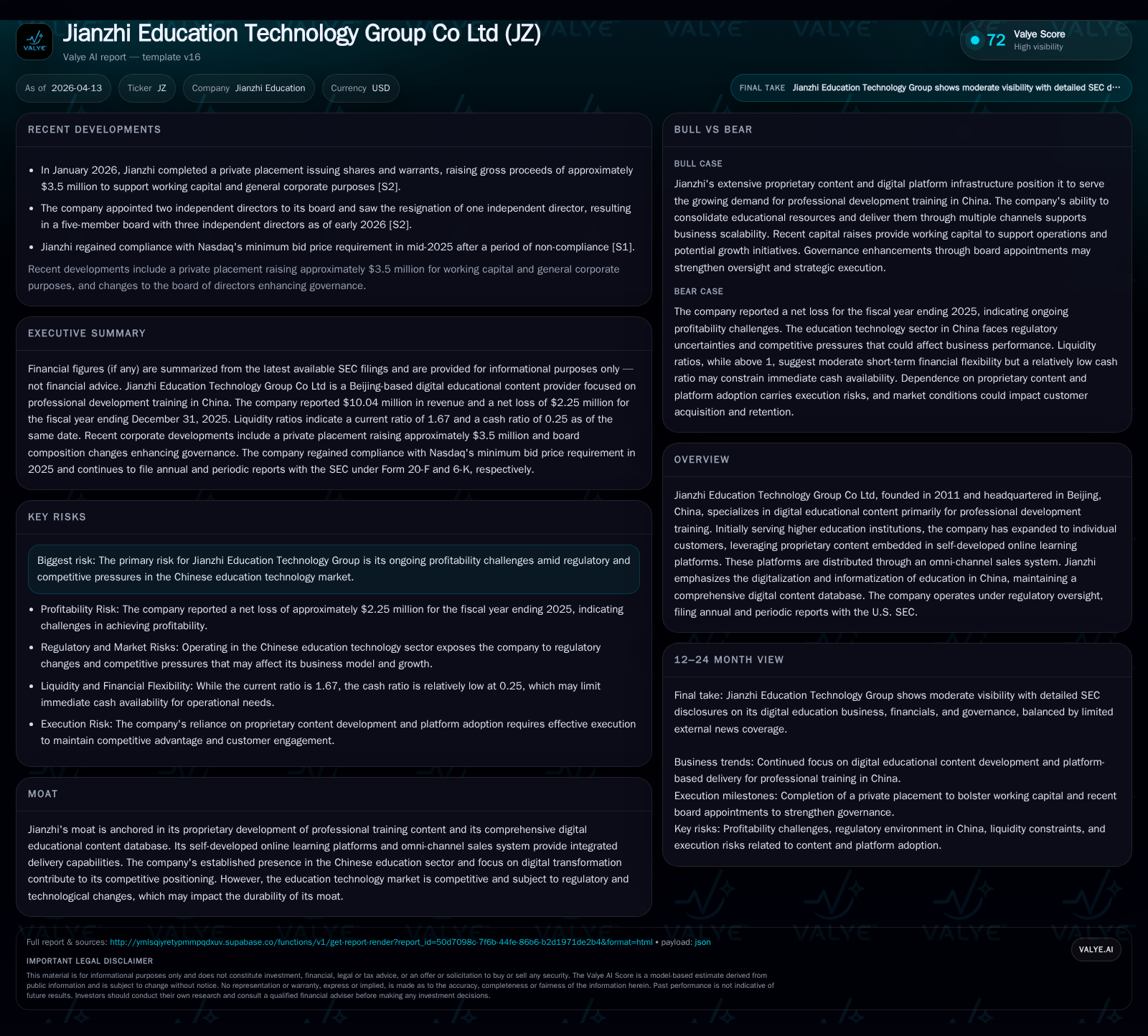
In January 2026, it completed a private placement issuing Class A ordinary shares and warrants raising gross proceeds of about $3.5 million USD for working capital purposes [S4][S5][S7]. Board governance was also strengthened through new independent director appointments emphasizing audit oversight [S3][S12].
Dividend payments remain suspended due to ongoing net losses since at least FY2022; capex declined sharply to only $1,226 USD in FY2025 consistent with disciplined cost management [F1]. The current ratio of approximately 1.67 indicates moderate liquidity coverage though constrained runway without sustained revenue recovery or additional financing [F1][S6][S9].
Cash Flow Analysis
Despite narrowing operating losses by around $370k USD year-over-year (13%), operating cash flow turned negative at approximately -$1.43 million USD reflecting working capital pressures or delays in cash collections possibly linked to credit risks from promotion partners [F1][S1]. Free cash flow correspondingly contracted highlighting limited discretionary spending capacity.
This divergence underscores structural challenges converting accounting improvements into liquid resources under current market conditions.
Outlook: Innovation and Market Penetration Key for Recovery
Future growth hinges on innovating digital training content aligned with evolving professional development demands while expanding individual consumer penetration beyond institutional clients.
Enhancements facilitating mobile learning may improve engagement but face intense competition alongside regulatory constraints limiting pricing power.
Continued focus on R&D investment balanced against cost discipline will be crucial for medium-term recovery prospects within China’s expanding online vocational education segment [S1].
Key Metrics and Risks Monitoring
- Current ratio near 1.67 signals moderate short-term liquidity coverage.
- Negative Return on Equity (~-32.6%) reflects accumulated losses impacting shareholder value [F1].
- Cash reserves of roughly $1.17 million provide limited buffer against downturns.
- Credit risk linked to trade receivables remains material due to dependence on few promotion companies.
- Customer retention and acquisition trends will be critical indicators of resilience amid competitive pressure.
- Governance enhancements post-board changes may improve oversight during challenging operating conditions.
Risks include persistent net losses driven by thin margins amid regulatory compliance costs; concentration risk from promotion partners; goodwill/intangible asset impairment threats; legal uncertainties tied to VIE structure operation under PRC law; brand reputation sensitivities; and growth management challenges underscored by recent sharp revenue contractions [S1].
This analysis is based on information available as of April 13, 2026 from publicly filed SEC documents including Form 20-F annual reports and related filings without offering investment advice.
Disclaimer: This is research-only, informational analysis and not investment advice. It may include AI-generated interpretation and general industry context. Always verify important details using primary sources.

Comments