
Transglobal Management Group: Integration Challenges and Golf Technology Growth Dynamics
Transglobal leverages a vertically integrated golf technology and operations model to fuel revenue growth while grappling with capital constraints and competitive pressures.
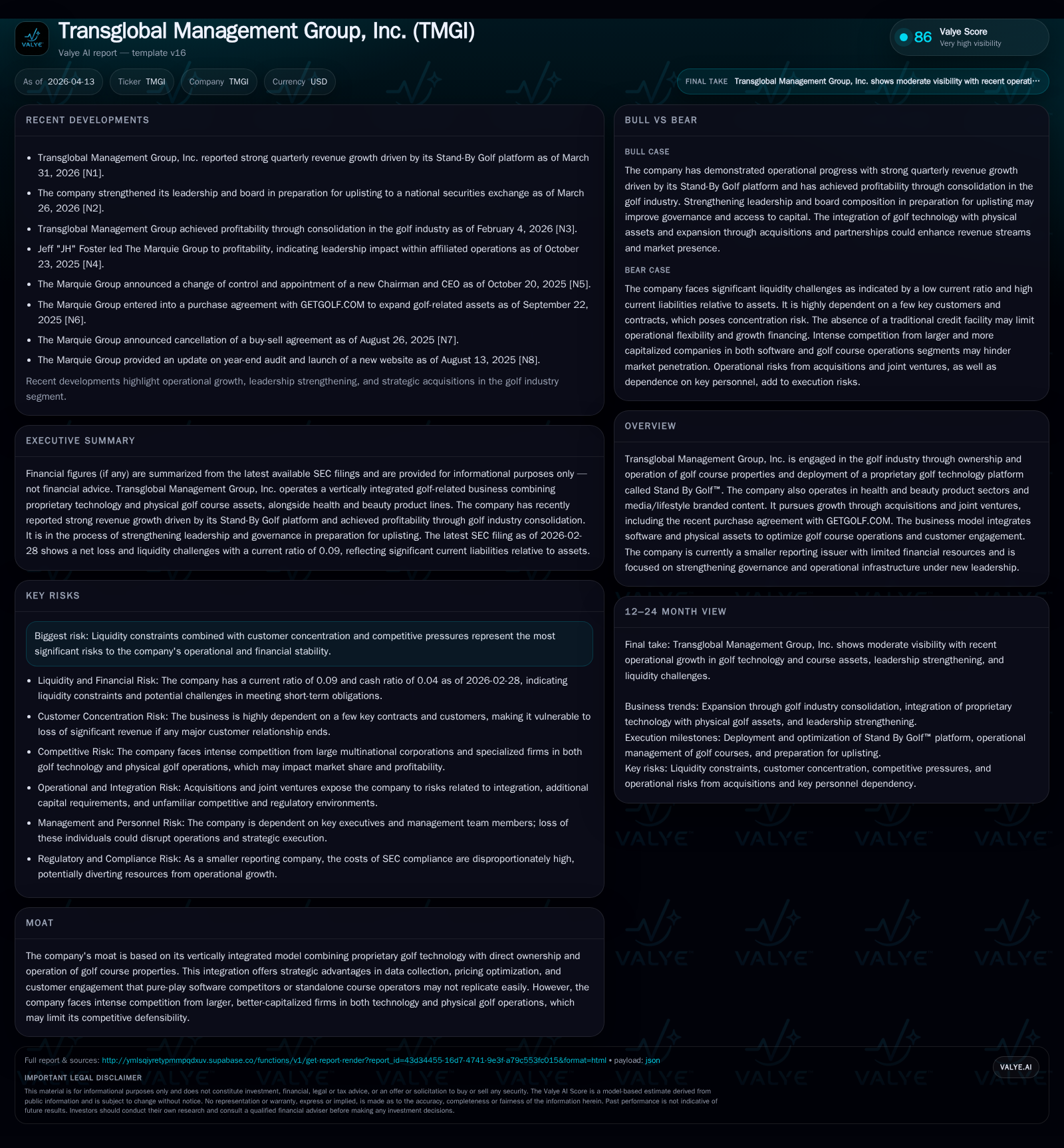
Transglobal Management Group, Inc. (TMGI) transitioned from zero revenue in prior years to $11,040 in FY2025 driven by its proprietary Stand By Golf™ platform and golf course acquisitions. Despite revenue emergence, operating losses remained materially negative at $151,872 with strained liquidity marked by a current ratio of 0.09 as of February 2026. Lacking traditional credit facilities, growth depends on equity financing amid dilution risks. Leadership changes in early 2026 aim to strengthen governance and prepare for uplisting. The company’s integrated model combining software and physical golf assets offers a strategic advantage but faces intense competition. Key near-term growth drivers include expanding technology licensing, optimizing course operations, and improving financial metrics.
Revenue Emergence via Stand By Golf™ Platform
Transglobal Management Group, Inc. reported no revenues from fiscal years 2022 through 2024, consistent with its pre-revenue stage prior to launching its proprietary golf technology platform Stand By Golf™ and acquiring physical golf assets. In FY2025, the company recorded $11,040 in revenues attributed primarily to the integration of the Stand By Golf™ platform—a cloud-based reservation and yield-management system designed to optimize tee-time utilization through dynamic pricing algorithms [F1][N1][S12][S16].
This platform monetizes unused tee times via a "stand-by" pricing model while linking digital bookings with direct operations at Mountain Brook Golf Club and Apache Creek Golf Club acquired during the GetGolf transaction in late 2025. This signifies a transition from development towards commercial deployment.
Leadership Changes Boost Governance Ahead of Uplisting
In March 2026, Transglobal restructured its executive team to strengthen operational oversight and investor confidence ahead of anticipated uplisting efforts. Jeff Foster moved from CEO to President while remaining Chairman; Kelly Kirchhoff was appointed CEO; Scott Carlston assumed CFO responsibilities [N2][S3].
These changes coincide with initiatives to enhance internal controls and corporate governance—important given the company's status as a smaller reporting issuer lacking typical exchange-listed governance measures. Such reforms aim to mitigate risks related to concentrated voting power held by insiders and align management practices with public market expectations [N2][S6][S3].
Liquidity Challenges Restrict Growth Flexibility
Despite initial revenue gains, liquidity pressures are acute. As of February 28, 2026, current assets totaled approximately $792,384 against current liabilities near $8.77 million, resulting in a low current ratio around 0.09—a significant short-term solvency concern [F1][S19]. Cash & equivalents were about $349k.
The absence of a traditional credit facility limits flexibility for capital-intensive golf course management activities such as maintenance and staffing beyond software development needs. Consequently, financing relies heavily on equity offerings and private placements that pose dilution risks for shareholders unless offset by successful scaling or profitability improvements [S4][S6][S10].
Auditors have expressed substantial doubt about the company's ability to continue as a going concern past May 31, 2026 without additional financing—underscoring critical near-term capital requirements [S13].
Competing Across Software Platforms and Physical Course Operations
Transglobal operates both Mountain Brook and Apache Creek golf courses directly while offering the Stand By Golf™ SaaS platform targeting third-party operators for tee-time booking solutions [S7][S12]. Competitors include large-scale tee-time marketplaces (e.g., GolfNow affiliates), dedicated course management software providers, regional multi-course operators leveraging scale advantages, and emerging AI-driven analytics firms.
While many competitors specialize exclusively in software or physical assets, Transglobal's hybrid model offers breadth but also exposes it to competition from better-capitalized rivals able to invest more aggressively in marketing or technology innovation [S5].
Vertical Integration as Strategic Differentiator
The company's key competitive advantage is its vertical integration: owning revenue-producing golf courses combined with proprietary software IP via Stand By Golf™ enables richer data aggregation across owned assets plus third-party licensees [S7].
This integration facilitates enhanced yield-management optimization not achievable by pure-play software vendors lacking direct access to course utilization data. Cross-channel loyalty programs further differentiate the offering by linking digital reservations with on-course experiences.
However, achieving sustainable profitability depends on improving operating efficiencies under capital constraints .
Historical Financial Overview
Historical performance (annual)
| FY | Rev ($) | Net ($mm) | CFO ($) | OpInc ($) | Net YoY |
|---|---|---|---|---|---|
| 2025 | 11040 | -1 | -11938 | -151872 | -473.2% |
| 2024 | 0 | 0 | -163604 | -549473 | -114.0% |
| 2023 | 0 | 1 | -133308 | -356470 | +128.7% |
| 2022 | 0 | -4 | -192285 | -262565 |
Source: SEC companyfacts cache [F1].
Capital returns and efficiency (annual)
| FY | ROE% |
|---|---|
| 2025 | -191.0 |
| 2024 | -76.4 |
| 2023 | -929.2 |
| 2022 |
Source: SEC companyfacts cache [F1].
The table illustrates Transglobal's recent financial trajectory: debuting modest revenue in FY2025 alongside narrowing operating losses by over 70% year-over-year. The net loss deepened mainly due to non-operating adjustments amid equity base expansion resulting in an approximate ROE of minus 191% for FY2025 [F1]. Operating cash flow remains negative reflecting ongoing investments exceeding operating receipts.
Capital Allocation Focused on Growth Investments
Capital allocation centers on sustaining operations and integrating recent golf acquisitions rather than shareholder returns; no dividends or share repurchases have been declared historically or currently planned [F1][S24][S28]. The lack of credit lines necessitates reliance on equity financings which may dilute shareholder value absent accretive growth or profitability gains [S4][S10].
Funds are directed toward Stand By Golf platform development enhancements, marketing campaigns supporting cross-promotional synergies (e.g., Simply Whim products), workforce expansion for segment expertise retention, and maintenance/upkeep of physical golf courses [F1][S24].
Growth Outlook Anchored on Strategic Integration and Licensing Expansion
Near-term priorities include full operational deployment of the GetGolf acquisition encompassing the Stand By Golf™ platform alongside Mountain Brook & Apache Creek courses within an integrated strategic framework focused on revenue optimization [N1][N2][S10].
Expansion targets scaling technology offerings through enterprise SaaS licensing agreements potentially white-labeled by resorts or managed course partnerships—aiming for recurring subscription fees complementing transactional revenues while minimizing incremental capital expenditures typical for physical asset growth.
Cross-channel marketing leveraging media/lifestyle branded content aims to broaden reach across health & beauty products alongside golf audiences enhancing revenue diversification beyond core golf operations alone [N1][N2]. Execution risks remain elevated due chiefly to funding limitations amid intense competition requiring disciplined capital deployment.
Milestones for Investor Monitoring
Investors should track execution milestones including:
- Progress toward uplisting facilitated by governance reforms under new leadership appointed March 2026 [N2][S3]
- Revenue ramp from third-party Stand By Golf™ licensing indicating market adoption beyond owned assets;
- Improvement in operating cash flow signaling movement toward breakeven in integrated golf segment;
- Enhanced utilization rates at Mountain Brook and Apache Creek translating into stronger property-level cash flows;
- Debt management progress reflected by reductions in current liabilities improving liquidity ratios;
- Expansion of customer base reducing concentration risk.
Transparent updates on these fronts will be vital as Transglobal evolves from entrepreneurial niche toward scalable recurring revenue models within golf technology and lifestyle sectors.
This analysis is based on publicly filed SEC data as of April 13th, 2026 combined with company disclosures without providing investment advice. Readers should consider risks including liquidity constraints and competitive dynamics before forming views on Transglobal Management Group's prospects.
Disclaimer: This is research-only, informational analysis and not investment advice. It may include AI-generated interpretation and general industry context. Always verify important details using primary sources.

Comments