
Datacentrex’s Strategic Expansion in Scrypt ASIC Mining Challenges Profitability and Operational Control
Datacentrex, Inc. grew its miner fleet post-merger but continues to face operational losses amid complex colocation reliance and volatile crypto markets.
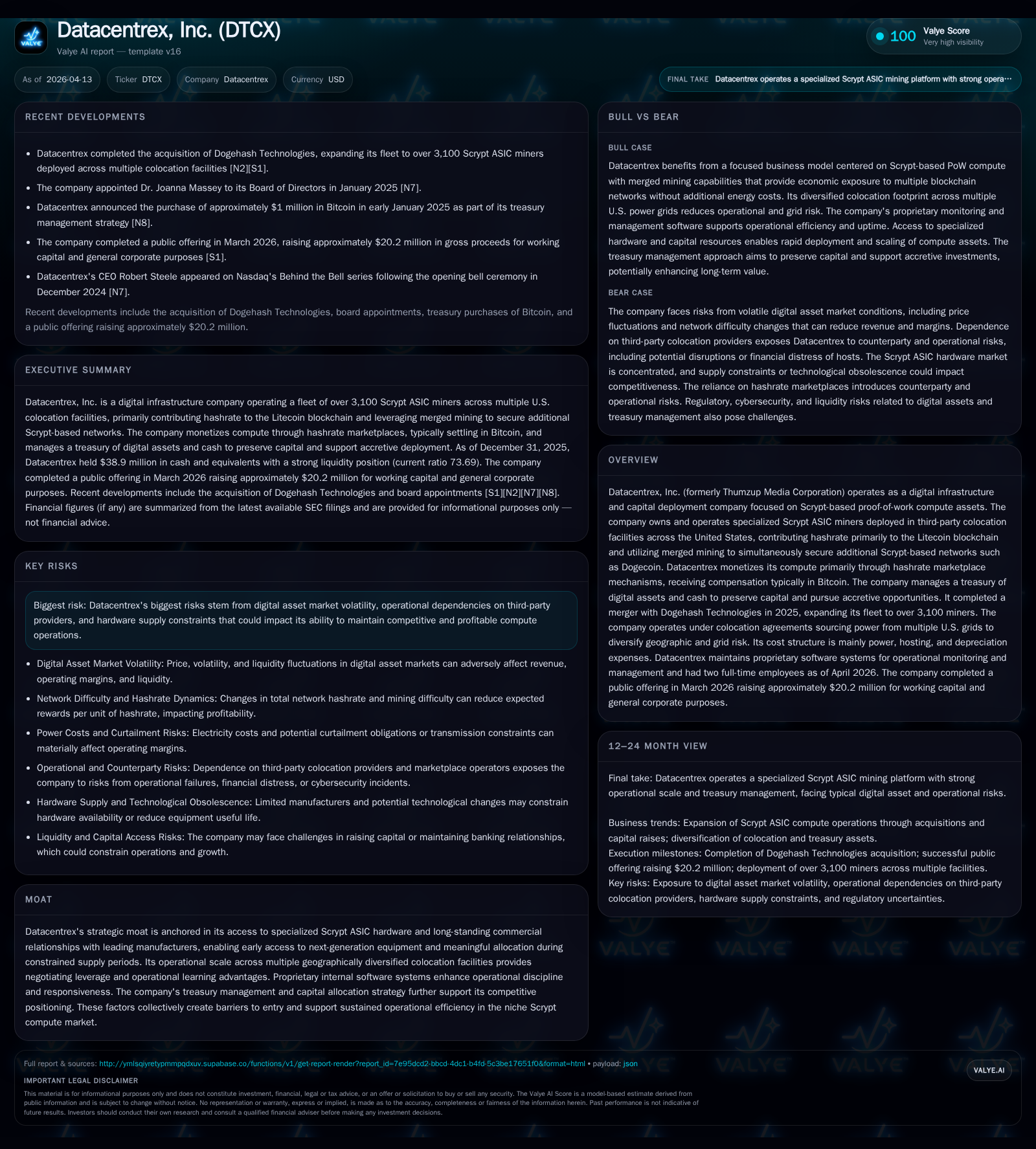
Datacentrex, Inc. operates a specialized Scrypt-based ASIC mining platform focusing on Litecoin and merged coins like Dogecoin, with over 3,100 miners deployed after its 2025 merger with Dogehash Technologies. Despite scaling operations and increasing capital expenditures dramatically in 2025, the company remains unprofitable, with widening net and operating losses driven by nascent scale inefficiencies, power hosting costs, and digital asset price volatility. Future growth hinges on securing newer hardware generations, managing third-party hosting risks, and leveraging its treasury strategically. Returns have been negative so far, with no dividends or buybacks declared, while regulatory and competitive uncertainties persist.
Company Overview
Datacentrex, Inc., formerly Thumzup Media Corporation until its late 2025 rebranding following a merger with Dogehash Technologies ("Doge"), is a niche digital infrastructure company focused on owning and operating Scrypt-based proof-of-work (PoW) compute assets primarily contributing to the Litecoin blockchain with additional merged-mining exposure to coins such as Dogecoin [S1][S18]. The business model centers on deploying specialized Scrypt ASIC mining hardware within third-party colocation facilities across the United States. Monetization occurs through hashrate marketplace sales that typically settle in Bitcoin rather than native protocol tokens [S10][S12]. This structure differentiates Datacentrex from miners relying strictly on protocol-native payouts or large-scale SHA-256 Bitcoin mining.
The merger finalized in December 2025 integrated Doge's assets—approximately 3,100 ASIC miners obtained from US Data & Energy LLC—and expanded Datacentrex's operational scale significantly from a smaller nascent base to one of moderate size within the Scrypt mining space [S1][S18][S26]. The company's headquarters are located in Salt Lake City, Utah.
Historical Performance
Datacentrex remains an early-stage enterprise facing persistent operating losses since embarking on digital asset mining. Financial figures reveal mounting losses as the company scaled its operations notably:
Historical performance (annual)
| FY | Net ($mm) | CFO ($mm) | OpInc ($mm) | Capex ($mm) | Net YoY |
|---|---|---|---|---|---|
| 2025 | -9 | -6 | -8 | 26 | -112.6% |
| 2024 | -4 | -3 | -4 | 0 | -20.3% |
| 2023 | -3 | -2 | -3 | 0 | -120.9% |
| 2022 | -2 | -1 | -1 | 0 |
Source: SEC companyfacts cache [F1].
Capital returns and efficiency (annual)
| FY | FCF ($mm) | ROE% |
|---|---|---|
| 2025 | -32 | -12.8 |
| 2024 | -3 | -83.9 |
| 2023 | -2 | -951.6 |
| 2022 | -1 | -191.3 |
Source: SEC companyfacts cache [F1].
Data sourced from SEC filings [F1].
The operating income deterioration—from roughly $1.2 million loss in FY22 widening close to $7.9 million loss in FY25—is largely attributable to rapid scaling costs including extremely elevated capital expenditures coinciding with fleet buildout post-merger. Capex leapt by over two hundredfold from FY24 to FY25 ($11k to ~$25.9M), predominantly reflecting ASIC purchases and deployment costs for the expanded miner fleet [F1][S20].
Operating cash flow losses reflect ongoing negative free cash flow after adjusting for such capex investments (approximate negative free cash flow of $32 million in FY25), underscoring the heavy cash burn nature of building out mining capacity under current cost structures [F1].
Despite the substantial investment outlays fueling growth in hashrate capacity and supporting infrastructure expenses (power contracts plus facility hosting fees), profitability has not been achieved since inception of active mining operations.
Business Model and Operational Drivers
Datacentrex's core revenue driver is the realized rate per unit of deployed hashrate across its ASIC hardware fleet contributing PoW consensus power predominantly to Litecoin's blockchain network [S23]. Uniquely leveraging merged-mining architecture allows single deployments to validate multiple Scrypt-based chains like Dogecoin concurrently without requiring extra electrical consumption or compute effort beyond Litecoin's requirements [S1][S18]. This efficiency theoretically enhances yield potential per unit of energy consumed.
Operating expenses primarily comprise electricity charges (fixed under contractual colocation agreements), hosting service fees (including networking and facility services), depreciation of capitalized miners over their estimated useful lives (~typical miner lifespan adjusted for slower innovation cycles relative to SHA-256 hardware), labor/management overhead (limited internal full-time staff supplemented by contractors), and other general administrative costs [S4][S20][S21].
Revenue is booked when settlements arrive from hashrate marketplace operators paying market-driven rates denominated mainly in Bitcoin rather than Litecoin or Dogecoin native tokens [S10][S12], aligning payout flows toward arguably more liquid digital assets though exposing revenue streams to BTC price volatility.
Proprietary internally developed software systems underpin real-time monitoring functionality essential for maintaining uptime and optimizing throughput across the geographically dispersed colocation sites—addressing vital metrics like power usage per site and miner health—to minimize downtime risks inherent in remote operations reliant on third-party hosts [S21].
Future Growth Prospects
Future performance depends critically on several factors:
Hardware Supply: The relatively concentrated market for Scrypt ASICs—with few manufacturers capable of sizable production—creates supply bottlenecks that Datacentrex partially mitigates through long-term commercial relationships affording early access at constrained supply times [S11]. However, rapidly evolving technology or delayed deliveries due to global chip shortages remain challenges.
Power Procurement & Hosting: Power remains the largest expense component; currently sourced under fixed-price contracts from facilities tied into ERCOT (Texas), MISO (Midcontinent), and Georgia Power grids offers geographic diversification reducing single-point grid risk but does not immunize against regional outages or regulatory curtailment programs [S9][S18]. Future margin enhancement could benefit from vertical integration upstream into power generation or interconnection assets but entails high capital intensity and regulatory complexity [S4][S13].
Crypto Market Dynamics: Volatility and price trends of Bitcoin (primary settlement asset) alongside network difficulty adjustments affecting reward distribution per hashrate unit directly impact revenues. Declines in crypto prices suppress income; increased network difficulty reduces yield unless offset by newer efficient machines or lower power costs [S6][S23].
Operational Execution: Maintaining high uptime—across dispersed colocation sites dependent on third parties—and swiftly addressing miner faults or connectivity issues affect actual output versus theoretical capacity.
Strategic Treasury Management: Digital asset holdings accumulated via monetization create optionality but also valuation risk; management cautiously pursues yield-generating pilot initiatives within certain ecosystems (e.g., limited Layer-2 Dogecoin exposure) while prioritizing capital preservation [S13]. Such strategies remain experimental without formal board-approved treasury policies.
Capital Allocation and Returns
Capital allocation favors reinvestment into expanding mining capacity with aggressive capex evident in FY25 reaching nearly $26 million contrasted against negligible capex prior years reflecting foundational buildout post-merger [F1][S20]. There have been no dividends declared or share repurchase programs initiated historically or currently planned ([S12][S14]). The company views returns mainly through operational growth and appreciation in digital asset treasury value rather than distribution.
ROE approximated at -12.8% for FY25 underscores ongoing losses despite equity base expansion driven by equity issuances including shares issued during the Dogehash merger transaction worth over $13.8 million shares plus preferred shares convertible into common stock ([F1] equity data; [S26]). Operating losses expanding double-digit percentages year-over-year reflect both startup cost burdens and subdued crypto market periods.
Liquidity remains supported by a substantial cash balance of approximately $38.9 million as of end FY25 with minimal current liabilities indicating strong short-term solvency ratios exceeding 70—though much cash is earmarked toward sustaining growth investments ([F1]). No material debt has been reported as of fiscal year-end but future borrowings remain possible for working capital or strategic acquisitions if conditions warrant ([S15]).
Competitive Landscape and Strategic Positioning
Datacentrex operates within a narrowly focused segment dominated by few large players specializing either in SHA-256 Bitcoin mining or broader compute infrastructure; pure Scrypt miners are comparatively rare allowing niche positioning but also limiting scale advantages found in larger crypto miners deploying hybrid fleets ([S11][S22]). Its moat arises chiefly from supplier ties affording prioritized access to scarce Scrypt ASIC hardware combined with multi-facility geographic dispersion facilitating operational resilience (, [S11]). Proprietary software for miner fleet management further enables tighter control over uptime metrics critical at scale ([S21]). Nonetheless competitors extending into adjacent data-center infrastructure segments or energy ownership pose indirect threats especially if new entrants vertically integrate power procurement driving down costs (, [S5]).
Management explicitly signals intent to maintain strategic flexibility beyond cryptocurrency computing alone by contemplating acquisitions or joint ventures across broader digital infrastructure spaces including energy-adjacent assets potentially broadening future revenue bases beyond Scrypt PoW compute (, [S5]).
Risks Summary
Major risks stem from inherent volatility within digital asset markets impacting revenue streams settled mostly in Bitcoin as well as the finite useful life and obsolescence risk for specialized Scrypt hardware amidst evolving technology cycles (, [S7],[S17],[F1]). Third-party operational dependencies through colocation agreements impose risks related to host provider failures or power interruptions that could reduce uptime materially (, [S9],[S15]). Regulatory uncertainties around digital assets—including potential classification changes or energy usage restrictions—and geopolitical motions against cryptocurrency adoption also present significant external headwinds (, [S24],[S25],). Finally competitive pressure arises indirectly from diversified miners benefiting from larger capital pools or alternative infrastructure capabilities that could erode margins over time (, [S22],[F1]).
Outlook Considerations (Analysis)
Near-term growth will likely be influenced by how effectively Datacetrex can deploy newly acquired equipment efficiently within existing colocation facilities while managing power cost exposure locked via fixed contracts. Monitoring trends around hashrate marketplace pricing set against Bitcoin price dynamics will shed light on sustainable revenue levels given partial hedging through selective retention of BTC receipts versus immediate fiat conversion. Additionally watching developments regarding next-generation ASIC availability will be critical as hardware refresh cycles dictate competitive positioning given marginal energy efficiencies across older machines.
Potential expansions into upstream power assets remain speculative pending permitting approvals and capital commitments. Meanwhile treasury experimentation within Layer-2 yield environments may introduce occasional incremental returns but carries exploratory status without firm commitments.
Investors should closely track progress on operational uptime improvements leveraging internal software tools designed for proactive maintenance signals along with any shifts in regulatory landscape affecting crypto mining operations generally.
Conclusion
Datacentrex is an emerging player specializing in Scrypt algorithm PoW mining with strategic advantages stemming from supplier relationships enabling fleet scale-up post-merger alongside geographically diversified U.S.-based colocation deployments. However inevitable startup hurdles manifest as rising losses deepened significantly alongside higher capital investments during FY25 highlighting scalability challenges inherent in highly competitive cryptocurrency mining arenas marked by volatile underlying asset prices and dependency on third-party host execution.
Longer-term viability pivots on ability to secure cutting-edge hardware ahead of peers while controlling power costs either contractually or via vertical integration alongside prudent treasury management cautious about digital asset volatility exposures. Although no dividends have been distributed thus far with negative returns prevailing at present capital bases indicate solid capitalization buffer supporting continued investment activities amid macroeconomic uncertainties characterizing the digital asset ecosystem at large.
This analysis is based exclusively on information publicly disclosed through SEC filings as of April 13th, 2026 and does not constitute investment advice.
Disclaimer: This is research-only, informational analysis and not investment advice. It may include AI-generated interpretation and general industry context. Always verify important details using primary sources.

Comments