
New Fortress Energy's Restructuring Reshapes Growth and Capital Strategy
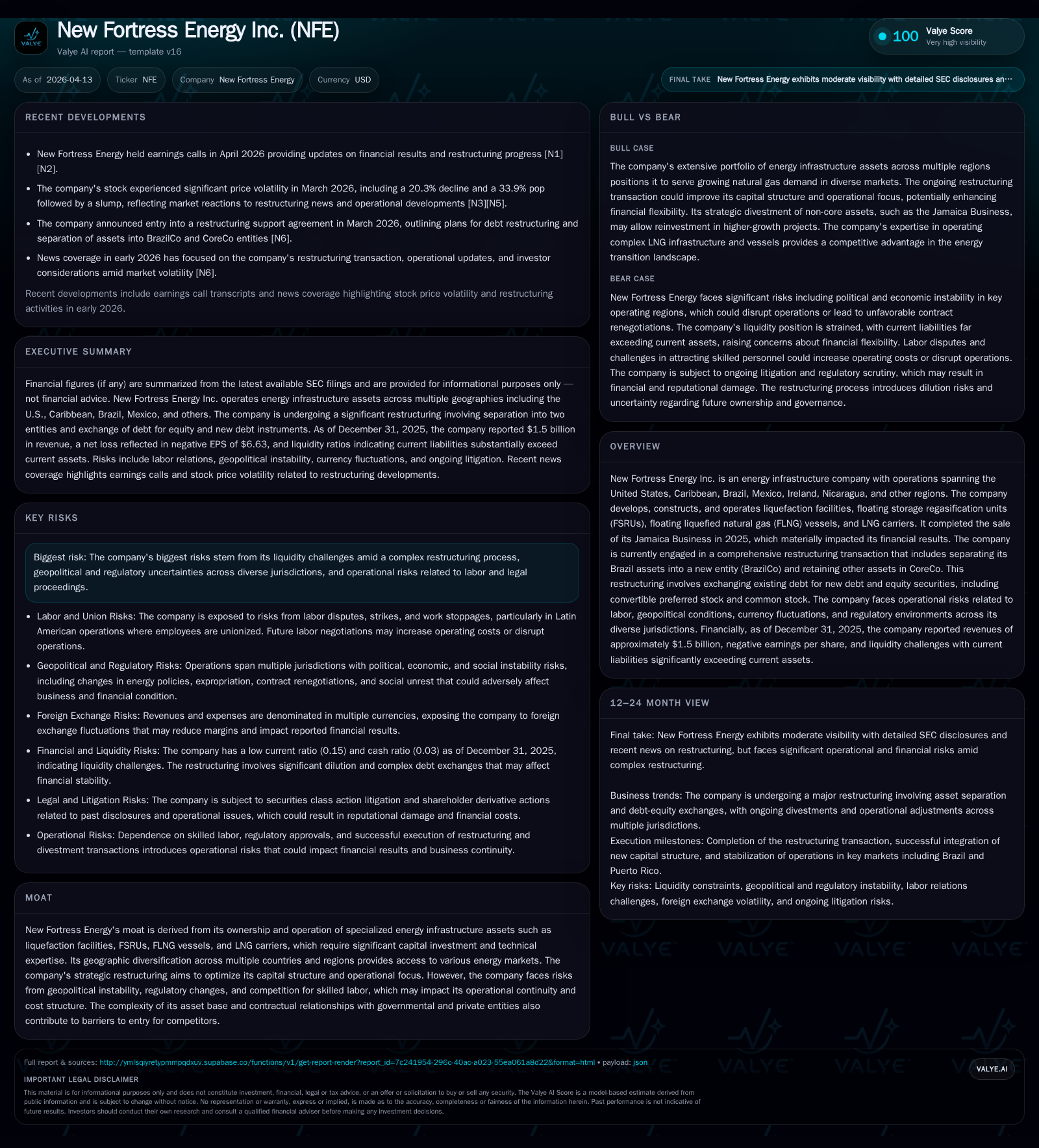
The company's FY2025 financials reflect a pivotal transition marked by asset divestiture and a complex restructuring effort reshaping its operational and capital trajectory.
New Fortress Energy’s financial statement for FY2025 reveals a dramatic revenue decrease of 36.4% year-over-year, primarily due to the sale of its Jamaica business, which led to a substantial operating loss exceeding $1 billion. This divestiture and an ongoing restructuring transaction segregating Brazil assets into BrazilCo while retaining CoreCo have introduced significant shifts in capital structure, including debt-for-equity swaps and convertible preferred stock issuances. Operational challenges, such as labor market tightness across multiple jurisdictions and geopolitical risks, add layers of complexity to project execution and cost management. Liquidity constraints remain acute, reflected in a current ratio of just 0.15 and increased covenant restrictions, while capital allocation has pivoted away from expansion toward liquidity preservation amid sharply reduced capex and dividends. Post-restructuring growth prospects hinge on distinct paths for BrazilCo and CoreCo, tempered by regulatory uncertainties and ongoing securities litigation.
Revenue Decline and Operating Loss: Drivers of FY 2025 Performance Shift
The fiscal year ending December 31, 2025, marks a watershed moment for New Fortress Energy (NFE), as total revenues precipitously dropped 36.4% to $1.50 billion from $2.36 billion a year earlier [F1]. This sharp contraction resulted predominantly from the strategic sale of the Jamaica business completed during 2025, effectively removing a key revenue contributor from NFE's reporting scope [N1], [S7]. The divestiture reframed NFE’s financial scale, shifting its profile away from certain Caribbean operations toward more geographically dispersed LNG infrastructure assets.
Accompanying this top-line retrenchment was an even more pronounced deterioration in operating profitability: operating income swung dramatically from a healthy positive $539 million in FY2024 to a sizeable loss of $1.12 billion in FY2025 [F1]. This reversal underscores the non-recurring costs associated with the asset sale, restructuring charges, and ongoing operational demands inherent to liquefaction facilities, Floating Storage Regasification Units (FSRUs), floating LNG vessels (FLNG), and LNG carriers that fundamentally define NFE’s business model. These specialized assets demand continual capital-intensive upkeep even amidst business realignments.
Net income figures do not yet capture FY2025 results; the latest available net income data pertains to FY2023 at $548 million [F1]. However, operating cash flows nosedived by nearly 200% year-over-year to negative $583 million as working capital swings intensified liquidity pressure [F1]. Consequently, despite prior profitability coherence through 2023 and early 2024, FY2025 emerges as a clear inflection point characterized by both contraction and cash flow stress.
Restructuring Transaction: Impact on Asset Portfolio and Capital Structure
NFE is executing an intricate restructuring transaction designed to optimize financial leverage and sharpen operational focus [N1], [S7], [S13]. Central to this arrangement is the bifurcation of corporate assets into two distinct entities:
- BrazilCo: Encompasses all Brazilian-based operations fully owned by NFE post-restructuring.
- CoreCo: Retains all non-Brazilian businesses including FSRUs, FLNG vessels, LNG carriers serving multiple geographies.
This division seeks to isolate Brazil-specific risks and allow tailored financing approaches aligned with differing regional regulatory environments [N1], [S7]. As part of the plan, creditors exchanged existing funded debt for new instruments including approximately $643 million in Senior Secured Term Loans backed by CoreCo subsidiaries plus up to $2.5 billion aggregate liquidation preference in CoreCo Convertible Preferred Stock ([S10], [S13]). Common stock representing 65% ownership post-transaction was allocated to creditors with the remaining held by legacy shareholders prior to incentive plans or conversions.
While these measures aim at stabilizing liquidity with improved covenant profiles and deferred maturities, they introduce considerable capital structure complexity involving layered equity classes subject to mandatory future conversion provisions [S13], [S24]. Restrictions embedded within amended credit agreements curtail dividend distributions, incurrence of additional indebtedness without lender consent, asset sales, and intercompany transfers—further constraining financial flexibility during the transition period.
Operational Challenges: Labor Market Constraints and Geopolitical Risks
Operating across jurisdictions including the United States (and Puerto Rico), Caribbean nations, Brazil, Mexico, Ireland, Nicaragua among others exposes NFE to heterogeneous labor pool tightness scenarios compounded by local legislative regimes governing employment terms [S1]. The company faces intensive competition for skilled personnel qualified to construct and operate liquefaction facilities plus FSRU/FLNG assets—a niche skill set essential for maintaining service quality standards.
Brazil exemplifies workforce localization requirements mandating hiring local crew members for vessel operation—a stipulation complicating crew retention given global shortages in technical labor [S1]. Collective bargaining agreements covering subsets of Latin American employees create exposure to strikes or work stoppages which could disrupt operations or inflate wage costs over time ([S20]). These dimensions elevate operating expense risk profiles amidst inflationary pressures impacting wages and benefits.
Simultaneously geopolitical uncertainties persist as governmental policy volatility spans contract renegotiations, energy tariff alterations, local content rules modifications or social unrest—all factors historically affecting Latin American energy infrastructure projects’ continuity ([S19]). Robust risk management adaptability remains critical as underlying host countries’ political climates fluctuate unpredictably.
Balance Sheet Pressures: Liquidity, Debt Covenants, and Financial Flexibility
Financial rigidity manifests starkly in New Fortress Energy’s balance sheet metrics post-restructuring efforts. As of FY2025 year-end disclosures reveal current assets totaled roughly $1.33 billion against vastly larger current liabilities near $8.65 billion culminating in a precarious current ratio around 0.15 [F1], signaling immediate liquidity strain.
Enabling maneuvers like sale-leaseback arrangements on turbines with Macquarie Energy LLC were utilized recently aiming at monetizing physical assets without operational disruption ([S3]). Meanwhile amendments across revolving credit agreements introduce “forbearance” constructs granting temporary covenant relief but imposing strict conditions whereby failure triggers acceleration rights entailing full indebtedness repayments ([S8], [S11]).
These liabilities interplay with hierarchical creditor groups negotiating exchanges outlined within Restructuring Support Agreements ([S10], [S26]) anticipated to each receive tranches combining term loans with preferred equity that cumulatively convert sizable portions of debt into ownership interests—illustrative of debt burden reduction strategies.
However restrictive covenants now circumscribe dividend payments severely; intercompany loans or investments are tightly regulated; asset sale proceeds face mandatory prepayment obligations further dampening discretionary capital deployment capacity ([S7]).
Capital Allocation Amid Transition: Dividends, Buybacks, and Investment Trends
In light of liquidity pressures combined with strategic reorientation away from high-capital growth previously evident at NFE’s peak stages—capital expenditures plunged 75.2% YoY declining from approximately $2.62 billion in FY2024 down to $650 million in FY2025 indicating sharply curtailed reinvestment into infrastructure expansions or new projects ([F1]).
Correspondingly dividends dwindled towards near immaterial sums totaling roughly $3.47 million paid out during the year versus over $65 million distributed last fiscal period consistent with amended credit agreement restrictions ([F1], [S25]). Cash flow exhaustion coupled with substantial negative free cash flow around -$1.23 billion (CFO minus capex) bespeaks prioritization of balance sheet stabilization above shareholder returns currently ([F1]).
An intriguing ROE distortion occurs as equity base collapsed sharply (to about $183 million) while positive net income surges manifest—reflecting one-time accounting adjustments tied largely to restructuring outcomes rather than sustainable earnings growth fundamentals ([F1]).
Further buyback activity has not been reported consistent with the company seeking preserve liquidity during this phase.
Growth Outlook: Prospects for CoreCo vs. BrazilCo after Spin-Off
Looking forward through regulatory filings ([N1], [S7]), NFE’s segmented strategy post-divestiture frames divergent growth trajectories:
- BrazilCo retains country-specific LNG assets leveraging strong market demand driven by evolving Brazilian energy policies but faces inherent sovereign risk exposures including tariff regime shifts or currency fluctuations.
- CoreCo, managing diverse global LNG infrastructure—especially FSRU utilization expanding ports serving emerging markets—anticipates organic growth opportunities contingent on stable regulatory environments across Mexico, Caribbean islands excluding Jamaica (sold), Ireland regionally plus other sectors.
Disclosures caution that both entities grapple with political uncertainties such as contract renegotiations or license renewals that could delay project ramp-ups or complicate financing ( [S19]). Milestone tracking should focus on each company’s ability to secure credit enhancements post spin-off coupled with successful completion of planned capital raises under the restructuring framework.
Legal Proceedings and Regulatory Risks: Overhang on Value and Management Focus
New Fortress Energy currently confronts multiple legal proceedings linked primarily to its Altamira FLNG project disclosures leading to securities class action suits filed since late 2024 consolidated into federal court in New York ([S4], [S5]). Further shareholder derivative actions allege breaches of fiduciary duty by officers pertaining to alleged misinformation claims connected with proxy statements issued during contentious periods.
These litigations represent uncertainties bearing significant cost potential directly impacting cash reserves alongside reputational damage risks which could dampen investor confidence further if adverse rulings arise ([S17]). Moreover management attention diversion towards defense efforts could impair strategic execution amid restructuring demands.
Key Metrics Snapshot: Historical Financials in Context
Historical performance (annual)
| FY | Rev ($bn) | Net ($mm) | CFO ($mm) | OpInc ($mm) | Rev YoY | Net YoY |
|---|---|---|---|---|---|---|
| 2025 | 1.5 | -583 | -1120 | -36.4% | ||
| 2024 | 2.4 | 587 | 539 | -2.0% | ||
| 2023 | 2.4 | 548 | 825 | 943 | +1.9% | +181.7% |
| 2022 | 2.4 | 194 | 355 | 737 | +100.3% |
Source: SEC companyfacts cache [F1].
Capital returns and efficiency (annual)
| FY | Div ($mm) | FCF ($bn) | ROE% |
|---|---|---|---|
| 2025 | 3 | -1.2 | |
| 2024 | 65 | -2.0 | |
| 2023 | 724 | -2.2 | 33.4 |
| 2022 | 99 | -0.8 | 15.1 |
Source: SEC companyfacts cache [F1].
Note: All revenue & expense figures are billions (B) or millions (M) USD per fiscal year end; net income for FY25 not yet published.
This table crystallizes the financial inflection wrought by portfolio sales combined with restructuring charges causing reversals across profit metrics while cash flow volatility deepened dramatically into negative territory alongside slashed investment spending confirming a material strategy recalibration.
Disclaimer: This analysis is based exclusively on disclosed SEC filings ([F1], [S#]) and verified news transcripts ([N#]), avoiding speculative forward-looking statements beyond published guidance or factual disclosure provided therein.
Disclaimer: This is research-only, informational analysis and not investment advice. It may include AI-generated interpretation and general industry context. Always verify important details using primary sources.

Comments