
ARTS WAY MANUFACTURING: Balancing Legacy Agricultural Products with Modular Building Expansion
ARTS WAY Manufacturing blends a heritage in niche farm machinery with growth in modular scientific buildings, navigating varied demand and margin pressures.
Founded in 1956 as a traditional farm equipment maker, ARTS WAY MANUFACTURING operates two distinct segments: specialized Agricultural Products and expanding Modular Buildings. The Agricultural segment faced headwinds from sugar beet market softness, while the Modular Buildings backlog nearly doubled year-over-year, enhancing growth prospects. Fiscal 2025 revenue declined by 6.2% with compressed operating income, yet net income increased significantly amid operational complexities including cash flow challenges and strategic reshoring efforts. Capital allocation remains conservative with minimal buybacks and no dividends, reflecting a cautious liquidity stance amid supply chain and competitive risks.
ARTS WAY Manufacturing’s Established Position in Agricultural Equipment
Historical performance (annual)
| FY | Rev ($mm) | Net ($) | CFO ($mm) | OpInc ($) | Rev YoY | Net YoY |
|---|---|---|---|---|---|---|
| 2025 | 23 | 1034899 | -1 | 289455 | -6.2% | +236.7% |
| 2024 | 24 | 307375 | 3 | 460697 | -19.1% | +15.1% |
| 2023 | 30 | 266969 | 0 | 1531241 | +6.6% | +173.0% |
| 2022 | 28 | 97797 | 1 | 332680 |
Source: SEC companyfacts cache [F1].
Capital returns and efficiency (annual)
| FY | Buybacks ($) | FCF ($) | ROE% |
|---|---|---|---|
| 2025 | 1542 | -1531758 | 7.8 |
| 2024 | 37654 | 1902021 | 2.5 |
| 2023 | 68536 | -896978 | 2.3 |
| 2022 | 92432 | -795630 | 0.9 |
Source: SEC companyfacts cache [F1].
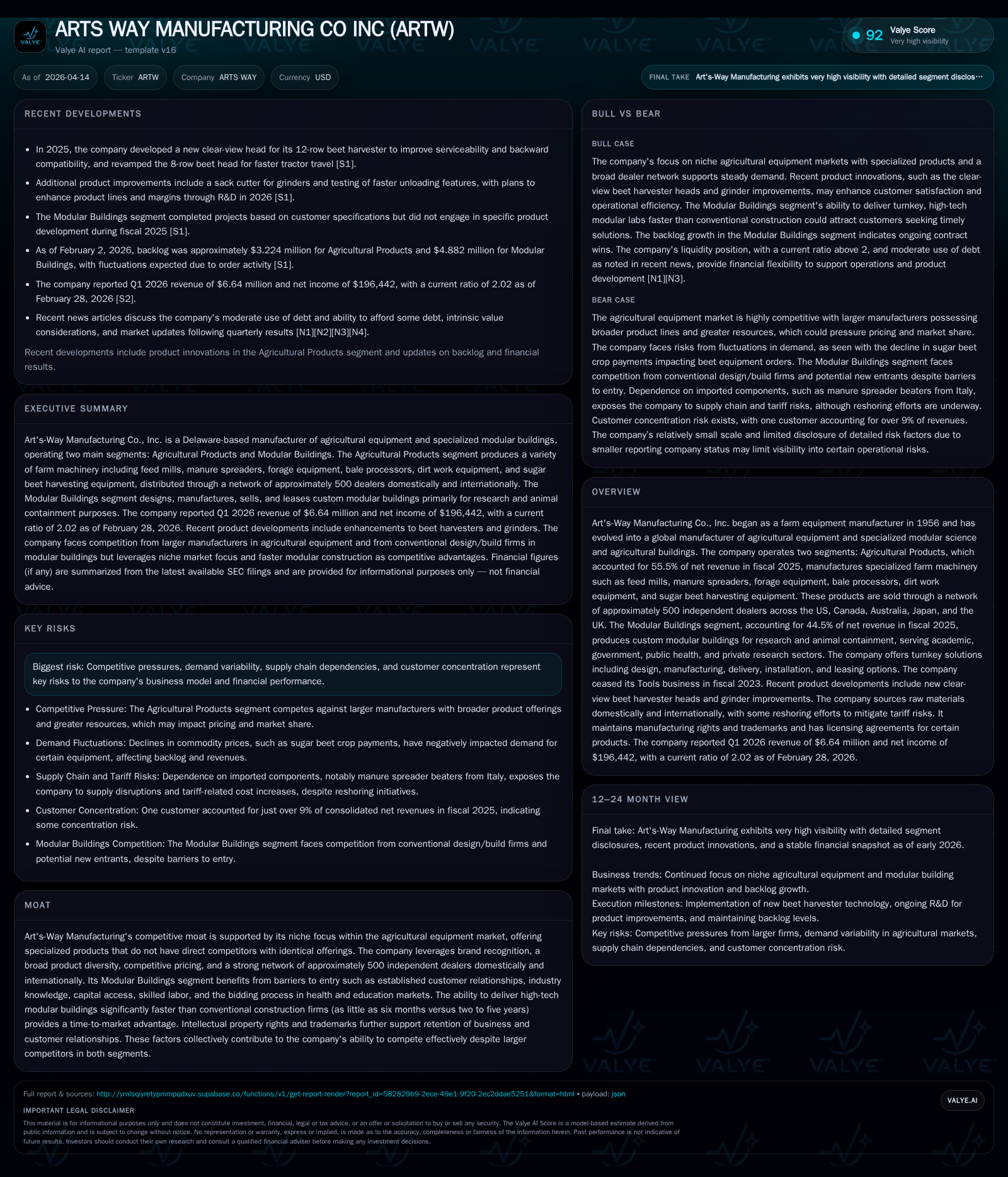
ARTS WAY Manufacturing began operations in 1956 and maintains a solid foothold through its Agricultural Products segment, which contributed 55.5% of net revenue in fiscal year (FY) 2025 [F1][S5][S6][S7]. This segment produces specialized farm machinery including portable and stationary feed mills designed to efficiently process custom animal feed rations using grinder mixers and roller mills known for reliability. The product range extends to manure spreaders featuring vertical beater placements combined with guillotine slop gate controls to optimize spreading patterns, as well as forage equipment such as high-capacity forage boxes with in-cab controls.
Sugar beet harvesting equipment incorporates patented grab roll beds optimized for muddy conditions, automatic leveling systems for consistent digging depth, and defoliators that return leaves to the soil to enhance fertility [S13][S15]. Distribution occurs primarily through roughly 500 independent dealers across the US and international markets including Canada, Australia, Japan, and the UK; local sales teams provide training and parts support [S6][S14].
The Agricultural backlog declined from $3.49 million at February 2025 to approximately $3.22 million at February 2026 [S6], reflecting sector-specific headwinds such as a reported 44% reduction in sugar beet crop payments by American Crystal Sugar late in calendar year 2025—a factor dampening early orders despite product improvements [S6]. Conversely, strong beef prices support demand for livestock-related products.
Revenue and Profitability Trends in Fiscal 2025
Consolidated revenues decreased by 6.2%, from $24.50 million in FY2024 to $22.98 million in FY2025 [F1], chiefly impacted by softness in the Agricultural segment related to commodity pricing pressures [S6]. Operating income fell more steeply by approximately 37.2%, declining from $460K to $289K USD [F1][S1][S2], indicating margin compression possibly due to fixed costs or product mix shifts.
Net income increased substantially by 236.7%, rising from approximately $307K to $1.03 million USD during the same period [F1]. While specific drivers are not detailed, SEC disclosures suggest factors such as cost management or tax benefits contributed to this divergence [S1][S2]. These results highlight operational leverage complexities beyond top-line performance.
Growth Outlook Driven by the Modular Buildings Segment
The Modular Buildings segment accounted for an increasing share of revenues—44.5% in FY2025 compared to 40.1% in FY2024 [F1][S14]—and its order backlog nearly doubled year-over-year from about $2.4 million to just under $4.9 million as of early February 2026 [S6][S16][S11]. This segment designs and delivers custom modular research facilities ranging from swine containment barns to secure laboratories serving academic institutions, government diagnostics centers, pharmaceutical companies, and public health entities.
A key competitive advantage is rapid delivery: modular buildings can be completed within roughly six months compared to two to five years for conventional design/build projects [S11]. Barriers limiting new entrants include established customer relationships, regulatory compliance requirements across state building codes, complex bidding processes typical of public sector contracts, capital intensity, and labor availability [S9][S10][S11].
Cash Flow Challenges Amid Operational Investments
ARTS WAY reported negative free cash flow near -$1.53 million for FY2025 driven by operating cash outflows around -$0.9 million combined with capital expenditures of approximately $0.63 million [F1][S16][S17][S18]. This contrasts with positive operating cash flow of about +$2.63 million recorded in FY2024.
The cash flow decline may relate to production timing mismatches such as inventory buildup ahead of modular project deliveries or raw material cost increases pressuring margins [S16]. The company also undertook reshoring of manure spreader beaters previously imported from Italy—a move addressing tariff exposure and supply security but likely increasing near-term costs [S11].
Capital Allocation and Financial Position
Capital deployment has been conservative: share repurchases were minimal at approximately $1.5K during FY2025 following reduced activity from prior years; no dividends have been paid since fiscal year 2016 [F1][S12][S13]. Liquidity remains solid with a current ratio near 2.02 as of February 2026 reflecting ample short-term asset coverage against liabilities [F1]. Equity grew steadily over recent years reaching about $13.3 million most recently supporting an estimated return on equity near 7.8% based on net income levels reported [F1]. This indicates measured profitability improvement balanced against working capital requirements associated with custom manufacturing cycles.
Risk Factors Including Customer Concentration and Supply Chain Exposure
Customer concentration risk is notable: one customer accounted for just over nine percent of consolidated revenues during FY2025—a significant portion given company scale—with implications for revenue volatility if this relationship changes materially [S4][S19][S20].
Supply chain exposure centers mainly on critical manure spreader components sourced internationally from Italy; however reshoring initiatives are underway mitigating tariff risks and availability concerns [S11]. Other raw materials are sourced domestically or from multiple suppliers reducing overall dependence.
Competition spans larger agricultural equipment manufacturers offering broader portfolios but lacking ART'S WAY's specialized machines; meanwhile the Modular Buildings business faces competition from established design/build firms plus emerging modular producers benefiting from construction digitization trends but constrained by bidding complexity and regulatory hurdles [S9][S10]. Intellectual property rights further protect ART'S WAY’s niche position.
Strategic Monitoring Points Going Forward
No explicit financial guidance is provided within filings or releases at this time; however key indicators that may reveal future trajectory include:
- Trends in modular buildings order backlog signaling contract momentum or slowdown impacting near-term revenues.
- Agricultural commodity price fluctuations especially sugar beet valuations influencing backlog quality for specialized harvest equipment.
- Interest rate movements affecting farmer capital expenditures thereby influencing agricultural equipment demand.
- Developments regarding proprietary technology enhancements or renewal/extension of manufacturing rights sustaining competitive edge.
- Progress on reshoring efforts potentially altering cost structures over time.
These factors contextualize ART'S WAY's balance between maintaining legacy agricultural machinery relevance while leveraging growth opportunities in modular scientific building markets.
This analysis reflects information available as of April 14, 2026 based on company filings without speculative forecasts or investment advice.
Disclaimer: This is research-only, informational analysis and not investment advice. It may include AI-generated interpretation and general industry context. Always verify important details using primary sources.

Comments