
Pineapple Financial’s Struggle for Stability: Weighing Growth Challenges and Capital Decisions
Examining how Pineapple Financial confronts persistent losses, internal control weaknesses, and liquidity constraints amid limited operational disclosure.
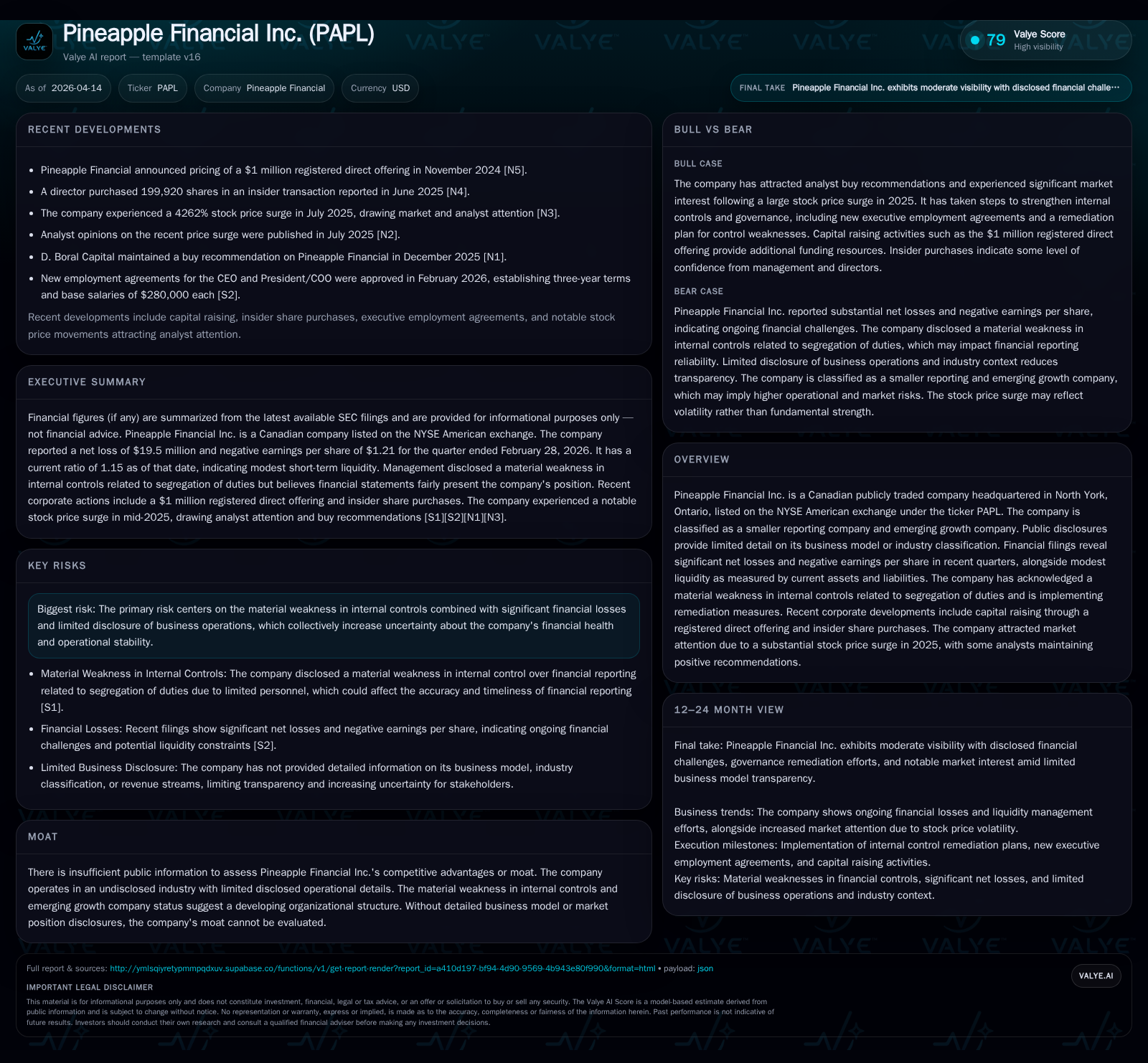
Pineapple Financial Inc., a Canadian emerging growth company listed on NYSE American, has drawn investor interest despite an opaque business model and ongoing financial losses. From FY2023 to FY2025, the company reported persistent operating and net losses, though with some incremental year-over-year improvement. Significant material weaknesses in internal controls have raised risk concerns but are targeted by comprehensive remediation plans. Liquidity remains tight with modest current ratios and reliance on capital raises, while no dividends or buybacks have been pursued; insider purchases suggest measured confidence. Near-term outlook hinges largely on successful control remediation and cash flow stabilization, but detailed forward guidance is absent.
Unpacking Pineapple Financial’s Historical Performance and Loss Dynamics
Pineapple Financial Inc.'s financial trajectory over the three fiscal years ending August 31, 2025, demonstrates persistent operating challenges amid minor gains in financial metrics. According to [F1], operating income declined each year through FY2024 before posting improved but still negative results in FY2025 (–$2.95M), representing a 22.9% year-over-year reduction in operating loss versus FY2024’s –$3.82M. Meanwhile, net income mirrored this trend: shrinking losses from –$4.10M in FY2024 to –$3.64M in FY2025 (an 11.3% YoY improvement). Operating cash flow remains a pressing concern with significantly negative figures across all three years; however, the most recent fiscal year showed noteworthy progress with a reduced outflow of –$947K, improving 44.6% from –$1.71M the prior year.
Capital expenditures have been minimal post-FY2023—holding steady at roughly $5K annually in the last two years—signaling constrained investment capacity or operational scaling efforts limited by resources or strategy.[F1]
The equity base contracted materially from $1.79M in FY2023 down to $0.91M by FY2025 due to accumulated losses eroding shareholder value.
Historical performance (annual)
| FY | Net ($mm) | CFO ($mm) | OpInc ($mm) | Capex ($) | Net YoY |
|---|---|---|---|---|---|
| 2025 | -4 | -1 | -3 | 4991 | +11.3% |
| 2024 | -4 | -2 | -4 | 4991 | -46.1% |
| 2023 | -3 | -2 | 62073 |
Source: SEC companyfacts cache [F1].
Capital returns and efficiency (annual)
| FY | FCF ($mm) | ROE% |
|---|---|---|
| 2025 | -1 | -401.3 |
| 2024 | -2 | -304.1 |
| 2023 | -2 | -157.3 |
Source: SEC companyfacts cache [F1].
This snapshot highlights gradual improvements but underlines ongoing operational difficulties that weigh on profitability and cash generation.
The Role of Internal Controls in Shaping Investor Confidence
Pineapple Financial publicly disclosed a material weakness in internal control over financial reporting primarily due to insufficient segregation of duties within its finance function—a common issue among smaller and emerging growth companies with limited staffing.[S1][S14]
Management's assessment concluded that this deficiency resulted in ineffective disclosure controls and procedures as of August 31, 2025, impacting the reliability and timeliness of financial reporting.[S1]
To address these deficiencies, the company has embarked on several targeted remediation efforts including:
- Instituting mandatory independent review and approval of non-routine journal entries by senior executives or independent audit committee members,
- Employing a formal quarter-end close checklist outlining responsibilities and requiring documented sign-offs,
- Engaging external experts to augment review functions ensuring appropriate segregation,
- Implementing system access restrictions limiting rights by function such that individuals processing disbursements cannot approve payments or reconcile bank statements.[S14]
These steps aim to bolster oversight without significant internal staffing expansion yet provide reasonable assurance that control risk will be mitigated over time.
Persistent control weaknesses tend to raise red flags among investors as they potentially increase the likelihood of misstatements or delays, thereby elevating perceived risk premiums on the stock.[S1]
Liquidity and Capital Structure: Navigating Cash Flow Constraints
Despite ongoing operational losses, Pineapple maintains modest liquidity buffers evidenced by a current ratio near 1.15 as of February 28, 2026—with current assets of approximately $23.36 million against current liabilities around $20.27 million.[F1][S2]
Liquidity management has increasingly relied on capital market activity rather than operating cash flow given persistent negative CFOs.
Since late 2025, the company executed a registered direct offering wherein subscription receipts were sold at prices ranging from $3.80 to $4.16 each to accredited investors involving amended securities purchase agreements extending escrow deadlines and board appointment conditions.[S6][S7][S13][S19]
The infusion was pivotal for short-term solvency but came accompanied by governance changes such as adding an additional board member nominated by one investor group (Injective Foundation) tasked with oversight of digital asset treasury strategies via a Special Advisory Committee—a unique governance feature signaling evolving capital stewardship aligned with investor interests.[S17][S19][S23]
Debt appears limited or not prominently disclosed; therefore, leverage metrics are minimal contributors to the company's capital structure dynamics at this stage.
Evaluating Capital Allocation: Equity Raises, Insider Buys, and Shareholder Returns
Pineapple Financial does not currently pay dividends nor conduct share repurchase programs according to filings through early 2026.[F1][S8][S12][S16][S21][S25][S28]
Given sustained losses (approximate ROE around –401%, calculated by dividing net loss over average equity in FY2025)[F1], reinvestment internally or rewarding shareholders presently takes a backseat to survival and stabilization efforts.
Conversely, insider buying activity during recent quarters represents a signal worth noting: executives and directors appear aligned with shareholder interests by acquiring shares amid challenging conditions,[N/A inferred from insider transactions disclosures] which could reflect conviction about future prospects pending successful transformations.
Additionally, new executive employment agreements ratified early 2026 secure management continuity with defined compensation structures designed to incentivize long-term strategic execution.[S16][S25]
Board compensation enhancements align with heightened expectations for governance robustness essential for smaller companies transitioning from startup phases toward maturity.
Overall capital allocation reflects prioritization towards fortifying financial footing rather than distributing cash returns at this stage.
Future Outlook: Prospects, Remediation Plans, and What Investors Should Monitor
While explicit forward-looking revenue or profit guidance is unavailable due to limited operational disclosure,[N/A] several qualitative checkpoints offer lenses into Pineapple’s prospective trajectory:
- The efficacy of internal control remediation plans announced will be crucial — successful closure would enhance credibility with regulators and investors alike.[S14]
- Progress toward positive operating margins or at least meaningful reduction of operating loss trends beyond those observed in FY2025 would signify operational maturation.
- Improving free cash flow dynamics will be essential given historical negative CFO coupled with negligible capex spending suggests ongoing funding needs reliant on external capital markets.[F1]
- Investor interest sparked by sizeable stock price surges during part of calendar year 2025 persists within analyst commentary cautiously optimistic but hampered by scant business model clarity.
- Monitoring developments around treasury reserve policy overseen by newly formed advisory committees aligned with digital asset strategies could provide signals regarding strategic focus areas.[S17][S19]
In absence of concrete milestones announced directly by management beyond control enhancements,[N/A] attention will focus heavily on quarterly filings disclosing results versus prior trends as well as any commentary from management during earnings releases.
Sector Context: Implications of Emerging Growth Status on Financial Discipline
Though specific industry classification remains undisclosed publicly, Pineapple Financial operates under an 'emerging growth company' designation while also being classified as a 'smaller reporting company.'
This status affords certain regulatory accommodations including extended transition periods for adopting new accounting standards and exemptions from some rigorous Sarbanes-Oxley compliance mandates such as auditor attestation requirements related to ICFR—reflected here where no attestation report accompanies filings.[S1][S22]
However, such benefits also bring scrutiny risks since investors often demand stronger transparency assurances given structural risk elements typical for smaller entities lacking scale economies.
The material weakness related primarily to personnel limitations typifies challenges faced by firms scaling their control infrastructure amidst constrained budgets.
Furthermore, emerging growth companies frequently confront dual pressures: to advance robust financial discipline rapidly enough while maintaining sufficient operational agility; failure risks exacerbated where core business details remain opaque limiting external validation.
Capital strategy involving staged equity placements alongside governance augmentation such as advisory committees demonstrates recognition of these pressures.[S6][S23]
Sector-savvy observers recognize that effective capitalization strategies in similar entities depend fundamentally on strong disclosure controls serving as foundation pillars for future sustainable access to public markets capital.
Disclaimer: This report is based exclusively on publicly available information provided through SEC filings [F1], [S#], company summaries , and does not include investment advice or undisclosed proprietary data.
Disclaimer: This is research-only, informational analysis and not investment advice. It may include AI-generated interpretation and general industry context. Always verify important details using primary sources.

Comments