
Cannae Holdings’ Strategic Portfolio Shifts and Capital Allocation in 2025
Despite ongoing operating losses and governance challenges, Cannae Holdings maintained assertive capital allocation through substantial share repurchases while managing liquidity and a diverse portfolio.
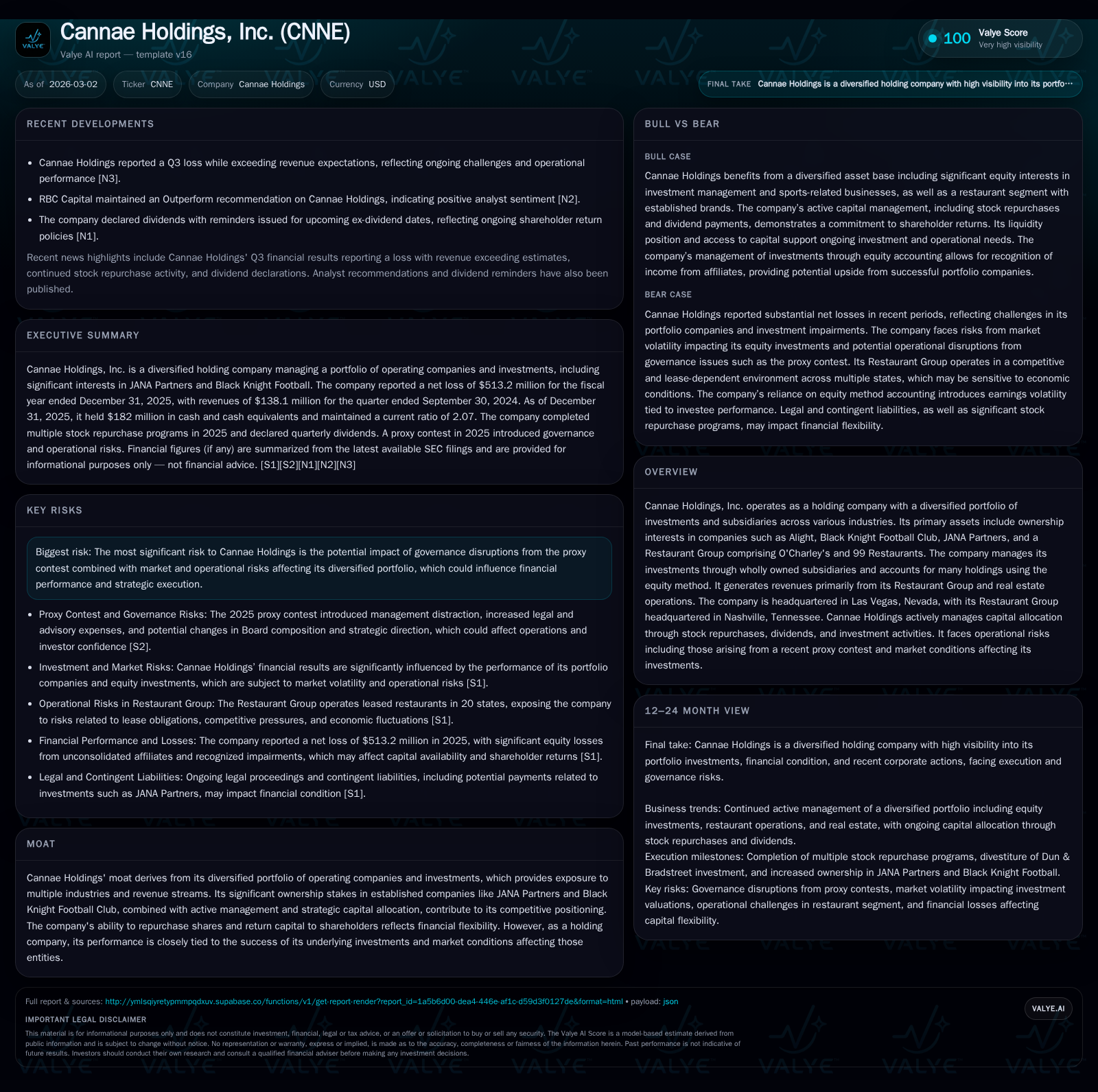
In 2025, Cannae Holdings experienced modest revenue growth but deeper operating losses and net income decline amid complex portfolio dynamics. The company completed stock repurchase programs totaling over $319 million, reflecting balance sheet strength despite earnings pressure. Governance disruption from an activist proxy contest incurred significant costs and uncertainty. Liquidity remained solid with $182 million in cash, no outstanding borrowings on key credit facilities, and a current ratio above 2.0. Future performance will depend on resolving governance risks and navigating operational challenges across investments.
Historical Financial Performance: Revenue, Earnings, and Cash Flow Trends
Cannae Holdings’ recent financial results reveal modest top-line growth alongside worsening profitability. According to the latest available full-year data ending 2023, revenues stood at approximately $499.7 million representing a compound annual growth of about 3.4% since 2022's $483.4 million [F1]. Despite this revenue progression, operating income deteriorated further reaching a loss of $119.6 million for FY2025 — down roughly 15.3% from a loss of $103.7 million the previous year [F1]. Net income showed a steeper decline with losses expanding approximately 68.5% to -$513.2 million in FY2025 driven primarily by goodwill impairments and operational challenges within portfolio companies [F1].
Operating cash flow (CFO) improved significantly by nearly 80%, narrowing losses to -$18.1 million in FY2025 from -$90.1 million in FY2024, yet remained negative overall [F1]. Capital expenditures have been curtailed relative to prior years — reported capex declined roughly 60% helping mitigate cash outflows but free cash flow remains negative at an estimated -$33.7 million when subtracting capex from CFO [F1].
Historical performance (annual)
| FY | Rev ($mm) | Net ($mm) | CFO ($mm) | OpInc ($mm) | Rev YoY | Net YoY |
|---|---|---|---|---|---|---|
| 2025 | -513 | -18 | -120 | -68.5% | ||
| 2024 | -305 | -90 | -104 | +2.8% | ||
| 2023 | 500 | -313 | -88 | -119 | +3.4% | +26.8% |
| 2022 | 483 | -428 | -205 | -145 | +6.8% |
Source: SEC companyfacts cache [F1].
Capital returns and efficiency (annual)
| FY | Buybacks ($mm) | ROE% |
|---|---|---|
| 2025 | 320 | -50.1 |
| 2024 | 231 | -16.6 |
| 2023 | 113 | -13.5 |
| 2022 | 230 | -15.7 |
Source: SEC companyfacts cache [F1].
Note: Revenue for FY2024-FY2025 not explicitly disclosed; growth inferred from prior annual rates cited [F1].
Portfolio Composition: Diverse Operating Segments Impact Financial Metrics
Cannae's business spans multiple segments including its Restaurant Group—operating brands like O'Charley's and 99 Restaurants across leased premises in roughly twenty states—and equity method investments such as Alight Solutions (human capital management software), JANA Partners (investment firm), among others [S1][S27]. The equity accounting approach inflates investing cash flows while operating cash flows remain negative due to GAAP classification nuances where distributions from unconsolidated affiliates are recorded as investing activities rather than operating activities [S12][S20].
This complex structure complicates profitability interpretation as impairments or earnings volatility at subsidiaries impact consolidated net income disproportionately without direct operating expense correlation at the holding level.
Governance Challenges: Proxy Contest Effects
A significant governance event during 2025 was an activist-led proxy contest imposing incremental costs estimated at $5.9 million related to legal fees and advisory expenses beyond normal annual meeting costs [S2]. This contest risks disrupting board continuity and distracting management from strategic execution while potentially unsettling investors and other stakeholders if dissident nominees prevail or raise uncertainties around future corporate direction [S8].
Management emphasizes constructive shareholder engagement but acknowledges potential adverse impacts on stock price volatility and operational stability stemming from this dispute.
Capital Allocation: Aggressive Share Repurchases Amid Losses
Despite persistent losses, Cannae aggressively returned capital via stock buybacks under three programs:
- The 2022 Repurchase Program repurchased over 2.29 million shares for approximately $42.1 million;
- The 2023 Repurchase Program saw around 10 million shares bought back for about $195.2 million;
- The 2025 Repurchase Program, initiated early in the year, repurchased roughly 4.7 million shares for approximately $80.6 million with additional purchases into January 2026 totaling over $86 million under this program alone [S4][S6][F1].
Combined buybacks exceeded $319 million for calendar year ended December 31, 2025—demonstrating strong balance sheet capacity and a preference for share repurchases over dividends or aggressive debt reduction currently.
Liquidity Position and Debt Overview
As of December 31, 2025, Cannae held approximately $182 million in cash and equivalents with a current ratio near 2.07 (current assets of $268 million versus current liabilities of $130 million), indicating solid short-term liquidity coverage [F1].
The company fully repaid its outstanding balance under the collateralized 2020 Margin Facility by August 26, 2025; no borrowings were outstanding at year-end though borrowing capacity based on pledged Alight shares was about $25 million providing optionality if needed [S5][S7]. Additional revolving credit arrangements remain accessible.
Long-term notes payable decreased to around $64.5 million at year-end with manageable maturities extending through late decade horizons; contractual purchase obligations primarily tied to Restaurant Group vendor contracts totaled approximately $66.6 million spread over coming years requiring ongoing liquidity oversight [F1][S9][S17].
Outlook: Navigating Governance Resolution & Operational Risks
Looking forward, Cannae faces several risks including resolution of the proxy contest which will impact governance stability; macroeconomic headwinds affecting restaurant consumer demand; regulatory compliance challenges inherent in hospitality operations; plus valuation uncertainty across equity method investments like Alight and JANA Partners [S2][S8][S27].
Legal contingencies remain monitored though accruals are currently immaterial; however episodic litigation typical of restaurant businesses persists as a latent risk factor.
Capital allocation will likely continue balancing opportunistic share repurchases with portfolio management actions including potential asset sales or acquisitions as market conditions evolve.
Key Milestones Ahead
Stakeholders should monitor:
- The outcome of the upcoming annual shareholder meeting resolving proxy contest implications which could alter board composition and strategic direction [S3];
- Execution pace of the ongoing 2025 Stock Repurchase Program reflecting management’s capital return priorities post-January;
- Portfolio developments including subsidiary performance updates or disposition decisions;
- Contingent liabilities such as JANA Partners’ AUM-based payments up to $26 million split into tranches impacting future obligations with initial payments considered probable at year-end but additional payments remain uncertain [S16];
- Regulatory developments affecting Restaurant Group operations especially labor law compliance or dram shop claims that could influence financial provisions going forward.
Disclaimer: This analysis is based exclusively on disclosed data through March 2, 2026 per cited SEC filings; it does not constitute investment advice.
Disclaimer: This is research-only, informational analysis and not investment advice. It may include AI-generated interpretation and general industry context. Always verify important details using primary sources.

Comments