
Cyclerion Therapeutics Accelerates CNS Pipeline Through Korsana Merger and CYC-126 Phase 2 Advances
The company sharpens focus on CNS drug development with strategic merger and clinical progress in 2026.
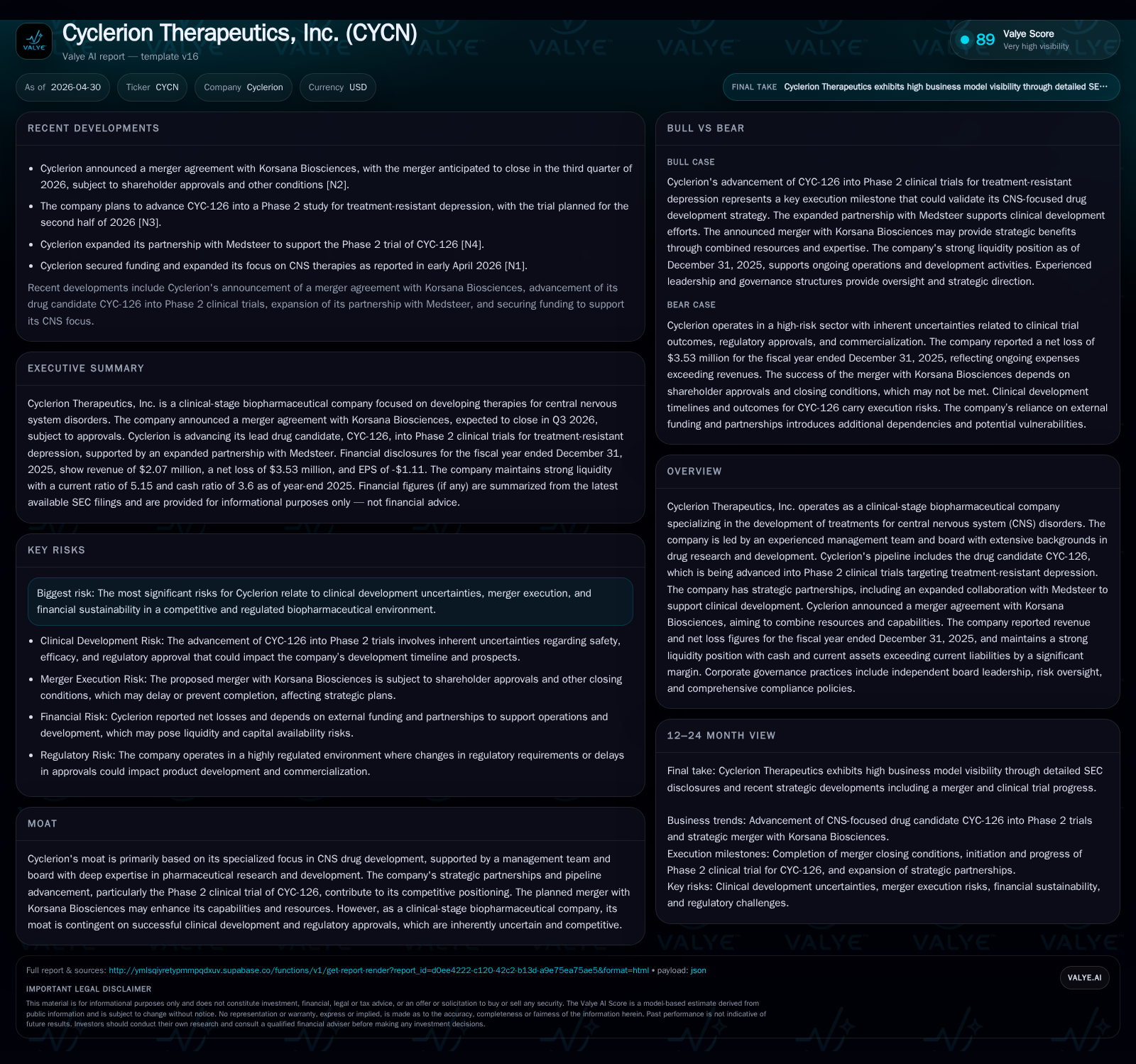
Cyclerion Therapeutics, a clinical-stage biopharmaceutical focused on central nervous system disorders, reported key recent developments including a proposed merger with Korsana Biosciences and progression of its lead candidate CYC-126 into Phase 2 trials targeting treatment-resistant depression. The merger, expected to close in Q3 2026, aims to enhance Cyclerion’s capabilities and resource base. While the CNS specialization underpins its competitive moat, the firm remains subject to typical clinical-stage risks such as regulatory hurdles and execution challenges. Liquidity is healthy with current assets exceeding liabilities by a wide margin, supporting ongoing R&D activities.
Recent Operating Update
Cyclerion Therapeutics’ latest quarterly filing from November 12, 2025 ([S2]) shows operational continuity without material changes beyond steady progress in research programs. The company remains committed to advancing its drug candidates within the Central Nervous System (CNS) disorders space.
A headline event materialized on April 1, 2026, when Cyclerion disclosed an entry into a definitive merger agreement with Korsana Biosciences ([S3],[N1]). Under this agreement, pre-merger stockholders of Cyclerion will hold approximately 98.5% of the combined entity post-merger, illustrating Cyclerion's dominant controlling interest. The merger is anticipated to close in the third quarter of 2026 subject to shareholder approvals and customary closing conditions ([S6]). This strategic consolidation aims to combine technological platforms, pipeline assets, and expertise to accelerate CNS therapeutic development. The company also addressed stockholder agreements intended to secure support for the transaction.
Business Model
Cyclerion operates as a clinical-stage biopharmaceutical company specializing exclusively in developing therapies for central nervous system disorders ([S1], [N2]). Its business model centers around progressing proprietary drug candidates through early- and mid-stage clinical trials to create value either via partnerships, licensing deals, or eventual commercial launch.
Revenue generation remains limited due to the pre-commercial stage of operations; $2.07 million recorded for fiscal year ended December 31, 2025 largely arises from collaboration milestones or licensing activities rather than product sales ([F1]). The company’s primary expenditure reflects R&D outlays driving clinical development—especially advancing CYC-126, its lead novel therapeutic candidate targeting treatment-resistant depression now entering Phase 2 trials. Success in such indications can command premium pricing post-approval due to high unmet medical needs.
Notably, Cyclerion leverages strategic partnerships such as its expanded collaboration with Medsteer ([N2]) which support its clinical programs and offer complementary capabilities without full internal cost burden. Such alliances exemplify its asset-light approach until proof-of-concept data justify larger-scale commitments.
Industry Structure and Competitive Position
The CNS disorder therapeutic market is fragmented but intensely competitive with large pharmaceutical incumbents and specialized biotech firms vying across indications like depression, schizophrenia, Alzheimer's disease, and other neurological conditions. Cyclerion’s emphasis on treatment-resistant depression positions it within a niche where innovation remains critically needed due to suboptimal efficacy of current treatments.
Cyclerion’s competitive edge derives from:
- Focused pipeline tailored to CNS modalities leveraging small molecules or novel mechanisms
- Advanced leadership team possessing extensive drug discovery and development experience [S1]
- Strategic partnerships broadening scientific reach while optimizing capital efficiency
- Upcoming enhanced scale post-merger with Korsana potentially increasing combined pipeline breadth and resource pool ([S3], [S6])
However, as a clinical-stage entity without approved products yet, the company's moat is conditional upon translating pipeline successes into marketable therapies amid regulatory scrutiny and multiple competitors pursuing similar patient populations.
Growth Drivers
Key growth catalysts include:
- Progression of CYC-126 through Phase 2 trials targeting treatment-resistant depression — positive readouts could validate mechanism and expand patient access opportunities ([S1])
- Successful closing and integration of the Korsana Biosciences merger slated for Q3 2026; anticipated to bring complementary pipelines or platform technologies accelerating development velocity ([S3], [S6])
- Expansion of strategic collaborations enhancing development capabilities while deferring upfront investments ([N2])
- Capital raise initiatives or licensing/partnership deals unlocking funds for late-stage trials or commercialization preparation
These drivers align around establishing proof points that materially increase valuation; interim milestones like regulatory approvals of trial protocols or enrollment targets serve as critical markers.
Risks and Watchpoints
Cyclerion faces inherent risks typical for early clinical-stage biotech firms:
- Clinical Development Uncertainty: Trial failures or delays in Phase 2 for CYC-126 can materially impair growth prospects.
- Merger Execution Risk: Integration challenges between Cyclerion and Korsana may consume management bandwidth or disrupt operations despite potential synergy benefits ([S3], [S6]).
- Financial Sustainability: Despite strong current liquidity (current ratio ~5.15x), continued operating losses (-$4.97M in FY25) require prudent cash management or external financing ([F1]).
- Competitive Landscape: Large pharma players with deeper resources may outpace innovation or capture market share post-launch.
- Regulatory Hurdles: CNS therapeutics face complex approval pathways requiring robust safety/efficacy evidence.
What to Watch Next
Multiple near-term indicators will be pivotal:
- Finalization and shareholder approval of the Korsana merger expected in Q3 2026 ([S6],[N1])
- Clinical trial initiations or interim data releases from CYC-126 Phase 2 program
- Announcements regarding additional partnerships or capital raises supporting pipeline expansion ([N2])
- Regulatory filings related to ongoing CNS programs signaling advancement progress
- Updates from governance highlighting risk mitigation approaches amid integration process ([S15]-[S18])
Tracking these events provides insight into Cyclerion’s trajectory toward de-risking drug candidates and scaling operational capabilities.
Financial Profile Summary
Latest financial snapshot
| Metric | Value | Period |
|---|---|---|
| Cash & equivalents | $3mm | |
| 2025-12-31 | ||
| Current assets | $5mm | |
| 2025-12-31 | ||
| Current liabilities | $900000 | |
| 2025-12-31 | ||
| Current ratio | 5.15x | |
| 2025-12-31 |
Source: SEC companyfacts cache [F1].
As of December 31, 2025 ([F1]):
| Metric | Value (USD) | Period End |
|---|---|---|
| Revenue | $2.07 million | |
| 2025-12-31 | ||
| Operating Income | -$4.97 million | |
| 2025-12-31 | ||
| Net Income | -$3.53 million | |
| 2025-12-31 | ||
| Cash & Equivalents | $3.24 million | |
| 2025-12-31 | ||
| Current Assets | $4.64 million | |
| 2025-12-31 | ||
| Current Liabilities | $900 thousand | |
| 2025-12-31 | ||
| Current Ratio | ~5.15x | Calculated |
The balance sheet reflects ample liquidity relative to short-term obligations enabling continued investment in R&D ahead of commercialization. Losses are characteristic for this phase but underscore dependency on milestone achievements to support subsequent funding rounds.
This analysis synthesizes information primarily drawn from Cyclerion Therapeutics’ latest SEC filings including the November 2025 quarterly report [S2], April 2026 merger-related Form 8-K [S3], and amended annual disclosure filed April 30, 2026 [S1] along with complementary news sources [N1,N2] and financial snapshot data [F1]. It focuses on operational context rather than investment guidance. Emerging developments warrant ongoing monitoring given inherent uncertainty within clinical-stage biopharmaceutical enterprises.
Disclaimer: This is research-only, informational analysis and not investment advice. It may include AI-generated interpretation and general industry context. Always verify important details using primary sources.

Comments